
Why govt & Indian enterprise must buy from local deeptechs


Indian deeptech ventures have a very real problem. We have heard this from many for a long time, but it’s a particularly big problem now when there’s so much talk about the importance of tech sovereignty in the age of AI and quantum. The latter are foundational technologies, and especially given the growing geopolitical rifts, getting these technologies from others may be difficult.

The deeptech problem is this: Their technologies take time to develop and mature. And that means they need enough funds to take them through this longish period. Traditional venture capital (VC) does not yet have the confidence to make such investments. So, govt needs to step in. The Centre has stepped in with the Rs 10,000-crore Startup India Fund of Funds, and the Rs 50,000-crore ANRF (Anusandhan National Research Foundation). These help, though some say they are not being directed as well as they should be.
The bigger problem is – and we had a discussion on this a few days ago – these ventures need buyers for their products, buyers who can then become reference points for other potential buyers. In several countries, and especially in the US and parts of Europe, their govts and large enterprises are willing to experiment with these completely new products. In India, they just don’t.
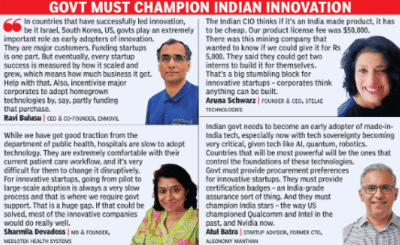
“There’s a lack of confidence in our own ability. And we don’t have an early adopter culture for technology,” said Atul Batra, a startup advisor who previously was with Algonomy Manthan, Yahoo, Motorola and Sun Microsystems. Some sectors like BFSI, retail, telecom have done well in terms of embracing new technology, but it’s foreign brands they adopt, not Indian. “And procurement is designed for the slow track, not the faster, innovative track,” he said.
Ravi Bulusu, CEO & co-founder of Enmovil, a supply chain and logistics intelligence platform, said many organisations default to global vendors simply because they are familiar and are perceived as lower risk. “Then there is the trust and the reference gap. Even when Indian products are competitive, decision-makers are always like ₹who else is using it at scale’. It’s a chicken and egg thing,” he said, indicating that you need a customer to get other customers, but then how do you get that first customer!
Foreign endorsement helps
Aruna Schwarz, founder & CEO of Bengaluru-based Stelae Technologies – which converts unstructured data from formats like PDFs and Word docs into structured, searchable, and usable data – did not face too much of a problem only because her CTO was a Frenchman. And France, Aruna said, is very innovation friendly and willing to experiment. The government offers a variety of grants. “For example, if you hire an engineer from a top-level school, you get the highest amount of grant just to fund him for two years so that he doesn’t have to worry about things like how to pay his rent, and instead can focus on innovating,” she said.
As it turned out, the CTO helped find customers in France, and very soon, they also had Rolls-Royce of the UK buying their software for their military engines business. And once that, the Indian market opened up, especially the defence market. “It’s unfortunate but true, that if you have a big non-Indian customer, your acceptance level in Indian enterprises goes up from 0 to 99%,” Aruna said.
On the other hand, it’s not been easy for Sharmila Devadoss, founder & MD of MedloTek Health Systems, which has developed what could be India’s first cuffless BP device, where you get blood pressure from the fingertip. Such devices have extremely long gestation periods, and they are at the cutting edge of technology, with deep tech algorithms coming into play. India, Sharmila said, just doesn’t have the funding ecosystem to support such innovations.
MedloTek has managed so far thanks to govt grants, and being selected by the govt as a solution for Covid-19 management, and by the Tamil Nadu public health department for screening people in Madurai. “But to scale it from there has been a challenge,” she said, noting that hospitals are particularly slow to adopt technology.
Partner, co-create, endorse
Ravi said giving business to startups is much better than just giving money – and govt and India Inc should both do that. Aruna said govt should not hesitate to endorse great startup products. That would be a big signal to India Inc, and foreign customers.
Sharmila said govt and India Inc should identify problem statements, and then identify new-age companies that can help co-create solutions. Atul said the ecosystem should come together to create structured engagement programmes for startups. It could be PoC (proof-of-concept) programmes, innovation labs. “The whole mindset and orchestration has to change for tech sovereignty,” he said.
The deeptech problem is this: Their technologies take time to develop and mature. And that means they need enough funds to take them through this longish period. Traditional venture capital (VC) does not yet have the confidence to make such investments. So, govt needs to step in. The Centre has stepped in with the Rs 10,000-crore Startup India Fund of Funds, and the Rs 50,000-crore ANRF (Anusandhan National Research Foundation). These help, though some say they are not being directed as well as they should be.
The bigger problem is – and we had a discussion on this a few days ago – these ventures need buyers for their products, buyers who can then become reference points for other potential buyers. In several countries, and especially in the US and parts of Europe, their govts and large enterprises are willing to experiment with these completely new products. In India, they just don’t.
“There’s a lack of confidence in our own ability. And we don’t have an early adopter culture for technology,” said Atul Batra, a startup advisor who previously was with Algonomy Manthan, Yahoo, Motorola and Sun Microsystems. Some sectors like BFSI, retail, telecom have done well in terms of embracing new technology, but it’s foreign brands they adopt, not Indian. “And procurement is designed for the slow track, not the faster, innovative track,” he said.
Ravi Bulusu, CEO & co-founder of Enmovil, a supply chain and logistics intelligence platform, said many organisations default to global vendors simply because they are familiar and are perceived as lower risk. “Then there is the trust and the reference gap. Even when Indian products are competitive, decision-makers are always like ₹who else is using it at scale’. It’s a chicken and egg thing,” he said, indicating that you need a customer to get other customers, but then how do you get that first customer!
Foreign endorsement helps
Aruna Schwarz, founder & CEO of Bengaluru-based Stelae Technologies – which converts unstructured data from formats like PDFs and Word docs into structured, searchable, and usable data – did not face too much of a problem only because her CTO was a Frenchman. And France, Aruna said, is very innovation friendly and willing to experiment. The government offers a variety of grants. “For example, if you hire an engineer from a top-level school, you get the highest amount of grant just to fund him for two years so that he doesn’t have to worry about things like how to pay his rent, and instead can focus on innovating,” she said.
As it turned out, the CTO helped find customers in France, and very soon, they also had Rolls-Royce of the UK buying their software for their military engines business. And once that, the Indian market opened up, especially the defence market. “It’s unfortunate but true, that if you have a big non-Indian customer, your acceptance level in Indian enterprises goes up from 0 to 99%,” Aruna said.
On the other hand, it’s not been easy for Sharmila Devadoss, founder & MD of MedloTek Health Systems, which has developed what could be India’s first cuffless BP device, where you get blood pressure from the fingertip. Such devices have extremely long gestation periods, and they are at the cutting edge of technology, with deep tech algorithms coming into play. India, Sharmila said, just doesn’t have the funding ecosystem to support such innovations.
MedloTek has managed so far thanks to govt grants, and being selected by the govt as a solution for Covid-19 management, and by the Tamil Nadu public health department for screening people in Madurai. “But to scale it from there has been a challenge,” she said, noting that hospitals are particularly slow to adopt technology.
Partner, co-create, endorse
Ravi said giving business to startups is much better than just giving money – and govt and India Inc should both do that. Aruna said govt should not hesitate to endorse great startup products. That would be a big signal to India Inc, and foreign customers.
Sharmila said govt and India Inc should identify problem statements, and then identify new-age companies that can help co-create solutions. Atul said the ecosystem should come together to create structured engagement programmes for startups. It could be PoC (proof-of-concept) programmes, innovation labs. “The whole mindset and orchestration has to change for tech sovereignty,” he said.
Next Story