
Xiaomi 17 Ultra review: A phone, mostly a camera


The Xiaomi 17 Ultra rattles. Pick it up off a table, walk down stairs, toss it onto a couch, and you'll hear the mechanical zoom lens shifting inside its housing like loose change. Most people would assume something's broken—it's not. That's a genuine optical zoom—75mm to 100mm, motorised, physically moving glass—sitting inside a camera module the size of a biscuit. No other phone has one, yet.
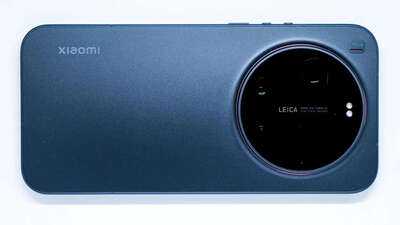
That one detail tells you what Xiaomi is doing here. The 17 Ultra isn't a phone with nice cameras bolted on. It's a camera system that also takes calls. Three Leica-tuned sensors—a 1-inch main, a 200-megapixel telephoto, and a 50-megapixel ultrawide—doing work that most phones fake through computation. Attach the grip—physical shutter button, exposure dial—and it doesn't even feel like a phone anymore.
I've been shooting on it for weeks. Street markets, dim restaurants, harsh afternoon sun, one sunset that refused to cooperate. The cameras delivered, the rest of the phone stayed out of the way, and there's plenty to talk about. Starting, obviously, with the cameras.
What a 1-inch sensor and 75mm of real glass actually get you
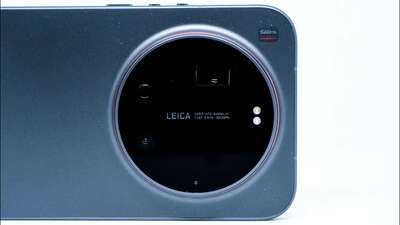
A 50-megapixel main camera with a 1-inch sensor and f/1.67 lens. A 200-megapixel telephoto with a mechanically zooming 75-100mm Leica APO lens on a 1/1.4-inch sensor. A 50-megapixel ultrawide at 14mm. All Leica-tuned. All sitting inside that comically large camera bump.
What it's actually like to shoot with is more interesting. And messier.

I'll start with what made me stop fiddling with settings and just shoot. The main sensor handles mixed light with a composure that phones don't usually have. I got a shot of two figures silhouetted against late-afternoon water, backlighting bouncing off the surface in hard, shimmery streaks. This is the kind of scene that forces most phones into a choice: blow the highlights or crush the shadows. The 17 Ultra didn't choose. It held both. The silhouettes stayed dark and legible. The water kept its shimmer without clipping white. The iron railing between the two figures had enough texture to read as metal, not just a dark shape. That's the 1-inch sensor and Xiaomi's LOFIC HDR working as intended: capturing highlight overflow in a single exposure rather than stacking frames and praying nothing moved between them.
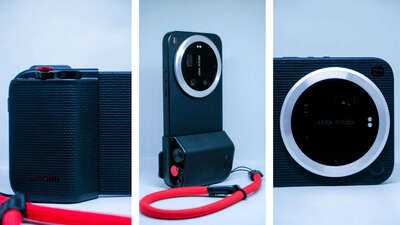
A lot of that confidence came down to how I was holding the phone. Without the optional Pro grip, the 17 Ultra is another large slab you're trying to steady with two thumbs. No dedicated shutter button on the phone itself—so you're tapping the screen or using a volume key, and your hand shifts every time.
With the grip clicked in via USB-C, you get a contoured handle, a shutter button with half-press focus and threading for a soft-release (you’ve got two in there: red and a black one), and a command dial. I kept the dial mapped to exposure compensation and used it constantly. It's the difference between taking a photo on your phone and actually shooting.

This composure in mixed light kept turning up. A building wrapped in a massive red LED bow at night, warm window lights flanking it, a scooter slipping through the bottom of the frame. Multiple light sources, multiple colour temperatures, deep shadows sitting between all of it. The reds held without bleeding. The window yellows didn't drift orange. The sky stayed dark blue instead of collapsing to black. Most phones would've either torched the LEDs or lifted the shadows until the whole thing went flat. This one let the scene keep its weight.
Previous Xiaomi Ultras had a habit of over-sharpening and over-contrasting, like the phone was performing enthusiasm about its own output. The 17 Ultra doesn't do that. A Budweiser can and an empty bottle on a cafe table, lit by a wedge of afternoon sun. The shadow side of the table fell away naturally. The glass bottle held one tight, clean highlight. The wall behind sat in a muted olive-grey that no phone processing pipeline would normally leave untouched. Straight out of camera, Leica Authentic mode, no edits. It looked like something off a Fujifilm with Classic Chrome loaded.

Leica Authentic is the less saturated of the two colour profiles, and it's the one I never left. Vibrant is fine, punchier, more social-media-ready. But Authentic has specificity. Greens go olive, not neon. Warm tones lean amber, not orange. There's a mild vignette and a contrast curve that favours depth over flatness. It does what Fujifilm's film simulations do for dedicated cameras, except Xiaomi gives you two choices instead of twelve. When the colour science is this considered, you don't need a menu. You need one setting that works.
And if you really want to commit to the bit, the grip kit lets you mount 67mm filters over the entire lens array. NDs, mist filters, polarisers—the works. A phone with a filter thread. Absurd on paper. Completely in character for the 17 Ultra.
Golden hour is where it all comes together. A colonnade draped in hanging vines, last light slicing across stone columns and terracotta rooftops, people walking through the frame as small figures against the architecture. The colour graduation from deep foreground shadow through warm mid-tones on the pillars to bright sky poking through gaps between vines—that takes actual tonal range to render. No HDR banding. No halo where the dark canopy meets bright background. Just a smooth, unhurried roll-off that reads like it came from a much larger sensor.

In a sense, it did. A 1-inch sensor is still smaller than APS-C, but by phone standards it's massive. And you see it in how images separate. That colonnade shot has people in the mid-ground who are sharp while the rooftops behind them just start to soften. Not portrait mode. Not a computational depth map drawing a line around them. Just optics. The lens is fast enough and the sensor big enough to produce real, graduated bokeh at medium distances. Subtle, but it changes how the images feel. They have layers. Not foreground and background with a software wall between them.
The grip made a particular difference here. Being able to hold the phone in one hand, thumb on the exposure dial, index finger resting on a proper shutter button, I could shoot from the hip while walking through a colonnade without breaking stride. Try that with a bare phone and you're fumbling at a touchscreen, losing the moment. With the grip, you're framing and firing the way you would with a point-and-shoot.
Now. The telephoto.

The 200-megapixel telephoto on a 1/1.4-inch sensor is the most technically ambitious piece of this phone, and it gave me some of the best frames from the entire trip. A person walking along a beachside path, fishing boats stacked in the haze behind them, the whole scene compressed into clean horizontal bands of green, sand, and blue. That's 75mm doing what a good telephoto does: flattening perspective, stacking visual planes, making a simple composition feel graphic.

Or two women on a mosaic bench under hanging vines, framed tight enough that individual tiles are legible and the foliage fills the top of the frame with texture. The background softens behind them without any edge artefacts. Their white embroidered dresses hold detail in direct sun without clipping. Big sensor, good glass—enough reach to isolate a subject without warping their face. The telephoto at its best is genuinely hard to tell apart from a camera.

There's a dedicated Portrait mode too, with Leica lens-style filters that mimic the character of specific Leica optics—swirly bokeh, soft vignettes, the works. Every Xiaomi-Leica phone has had these, and they're good. Better than good, actually, if you want a specific look without opening Lightroom. But I rarely bothered. At 75mm, the regular Photo mode was already giving me portraits with real depth separation from that 1/1.4-inch sensor. No fake blur, no edge artefacts, no need to tell the phone I was shooting a person. The glass knew.

It's also the best low-light telephoto I've used on a phone. During an outdoor night show, performers carrying LED ring props moved across a wet stage. At 75mm, the 17 Ultra held individual dancers sharp enough to pick out costume details, kept the blue stage wash clean, and preserved reflections on the wet ground as actual reflections rather than smeared bright patches.

A wider shot of the same show—fire jets erupting above an arch, smoke catching coloured light across water—had the kind of drama you'd expect from event photography, not a phone.
The grip's extra 2,000mAh battery on top of the phone's own 6,000mAh cell mattered here. Heavy shooting that stretched past midnight, and I rarely saw the battery dip below 80 percent. That kind of headroom means you're not rationing shots to save power.
Though I should note that colour rendition shifted noticeably between the main and telephoto on some of these night shots. The telephoto pushed cooler and more contrasty. The main camera, warmer and more forgiving.
But the telephoto's biggest frustration isn't colour. It's the zoom range. That mechanical lens covers 75mm to 100mm. Real glass movement, real optical zoom—and a 25mm window. I spent weeks trying to find a moment where choosing 85mm or 90mm over 75mm actually changed how I composed a shot. I mostly couldn't. I'd park at 75mm for portraits and street work, or skip past 100mm to a longer digital crop when I needed reach.
The grip's zoom rocker should help here, but it doesn't. It toggles between cameras rather than smoothly shifting focal length, and there's noticeable lag before the lens catches up. I gave up on it within a day and went back to the touchscreen.

The digital crops, at least, hold up. At 8.6x you're still reading from 50 megapixels of sensor data. A harbour dense with fishing boats, shot from distance, kept individual vessel details readable at that level. Past about 17x, AI upscaling steps in and images start looking like reconstructions.
There's also the focus distance problem. The telephoto can't focus closer than 30cm—on the 15 Ultra, it was 10cm. On a phone built for photography, losing telemacro isn't a trade-off. It's a step backward. The Super Macro mode uses the telephoto from 30cm but forces heavy cropping. The ultrawide gets to 5cm but then you're casting your own shadow. Neither is satisfying.
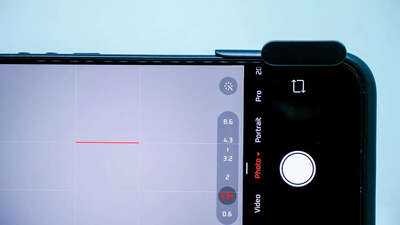
And while I'm listing telephoto frustrations: RAW is capped at 12.5 megapixels. The full 200-megapixel mode outputs JPEGs only—strips all manual controls, pauses between shots. The main camera does 50-megapixel RAW without blinking. This reads like a software limitation Xiaomi could lift in firmware. For now, it undercuts what that sensor is capable of. The Pro mode, similarly, has strange gaps. No burst shooting. No access to the 2x (46mm) digital crop of the main sensor—which leaves an awkward jump from 23mm straight to 75mm when you're shooting manual. These feel like firmware fixes waiting to happen.

The ultrawide, honestly, doesn't need many words. It's the weakest camera, as it is on nearly every phone. A smaller 1/2.76-inch sensor, no OIS. Daytime shots are solid enough. A night shot of a corner cafe held illuminated signage and warm interiors without collapsing, though it was visibly softer than what the main sensor would've given me. Low light is where it drops.

But as a scene-setting lens for architecture and wide contexts, it does the job.
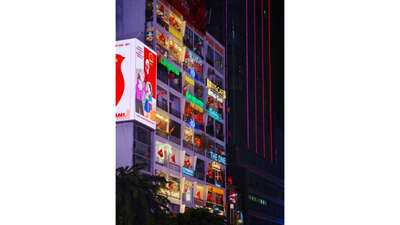
The shots I keep returning to, though, are the night street images. A building in Ho Chi Minh City stacked floor-to-floor with neon signs, red Vietnamese flags hanging from every balcony, warm interiors glowing through glass. The telephoto picked it out cleanly from across the street. Every sign is legible. The reds don't bleed. The colour temperature shifts between neon tubes, incandescent bulbs, and LED strips are each preserved, not averaged into one muddy tone. That's a lot of competing information for a handheld frame, and the phone didn't buckle.
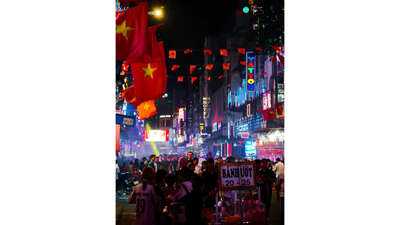
Or a packed street: flags strung overhead, a banh uot cart in the foreground, neon receding into the distance, dozens of faces in a crowd. The main camera kept sharpness across the full depth while juggling at least four different light sources simultaneously. Flag reds stayed red. Green neon stayed green. Warm streetlight didn't wash everything amber. Somewhere around this shot, I stopped thinking about the 17 Ultra as a phone and started thinking about it as a camera. Which is, I suspect, the entire point Xiaomi is trying to make. It mostly succeeds with stills.
And if you ever point the camera at yourself instead of away from it, the 50-megapixel front camera now has autofocus. It makes a noticeable difference. Selfies are sharper, skin tones sit in a natural range, and it handles backlit situations without turning your face into a shadow.
The video side of things
I'm not much of a videographer, so I won't pretend this is an exhaustive breakdown. But I shot enough clips across the trip to get a sense of what the 17 Ultra can and can't do with moving images.
The phone shoots up to 4K at 120fps with Dolby Vision and Log recording, which on paper reads like a content-creator's wish list. I mostly used it for static handheld clips: speedboats cutting across open water, people cooking at street-side stalls, the neon sprawl of a night market playing out in front of me. The main camera and telephoto both gave me clean, stable footage with enough dynamic range that I could see it slotting into a proper edit without looking out of place. Colours tracked well with the photo output, stabilisation held steady without a gimbal, and the Log profile had genuine grading latitude rather than being a flat-looking gimmick.
But then the gaps show up. No 24fps option at all, which rules out a cinematic look if that's what you're after. The 8K mode exists but kills all manual controls and Log, turning the camera fully automatic with a visible pause between takes. And you can't long-press the shutter to jump into Pro video mode, only basic video, so there's always an extra tap before you're recording with the controls you actually want.
The Pro grip adds another wrinkle here. Its USB-C port is charging-only. No data, no external mic, no SSD—nothing. The moment you want to plug in a microphone, the grip comes off, and with it the ergonomics, the shutter button, the exposure dial—all of it. For stills, that's something you can live with. For video, it's the kind of compromise that keeps the 17 Ultra a step short of being a true hybrid tool.
None of this erases the fact that the footage looks very good. For now, the 17 Ultra is a stills-first camera that happens to shoot solid video. Not a bad place to be, but not the full picture either.
The phone around the camera
Cameras don't exist in a vacuum. They live inside a phone you carry all day, charge every night, and argue with every time a notification drops.
And that camera module on the back is impossible to ignore. It's massive, circular, sticks out far enough that you'd expect the phone to wobble on any flat surface—except it doesn't. The module is wide enough to act as its own base, so the phone sits perfectly level on a table. It's a small thing. I appreciated it every single day.
The phone itself is big and heavy. 219 grams before the grip, north of 300 with it. During shooting, the weight was a plus. It helped me hold steady, the grip distributed it well, and the whole setup felt planted rather than flimsy. But this is not a phone that vanishes into a pocket. 6.9 inches of flat OLED behind Victus 2 glass, aluminium frame, fibre-reinforced back. IP68 rated, Corning Gorilla Glass 7i over the camera lenses.
The black colour is understated in the way good cameras tend to be—dark everything, with a subtle red ring around the camera module as the only hint of personality. There's also a white and a Starlit Green with mineral flecks in the back panel, if restraint isn't your thing.
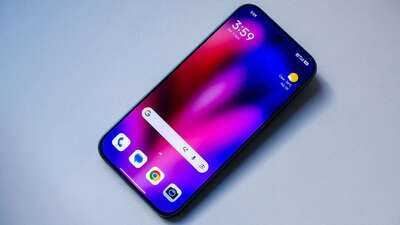
I trusted the display enough to edit RAW files on it, and when I opened those same edits on my laptop later, nothing looked different. That matters on a phone selling itself as a camera. If the screen can't tell you the truth about colour and exposure, your workflow falls apart the moment you switch devices. This one didn't lie. At 3,500 nits peak, it stayed readable under direct tropical sun while I was composing shots. The 120Hz refresh made gallery scrolling and video scrubbing feel effortless. And it's flat now, no curved edges, which is a genuine improvement. The older curved Ultras caught phantom touches all the time, especially with the grip attached. The speakers are warmer and fuller than I expected too. I ended up reviewing most of my footage on the phone itself before deciding what to export, and never felt like I was missing anything.
Snapdragon 8 Elite Gen 5, 16GB of RAM—and I have nothing interesting to say about either. RAW editing in Lightroom, 4K exports, twenty apps open at once, the phone didn't flinch. It got warm during long editing stretches but never enough to throttle. The 6,000mAh battery kept pace. Heavy shooting days layered with editing, streaming, and messaging still left me at 25-30 percent by bedtime. Not spectacular for the cell size, but never stressful either. When it did run low, 15 minutes on a 90W charger brought it back to 40 percent. At that speed, you stop worrying about the battery and just use the phone.
HyperOS 3 running over Android 16 does its job without getting in the way most of the time. But the quirks add up. Notifications and quick toggles live on separate swipe-down panels with no option to combine them. On a phone this wide, I kept swiping from the wrong half of the screen. The status bar defaults to showing a single notification icon, upgradeable to a maximum of three if you find the setting. On 6.9 inches of screen real estate—that's oddly restrictive. And pre-loaded apps on a phone north of a lakh—Facebook, Amazon, a bunch of Xiaomi ecosystem stuff—that's just annoying. You can remove most of it. You shouldn't have to.
And the AI tools, they're everywhere. Object removal and generative expand in the gallery, AI bokeh on non-portrait shots, plus the usual productivity suite: translation, transcription, writing assistance, summarisation. The productivity stuff works fine, nothing you haven't seen on other Android flagships. But the camera-facing AI is where it gets quietly funny. A phone that invests this heavily in real optics—a 1-inch sensor, mechanical zoom, Leica glass—hardware built so the physics does the work, and then ships software designed to fix the kind of photos those components shouldn't be producing in the first place. You almost never need the camera AI tools. Which is a nice problem to have, if you think about it.
If the camera is why you buy a phone, this is the one
I've written a lot of words about this phone. Most of them were about the cameras, which tells you something already. But if you're someone who prefers reading the last page of the book first, here it is.
Every now and then, a phone comes along that makes me question how much I actually need my camera bag. The 17 Ultra is that phone right now. Not because it matches a dedicated camera—it doesn't—but because the gap has shrunk to where the convenience of always having it in your pocket starts winning over the marginal quality gain of carrying a separate body and lens—and a bag to carry them all.
The 1-inch main sensor gives images real depth and tonal richness. The telephoto, for all its frustrations, is the best zoom lens I've used on a phone. Leica Authentic gives photos a character most phones don't know how to produce. And the grip turns the whole experience from touchscreen fumbling into something deliberate, physical, closer to a point-and-shoot than a smartphone. It's an extra Rs 19,999, mind you.
The rough edges are there. The mechanical zoom's 25mm range is too narrow to matter much in practice. Thirty-centimetre minimum focus on the telephoto stings. RAW on anything except the main camera is hobbled. Pro mode has gaps that shouldn't exist. The OS has its own quirks. None of it is a dealbreaker alone, but it accumulates into a phone that occasionally trips over its own ambition.
Every time that happened, though, I'd take another photo and stop caring. A neon-soaked building across the street. A backlit silhouette against shimmering water. A Budweiser can on a cafe table that looked like it came off a Fujifilm. The 17 Ultra kept handing me images I wanted to keep—not just post and move on. For a phone, that's uncommon. For a phone that rattles when you pick it up because there's actual glass shifting inside, it feels earned.
If the camera is why you buy a phone, this is the one to get right now. Everything else—the performance, the display, the battery—works well enough that you never feel like you gave up the phone to get the camera. Rs 1,39,999 is quite some money for all this, but Xiaomi has, for the most part, made good on the ask.
Our rating: 4.5/5
That one detail tells you what Xiaomi is doing here. The 17 Ultra isn't a phone with nice cameras bolted on. It's a camera system that also takes calls. Three Leica-tuned sensors—a 1-inch main, a 200-megapixel telephoto, and a 50-megapixel ultrawide—doing work that most phones fake through computation. Attach the grip—physical shutter button, exposure dial—and it doesn't even feel like a phone anymore.
I've been shooting on it for weeks. Street markets, dim restaurants, harsh afternoon sun, one sunset that refused to cooperate. The cameras delivered, the rest of the phone stayed out of the way, and there's plenty to talk about. Starting, obviously, with the cameras.
What a 1-inch sensor and 75mm of real glass actually get you
A 50-megapixel main camera with a 1-inch sensor and f/1.67 lens. A 200-megapixel telephoto with a mechanically zooming 75-100mm Leica APO lens on a 1/1.4-inch sensor. A 50-megapixel ultrawide at 14mm. All Leica-tuned. All sitting inside that comically large camera bump.
What it's actually like to shoot with is more interesting. And messier.
I'll start with what made me stop fiddling with settings and just shoot. The main sensor handles mixed light with a composure that phones don't usually have. I got a shot of two figures silhouetted against late-afternoon water, backlighting bouncing off the surface in hard, shimmery streaks. This is the kind of scene that forces most phones into a choice: blow the highlights or crush the shadows. The 17 Ultra didn't choose. It held both. The silhouettes stayed dark and legible. The water kept its shimmer without clipping white. The iron railing between the two figures had enough texture to read as metal, not just a dark shape. That's the 1-inch sensor and Xiaomi's LOFIC HDR working as intended: capturing highlight overflow in a single exposure rather than stacking frames and praying nothing moved between them.
A lot of that confidence came down to how I was holding the phone. Without the optional Pro grip, the 17 Ultra is another large slab you're trying to steady with two thumbs. No dedicated shutter button on the phone itself—so you're tapping the screen or using a volume key, and your hand shifts every time.
With the grip clicked in via USB-C, you get a contoured handle, a shutter button with half-press focus and threading for a soft-release (you’ve got two in there: red and a black one), and a command dial. I kept the dial mapped to exposure compensation and used it constantly. It's the difference between taking a photo on your phone and actually shooting.
This composure in mixed light kept turning up. A building wrapped in a massive red LED bow at night, warm window lights flanking it, a scooter slipping through the bottom of the frame. Multiple light sources, multiple colour temperatures, deep shadows sitting between all of it. The reds held without bleeding. The window yellows didn't drift orange. The sky stayed dark blue instead of collapsing to black. Most phones would've either torched the LEDs or lifted the shadows until the whole thing went flat. This one let the scene keep its weight.
Previous Xiaomi Ultras had a habit of over-sharpening and over-contrasting, like the phone was performing enthusiasm about its own output. The 17 Ultra doesn't do that. A Budweiser can and an empty bottle on a cafe table, lit by a wedge of afternoon sun. The shadow side of the table fell away naturally. The glass bottle held one tight, clean highlight. The wall behind sat in a muted olive-grey that no phone processing pipeline would normally leave untouched. Straight out of camera, Leica Authentic mode, no edits. It looked like something off a Fujifilm with Classic Chrome loaded.
Leica Authentic is the less saturated of the two colour profiles, and it's the one I never left. Vibrant is fine, punchier, more social-media-ready. But Authentic has specificity. Greens go olive, not neon. Warm tones lean amber, not orange. There's a mild vignette and a contrast curve that favours depth over flatness. It does what Fujifilm's film simulations do for dedicated cameras, except Xiaomi gives you two choices instead of twelve. When the colour science is this considered, you don't need a menu. You need one setting that works.
And if you really want to commit to the bit, the grip kit lets you mount 67mm filters over the entire lens array. NDs, mist filters, polarisers—the works. A phone with a filter thread. Absurd on paper. Completely in character for the 17 Ultra.
Golden hour is where it all comes together. A colonnade draped in hanging vines, last light slicing across stone columns and terracotta rooftops, people walking through the frame as small figures against the architecture. The colour graduation from deep foreground shadow through warm mid-tones on the pillars to bright sky poking through gaps between vines—that takes actual tonal range to render. No HDR banding. No halo where the dark canopy meets bright background. Just a smooth, unhurried roll-off that reads like it came from a much larger sensor.
In a sense, it did. A 1-inch sensor is still smaller than APS-C, but by phone standards it's massive. And you see it in how images separate. That colonnade shot has people in the mid-ground who are sharp while the rooftops behind them just start to soften. Not portrait mode. Not a computational depth map drawing a line around them. Just optics. The lens is fast enough and the sensor big enough to produce real, graduated bokeh at medium distances. Subtle, but it changes how the images feel. They have layers. Not foreground and background with a software wall between them.
The grip made a particular difference here. Being able to hold the phone in one hand, thumb on the exposure dial, index finger resting on a proper shutter button, I could shoot from the hip while walking through a colonnade without breaking stride. Try that with a bare phone and you're fumbling at a touchscreen, losing the moment. With the grip, you're framing and firing the way you would with a point-and-shoot.
Now. The telephoto.
The 200-megapixel telephoto on a 1/1.4-inch sensor is the most technically ambitious piece of this phone, and it gave me some of the best frames from the entire trip. A person walking along a beachside path, fishing boats stacked in the haze behind them, the whole scene compressed into clean horizontal bands of green, sand, and blue. That's 75mm doing what a good telephoto does: flattening perspective, stacking visual planes, making a simple composition feel graphic.
Or two women on a mosaic bench under hanging vines, framed tight enough that individual tiles are legible and the foliage fills the top of the frame with texture. The background softens behind them without any edge artefacts. Their white embroidered dresses hold detail in direct sun without clipping. Big sensor, good glass—enough reach to isolate a subject without warping their face. The telephoto at its best is genuinely hard to tell apart from a camera.
There's a dedicated Portrait mode too, with Leica lens-style filters that mimic the character of specific Leica optics—swirly bokeh, soft vignettes, the works. Every Xiaomi-Leica phone has had these, and they're good. Better than good, actually, if you want a specific look without opening Lightroom. But I rarely bothered. At 75mm, the regular Photo mode was already giving me portraits with real depth separation from that 1/1.4-inch sensor. No fake blur, no edge artefacts, no need to tell the phone I was shooting a person. The glass knew.
It's also the best low-light telephoto I've used on a phone. During an outdoor night show, performers carrying LED ring props moved across a wet stage. At 75mm, the 17 Ultra held individual dancers sharp enough to pick out costume details, kept the blue stage wash clean, and preserved reflections on the wet ground as actual reflections rather than smeared bright patches.
A wider shot of the same show—fire jets erupting above an arch, smoke catching coloured light across water—had the kind of drama you'd expect from event photography, not a phone.
The grip's extra 2,000mAh battery on top of the phone's own 6,000mAh cell mattered here. Heavy shooting that stretched past midnight, and I rarely saw the battery dip below 80 percent. That kind of headroom means you're not rationing shots to save power.
Though I should note that colour rendition shifted noticeably between the main and telephoto on some of these night shots. The telephoto pushed cooler and more contrasty. The main camera, warmer and more forgiving.
But the telephoto's biggest frustration isn't colour. It's the zoom range. That mechanical lens covers 75mm to 100mm. Real glass movement, real optical zoom—and a 25mm window. I spent weeks trying to find a moment where choosing 85mm or 90mm over 75mm actually changed how I composed a shot. I mostly couldn't. I'd park at 75mm for portraits and street work, or skip past 100mm to a longer digital crop when I needed reach.
The grip's zoom rocker should help here, but it doesn't. It toggles between cameras rather than smoothly shifting focal length, and there's noticeable lag before the lens catches up. I gave up on it within a day and went back to the touchscreen.
The digital crops, at least, hold up. At 8.6x you're still reading from 50 megapixels of sensor data. A harbour dense with fishing boats, shot from distance, kept individual vessel details readable at that level. Past about 17x, AI upscaling steps in and images start looking like reconstructions.
There's also the focus distance problem. The telephoto can't focus closer than 30cm—on the 15 Ultra, it was 10cm. On a phone built for photography, losing telemacro isn't a trade-off. It's a step backward. The Super Macro mode uses the telephoto from 30cm but forces heavy cropping. The ultrawide gets to 5cm but then you're casting your own shadow. Neither is satisfying.
And while I'm listing telephoto frustrations: RAW is capped at 12.5 megapixels. The full 200-megapixel mode outputs JPEGs only—strips all manual controls, pauses between shots. The main camera does 50-megapixel RAW without blinking. This reads like a software limitation Xiaomi could lift in firmware. For now, it undercuts what that sensor is capable of. The Pro mode, similarly, has strange gaps. No burst shooting. No access to the 2x (46mm) digital crop of the main sensor—which leaves an awkward jump from 23mm straight to 75mm when you're shooting manual. These feel like firmware fixes waiting to happen.
The ultrawide, honestly, doesn't need many words. It's the weakest camera, as it is on nearly every phone. A smaller 1/2.76-inch sensor, no OIS. Daytime shots are solid enough. A night shot of a corner cafe held illuminated signage and warm interiors without collapsing, though it was visibly softer than what the main sensor would've given me. Low light is where it drops.
But as a scene-setting lens for architecture and wide contexts, it does the job.
The shots I keep returning to, though, are the night street images. A building in Ho Chi Minh City stacked floor-to-floor with neon signs, red Vietnamese flags hanging from every balcony, warm interiors glowing through glass. The telephoto picked it out cleanly from across the street. Every sign is legible. The reds don't bleed. The colour temperature shifts between neon tubes, incandescent bulbs, and LED strips are each preserved, not averaged into one muddy tone. That's a lot of competing information for a handheld frame, and the phone didn't buckle.
Or a packed street: flags strung overhead, a banh uot cart in the foreground, neon receding into the distance, dozens of faces in a crowd. The main camera kept sharpness across the full depth while juggling at least four different light sources simultaneously. Flag reds stayed red. Green neon stayed green. Warm streetlight didn't wash everything amber. Somewhere around this shot, I stopped thinking about the 17 Ultra as a phone and started thinking about it as a camera. Which is, I suspect, the entire point Xiaomi is trying to make. It mostly succeeds with stills.
And if you ever point the camera at yourself instead of away from it, the 50-megapixel front camera now has autofocus. It makes a noticeable difference. Selfies are sharper, skin tones sit in a natural range, and it handles backlit situations without turning your face into a shadow.
The video side of things
I'm not much of a videographer, so I won't pretend this is an exhaustive breakdown. But I shot enough clips across the trip to get a sense of what the 17 Ultra can and can't do with moving images.
The phone shoots up to 4K at 120fps with Dolby Vision and Log recording, which on paper reads like a content-creator's wish list. I mostly used it for static handheld clips: speedboats cutting across open water, people cooking at street-side stalls, the neon sprawl of a night market playing out in front of me. The main camera and telephoto both gave me clean, stable footage with enough dynamic range that I could see it slotting into a proper edit without looking out of place. Colours tracked well with the photo output, stabilisation held steady without a gimbal, and the Log profile had genuine grading latitude rather than being a flat-looking gimmick.
But then the gaps show up. No 24fps option at all, which rules out a cinematic look if that's what you're after. The 8K mode exists but kills all manual controls and Log, turning the camera fully automatic with a visible pause between takes. And you can't long-press the shutter to jump into Pro video mode, only basic video, so there's always an extra tap before you're recording with the controls you actually want.
The Pro grip adds another wrinkle here. Its USB-C port is charging-only. No data, no external mic, no SSD—nothing. The moment you want to plug in a microphone, the grip comes off, and with it the ergonomics, the shutter button, the exposure dial—all of it. For stills, that's something you can live with. For video, it's the kind of compromise that keeps the 17 Ultra a step short of being a true hybrid tool.
None of this erases the fact that the footage looks very good. For now, the 17 Ultra is a stills-first camera that happens to shoot solid video. Not a bad place to be, but not the full picture either.
The phone around the camera
Cameras don't exist in a vacuum. They live inside a phone you carry all day, charge every night, and argue with every time a notification drops.
And that camera module on the back is impossible to ignore. It's massive, circular, sticks out far enough that you'd expect the phone to wobble on any flat surface—except it doesn't. The module is wide enough to act as its own base, so the phone sits perfectly level on a table. It's a small thing. I appreciated it every single day.
The phone itself is big and heavy. 219 grams before the grip, north of 300 with it. During shooting, the weight was a plus. It helped me hold steady, the grip distributed it well, and the whole setup felt planted rather than flimsy. But this is not a phone that vanishes into a pocket. 6.9 inches of flat OLED behind Victus 2 glass, aluminium frame, fibre-reinforced back. IP68 rated, Corning Gorilla Glass 7i over the camera lenses.
The black colour is understated in the way good cameras tend to be—dark everything, with a subtle red ring around the camera module as the only hint of personality. There's also a white and a Starlit Green with mineral flecks in the back panel, if restraint isn't your thing.
I trusted the display enough to edit RAW files on it, and when I opened those same edits on my laptop later, nothing looked different. That matters on a phone selling itself as a camera. If the screen can't tell you the truth about colour and exposure, your workflow falls apart the moment you switch devices. This one didn't lie. At 3,500 nits peak, it stayed readable under direct tropical sun while I was composing shots. The 120Hz refresh made gallery scrolling and video scrubbing feel effortless. And it's flat now, no curved edges, which is a genuine improvement. The older curved Ultras caught phantom touches all the time, especially with the grip attached. The speakers are warmer and fuller than I expected too. I ended up reviewing most of my footage on the phone itself before deciding what to export, and never felt like I was missing anything.
Snapdragon 8 Elite Gen 5, 16GB of RAM—and I have nothing interesting to say about either. RAW editing in Lightroom, 4K exports, twenty apps open at once, the phone didn't flinch. It got warm during long editing stretches but never enough to throttle. The 6,000mAh battery kept pace. Heavy shooting days layered with editing, streaming, and messaging still left me at 25-30 percent by bedtime. Not spectacular for the cell size, but never stressful either. When it did run low, 15 minutes on a 90W charger brought it back to 40 percent. At that speed, you stop worrying about the battery and just use the phone.
HyperOS 3 running over Android 16 does its job without getting in the way most of the time. But the quirks add up. Notifications and quick toggles live on separate swipe-down panels with no option to combine them. On a phone this wide, I kept swiping from the wrong half of the screen. The status bar defaults to showing a single notification icon, upgradeable to a maximum of three if you find the setting. On 6.9 inches of screen real estate—that's oddly restrictive. And pre-loaded apps on a phone north of a lakh—Facebook, Amazon, a bunch of Xiaomi ecosystem stuff—that's just annoying. You can remove most of it. You shouldn't have to.
And the AI tools, they're everywhere. Object removal and generative expand in the gallery, AI bokeh on non-portrait shots, plus the usual productivity suite: translation, transcription, writing assistance, summarisation. The productivity stuff works fine, nothing you haven't seen on other Android flagships. But the camera-facing AI is where it gets quietly funny. A phone that invests this heavily in real optics—a 1-inch sensor, mechanical zoom, Leica glass—hardware built so the physics does the work, and then ships software designed to fix the kind of photos those components shouldn't be producing in the first place. You almost never need the camera AI tools. Which is a nice problem to have, if you think about it.
If the camera is why you buy a phone, this is the one
I've written a lot of words about this phone. Most of them were about the cameras, which tells you something already. But if you're someone who prefers reading the last page of the book first, here it is.
Every now and then, a phone comes along that makes me question how much I actually need my camera bag. The 17 Ultra is that phone right now. Not because it matches a dedicated camera—it doesn't—but because the gap has shrunk to where the convenience of always having it in your pocket starts winning over the marginal quality gain of carrying a separate body and lens—and a bag to carry them all.
The 1-inch main sensor gives images real depth and tonal richness. The telephoto, for all its frustrations, is the best zoom lens I've used on a phone. Leica Authentic gives photos a character most phones don't know how to produce. And the grip turns the whole experience from touchscreen fumbling into something deliberate, physical, closer to a point-and-shoot than a smartphone. It's an extra Rs 19,999, mind you.
The rough edges are there. The mechanical zoom's 25mm range is too narrow to matter much in practice. Thirty-centimetre minimum focus on the telephoto stings. RAW on anything except the main camera is hobbled. Pro mode has gaps that shouldn't exist. The OS has its own quirks. None of it is a dealbreaker alone, but it accumulates into a phone that occasionally trips over its own ambition.
Every time that happened, though, I'd take another photo and stop caring. A neon-soaked building across the street. A backlit silhouette against shimmering water. A Budweiser can on a cafe table that looked like it came off a Fujifilm. The 17 Ultra kept handing me images I wanted to keep—not just post and move on. For a phone, that's uncommon. For a phone that rattles when you pick it up because there's actual glass shifting inside, it feels earned.
If the camera is why you buy a phone, this is the one to get right now. Everything else—the performance, the display, the battery—works well enough that you never feel like you gave up the phone to get the camera. Rs 1,39,999 is quite some money for all this, but Xiaomi has, for the most part, made good on the ask.
Our rating: 4.5/5
Next Story