
Accurate forecasting tough as currency shocks, FTA uncertainty, supply disruptions weigh: Consumer chiefs


New Delhi: Chief executives and leaders across consumer sectors say they have "given up on forecasting and planning long-term strategies" amid fluctuating currencies, unclear decisions on free trade agreements, geopolitical uncertainties and supply disruptions.
"High levels of volatility in terms of commodity prices, dollar movement, tariff barriers, supply chain disruptions-all these are moving parts. And when you have all these moving parts coming together, it creates a fair amount of uncertainty for anybody to take a firm view on the long term," said Mukundan Menon, MD, Voltas.

Voltas imports about 30% of components for its ACs and is planning to hike AC prices by up to 15% this summer amid surging copper prices, a key part for AC manufacturing. Copper prices, which were hovering at $8,500 per tonne last year, have shot up to $12,000-13,000 a tonne this year. Executives said while fluctuating inflationary environments and supply disruptions are the new normals, a flurry of global FTAs, which have been inconsistent of late, and devalued currencies have added to the mix of elements of uncertainty. Add to that, climate change.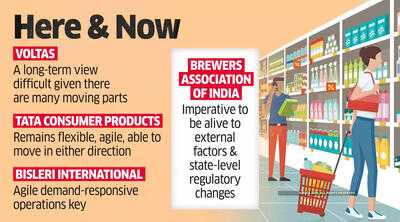
Similarly, prices of tea, cocoa and coffee, too, have seen wide fluctuations, directly impacting companies across confectionery, beverages and foods.
"We have given up on forecasting with accuracy. You don't know how things pan out," said Sunil D'Souza, managing director of Tata Consumer Products, at the third quarter company's earnings call. "I would not make a statement on whether we will be better off or worse off. So, we remain flexible, agile, able to move in either direction."
The latest round of proposed US tariffs on India remain uncertain, with the Supreme Court striking down president Donald Trump's proposed tariffs as invalid. Trump, in retaliation, warned trade partner countries against backing away from already negotiated trade deals.
Calling out for agile demand-responsive operations, Angelo George, chief executive of packaged water manufacturer Bisleri International, said: "Volatility driven by demand fluctuations, input costs, logistics costs and supply-chain disruptions is accelerating the shift from long-term forecasting to agile, short-cycle planning in packaged drinking water, where logistics efficiency and market responsiveness are critical."
He said building resilience through flexible, distributed supply networks and demand-responsive operations have been crucial for the company as it adapts to demand variables.
Packaged water, being an essential category with frequent daily replenishment cycles, is heavily dependent on freight and logistics. Packaging costs, too, are dependent on petroleum prices, which have a huge impact on the category.
Disruptions have impacted sectors with varying degrees, some global, others local.
"High levels of volatility in terms of commodity prices, dollar movement, tariff barriers, supply chain disruptions-all these are moving parts. And when you have all these moving parts coming together, it creates a fair amount of uncertainty for anybody to take a firm view on the long term," said Mukundan Menon, MD, Voltas.
Voltas imports about 30% of components for its ACs and is planning to hike AC prices by up to 15% this summer amid surging copper prices, a key part for AC manufacturing. Copper prices, which were hovering at $8,500 per tonne last year, have shot up to $12,000-13,000 a tonne this year. Executives said while fluctuating inflationary environments and supply disruptions are the new normals, a flurry of global FTAs, which have been inconsistent of late, and devalued currencies have added to the mix of elements of uncertainty. Add to that, climate change.
Similarly, prices of tea, cocoa and coffee, too, have seen wide fluctuations, directly impacting companies across confectionery, beverages and foods.
"We have given up on forecasting with accuracy. You don't know how things pan out," said Sunil D'Souza, managing director of Tata Consumer Products, at the third quarter company's earnings call. "I would not make a statement on whether we will be better off or worse off. So, we remain flexible, agile, able to move in either direction."
The latest round of proposed US tariffs on India remain uncertain, with the Supreme Court striking down president Donald Trump's proposed tariffs as invalid. Trump, in retaliation, warned trade partner countries against backing away from already negotiated trade deals.
Calling out for agile demand-responsive operations, Angelo George, chief executive of packaged water manufacturer Bisleri International, said: "Volatility driven by demand fluctuations, input costs, logistics costs and supply-chain disruptions is accelerating the shift from long-term forecasting to agile, short-cycle planning in packaged drinking water, where logistics efficiency and market responsiveness are critical."
He said building resilience through flexible, distributed supply networks and demand-responsive operations have been crucial for the company as it adapts to demand variables.
Packaged water, being an essential category with frequent daily replenishment cycles, is heavily dependent on freight and logistics. Packaging costs, too, are dependent on petroleum prices, which have a huge impact on the category.
Disruptions have impacted sectors with varying degrees, some global, others local.
Next Story