
ADB will help finance $70 bn worth of projects to improve electricity-sharing, internet access across Asia-Pacific by 2035


Samarkand, Uzbekistan: The Asian Development Bank ( ADB) will support $70 billion in new energy and digital infrastructure projects aimed at connecting power grids, expanding cross-border electricity transmission, and improving broadband access throughout the Asia-Pacific region by 2035, according to its president, Masato Kanda.
“These two initiatives build the systems Asia and the Pacific need to grow, compete, and connect,” Kanda told reporters on Sunday. “By linking power grids and digital networks across borders, we can lower costs, expand opportunity, and bring reliable power and digital access to hundreds of millions of people.”
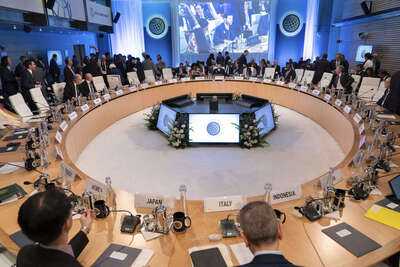
Under the Pan-Asia Power Grid Initiative, ADB will work with governments, utilities, the private sector and development partners to mobilise $50 billion by 2035 for cross-border power infrastructure that can unlock renewable energy at scale.
The initiative will focus on transmission and grid integration, including cross-border lines, substations, storage and grid digitalisation. It will also support power generation linked to electricity trade, including renewable energy export projects, regional renewable hubs, and hybrid generation-storage facilities.
By 2035, ADB aims to integrate about 20 gigawatts of renewable energy across borders, connect 22,000 circuit-kilometers of transmission lines, improve energy access for 200 million people, create 840,000 jobs, and cut regional power sector emissions by 15%.
ADB expects to finance about half of the $50 billion worth of initiatives from its own resources and raise the rest through cofinancing, including from the private sector.
Up to $10 million in technical assistance will support efforts to align regulations, adopt common technical standards, prepare feasibility studies and advance other work needed for major projects.
The Asia-Pacific Digital Highway will mobilise $20 billion by 2035 to finance digital corridors, data infrastructure and artificial intelligence (AI)-ready economies.
Investments will focus on connected infrastructure, including terrestrial and subsea fiber networks, satellite links and regional data centres.
ADB will also provide policy and regulatory support, including on cybersecurity risk management, and invest in skills programmes to strengthen digital and AI readiness.
By 2035, the initiative aims to provide first-time broadband access to 200 million people and faster, more reliable digital connectivity for another 450 million people across the region.
ADB expects to finance $15 billion of the $20 billion initiative from its own resources and raise $5 billion through cofinancing, including from the private sector.
Stress Test
On the impact of the conflict in West Asia, he said ADB is positioning its response in stages. “What we are seeing is not only a security crisis, but a stress test of the global order,” Kandasaid.
To a query from ET on how countries in Asia, such as India, build resilience in the wake of this crisis and weaponisation of tariffs, he said countries should strengthen domestic economy, build on sound macro fundamentals, and build reserves.
Kanda said this is a wakeup call on energy dependence and noted the need to build local currency markets in the region.
“These two initiatives build the systems Asia and the Pacific need to grow, compete, and connect,” Kanda told reporters on Sunday. “By linking power grids and digital networks across borders, we can lower costs, expand opportunity, and bring reliable power and digital access to hundreds of millions of people.”
Under the Pan-Asia Power Grid Initiative, ADB will work with governments, utilities, the private sector and development partners to mobilise $50 billion by 2035 for cross-border power infrastructure that can unlock renewable energy at scale.
The initiative will focus on transmission and grid integration, including cross-border lines, substations, storage and grid digitalisation. It will also support power generation linked to electricity trade, including renewable energy export projects, regional renewable hubs, and hybrid generation-storage facilities.
By 2035, ADB aims to integrate about 20 gigawatts of renewable energy across borders, connect 22,000 circuit-kilometers of transmission lines, improve energy access for 200 million people, create 840,000 jobs, and cut regional power sector emissions by 15%.
ADB expects to finance about half of the $50 billion worth of initiatives from its own resources and raise the rest through cofinancing, including from the private sector.
Up to $10 million in technical assistance will support efforts to align regulations, adopt common technical standards, prepare feasibility studies and advance other work needed for major projects.
The Asia-Pacific Digital Highway will mobilise $20 billion by 2035 to finance digital corridors, data infrastructure and artificial intelligence (AI)-ready economies.
Investments will focus on connected infrastructure, including terrestrial and subsea fiber networks, satellite links and regional data centres.
ADB will also provide policy and regulatory support, including on cybersecurity risk management, and invest in skills programmes to strengthen digital and AI readiness.
By 2035, the initiative aims to provide first-time broadband access to 200 million people and faster, more reliable digital connectivity for another 450 million people across the region.
ADB expects to finance $15 billion of the $20 billion initiative from its own resources and raise $5 billion through cofinancing, including from the private sector.
Stress Test
On the impact of the conflict in West Asia, he said ADB is positioning its response in stages. “What we are seeing is not only a security crisis, but a stress test of the global order,” Kandasaid.
To a query from ET on how countries in Asia, such as India, build resilience in the wake of this crisis and weaponisation of tariffs, he said countries should strengthen domestic economy, build on sound macro fundamentals, and build reserves.
Kanda said this is a wakeup call on energy dependence and noted the need to build local currency markets in the region.
Next Story