
Emerging tech redefining what it takes to scale globally


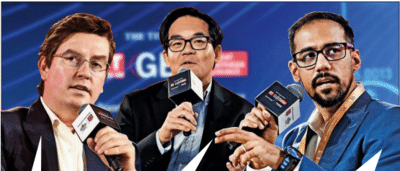
The race to build the world's next breakout brands is increasingly being shaped by how companies combine technology with trust, industry depth, and sustainability. In a panel discussion at the ET Now Global Business Summit featuring Mate Pencz, founder and CEO of Loft, Ren Ito, co-founder and CEO of Sakana AI, and Pratik Gauri, founder and CEO of 5ire, the conversation focused on how emerging technologies-from AI to blockchain-are reshaping complex industries and redefining what it takes to scale globally.
Technology That Solves Real Problems
Globally, real estate remains one of the most promising yet under-digitised sectors for innovation. "Real estate is by far the largest asset class in the world, yet it's one of the most analog sectors as well," Mate Pencz said, describing the opportunity for technology-led brands to simplify a complex ecosystem.
According to Pencz, the biggest barrier is trust, particularly in emerging markets where transactions depend heavily on personal relationships. "At the end of the day, we're really trying to fill a trust gap," he said, adding how Loft blends AI-driven tools with human brokers to make transactions more efficient without losing the personal element. As a result, breakthrough brands are likely to emerge in sectors where inefficiency and trust deficits still dominate. Ren Ito, however, cautioned against a one-size-fits-all view of artificial intelligence.
"Whenever you're talking about AI, you have to specify which sector you're talking about," he said. While foundation models are powerful, Ito argued that true value lies in industry-specific applications. He pointed to financial services as an example, where automating loan applications requires deep understanding of both procedures and real-world context. "It's not enough to build excellent models. We have to go the extra mile by focusing on specific industries," he said. The perspective reflects a broader shift in AI -from general capability to deep, verticalised solutions that drive measurable outcomes. Also, it highlighted how infrastructure technologies are quietly reshaping industries by removing friction rather than reinventing the consumer experience from scratch.
For Gauri, blockchain is already proving its value by solving practical challenges. "You don't need to wait days for cross-border payments anymore-you can do it instantly," he said, pointing to stablecoins and decentralised finance as examples. Gauri argued that combining AI with blockchain will make advanced systems accessible to everyday users. "The front layer becomes AI, while the backend is blockchain," he said, predicting that this integration will shape the future of fintech.
Trust & Industry Knowledge Still Matter
Despite the excitement around technology, human expertise remains critical. Pencz described real estate transactions as highly complex, often involving hundreds of steps. "You're not going to solve the entire problem end-to-end just by putting a chatbot on it," he said. Instead, he argued that successful brands will use AI agents to remove inefficiencies while preserving essential human interactions such as property visits and negotiations.
There is a growing consensus that hybrid models-automation backed by human judgement-will define the next phase of innovation.
"There are written rules, unwritten rules, and human discretion," Ito said, adding how younger professionals learn not only from manuals but also from observing experienced colleagues. Training AI requires collecting both formal documentation and tacit knowledge. "You can put written rules into AI, but you also need to teach it the nuances that come from experience," he said, comparing the process to learning through observation rather than just reading instructions. This points to one of AI's biggest challenges: translating human intuition and contextual decision-making into scalable digital systems.
Gauri too echoed this sentiment from a blockchain perspective, emphasising that technology must remain grounded in human values. "Humanity needs to stay at the centre of any technology," he said. He warned that certain consensus mechanisms can reinforce inequality if not designed thoughtfully, and argued that future brands must align innovation with fairness and sustainability. Their message signals a broader shift in brand-building-where ethical design and long-term impact increasingly influence investor and consumer decisions.
Emerging Markets and Sustainability Driving the Next Wave
The panelists agreed that emerging markets could lead the next phase of breakout brand creation. Pencz predicted rapid adoption of AI in regions still undergoing digitisation. "Countries like India and Brazil are going to see extremely rapid adoption because consumers are more digitally native," he said, noting that fewer legacy systems allow faster experimentation and scale.
This reflects a wider trend of emerging economies leapfrogging traditional technology cycles and becoming innovation hubs rather than followers.
Ito described this as a form of technological leapfrogging. "Leapfrogging is key to adopting new technology," he said, highlighting how digital banks are expanding into integrated financial ecosystems powered by AI. Rather than focusing only on sleek interfaces, he argued that companies must build end-to-end solutions that redefine how industries operate. His comments suggest that future leaders will be those who rethink entire value chains rather than optimise isolated processes. Gauri pointed to blockchain's growing role in supply chains and manufacturing. "The whole system from manufacturer to retailer can go on the blockchain," he said, explaining how brands can reduce counterfeiting and improve transparency. He noted that fashion and healthcare companies are already experimenting with blockchain-based tracking, and predicted that sustainability will become a core differentiator for future brands.
A New Blueprint for Breakout Brands
The speakers also converged on a shared vision for building the next generation of global companies. Breakout brands, they said, will be those that combine deep industry knowledge with multiple technologies-AI, blockchain, and fintech-while maintaining a strong human focus.
Technology That Solves Real Problems
Globally, real estate remains one of the most promising yet under-digitised sectors for innovation. "Real estate is by far the largest asset class in the world, yet it's one of the most analog sectors as well," Mate Pencz said, describing the opportunity for technology-led brands to simplify a complex ecosystem.
According to Pencz, the biggest barrier is trust, particularly in emerging markets where transactions depend heavily on personal relationships. "At the end of the day, we're really trying to fill a trust gap," he said, adding how Loft blends AI-driven tools with human brokers to make transactions more efficient without losing the personal element. As a result, breakthrough brands are likely to emerge in sectors where inefficiency and trust deficits still dominate. Ren Ito, however, cautioned against a one-size-fits-all view of artificial intelligence.
"Whenever you're talking about AI, you have to specify which sector you're talking about," he said. While foundation models are powerful, Ito argued that true value lies in industry-specific applications. He pointed to financial services as an example, where automating loan applications requires deep understanding of both procedures and real-world context. "It's not enough to build excellent models. We have to go the extra mile by focusing on specific industries," he said. The perspective reflects a broader shift in AI -from general capability to deep, verticalised solutions that drive measurable outcomes. Also, it highlighted how infrastructure technologies are quietly reshaping industries by removing friction rather than reinventing the consumer experience from scratch.
For Gauri, blockchain is already proving its value by solving practical challenges. "You don't need to wait days for cross-border payments anymore-you can do it instantly," he said, pointing to stablecoins and decentralised finance as examples. Gauri argued that combining AI with blockchain will make advanced systems accessible to everyday users. "The front layer becomes AI, while the backend is blockchain," he said, predicting that this integration will shape the future of fintech.
Trust & Industry Knowledge Still Matter
Despite the excitement around technology, human expertise remains critical. Pencz described real estate transactions as highly complex, often involving hundreds of steps. "You're not going to solve the entire problem end-to-end just by putting a chatbot on it," he said. Instead, he argued that successful brands will use AI agents to remove inefficiencies while preserving essential human interactions such as property visits and negotiations.
There is a growing consensus that hybrid models-automation backed by human judgement-will define the next phase of innovation.
"There are written rules, unwritten rules, and human discretion," Ito said, adding how younger professionals learn not only from manuals but also from observing experienced colleagues. Training AI requires collecting both formal documentation and tacit knowledge. "You can put written rules into AI, but you also need to teach it the nuances that come from experience," he said, comparing the process to learning through observation rather than just reading instructions. This points to one of AI's biggest challenges: translating human intuition and contextual decision-making into scalable digital systems.
Gauri too echoed this sentiment from a blockchain perspective, emphasising that technology must remain grounded in human values. "Humanity needs to stay at the centre of any technology," he said. He warned that certain consensus mechanisms can reinforce inequality if not designed thoughtfully, and argued that future brands must align innovation with fairness and sustainability. Their message signals a broader shift in brand-building-where ethical design and long-term impact increasingly influence investor and consumer decisions.
Emerging Markets and Sustainability Driving the Next Wave
The panelists agreed that emerging markets could lead the next phase of breakout brand creation. Pencz predicted rapid adoption of AI in regions still undergoing digitisation. "Countries like India and Brazil are going to see extremely rapid adoption because consumers are more digitally native," he said, noting that fewer legacy systems allow faster experimentation and scale.
This reflects a wider trend of emerging economies leapfrogging traditional technology cycles and becoming innovation hubs rather than followers.
Ito described this as a form of technological leapfrogging. "Leapfrogging is key to adopting new technology," he said, highlighting how digital banks are expanding into integrated financial ecosystems powered by AI. Rather than focusing only on sleek interfaces, he argued that companies must build end-to-end solutions that redefine how industries operate. His comments suggest that future leaders will be those who rethink entire value chains rather than optimise isolated processes. Gauri pointed to blockchain's growing role in supply chains and manufacturing. "The whole system from manufacturer to retailer can go on the blockchain," he said, explaining how brands can reduce counterfeiting and improve transparency. He noted that fashion and healthcare companies are already experimenting with blockchain-based tracking, and predicted that sustainability will become a core differentiator for future brands.
A New Blueprint for Breakout Brands
The speakers also converged on a shared vision for building the next generation of global companies. Breakout brands, they said, will be those that combine deep industry knowledge with multiple technologies-AI, blockchain, and fintech-while maintaining a strong human focus.
Next Story