
Game of cards: Top banking players opt for tight gambit, rivals up the ante


MUMBAI: Indian banks are tightening credit card rewards across segments, with top issuers cutting benefits, raising spending thresholds and changing loyalty transfer terms to curb rising costs. At the same time, smaller private lenders and state-run banks are making big forays to capture higher-spending customers.
Since the start of the calendar year, major devaluations have hit multiple premium and super-premium cards, shocking the high spenders. No card has been spared, be it the ICICI Emeralde Private Metal (removal of some vouchers for accelerated rewards), American Express Platinum Travel (higher spend milestones for bonus rewards), or Axis Bank (removal of three popular transfer partners without advance notice). HDFC Bank, too, has asked its Infinia customers to clock in annual spends of at least Rs 18 lakh or maintain a total relationship value of at least Rs 50 lakh to retain the by-invite-only metal.
While the biggest players, chafing under the weight of rising costs, winnow the ‘wheat’ from the ‘chaff ’, smaller private banks and some large publicsector banks are issuing more premium cards sweetened with attractive offers.
MAKING BIG STRIDES
Since its launch in 2021, IDFC First Bank’s credit card business has seen strong growth, with the number of cards in force touching 4.5 million as of FY26, and the bank says premium cards have been a big contributor.
Also Read: Deposit rates could be headed up in a squeeze for banks
“IDFC First Bank has taken a structurally different approach by unbundling premium features from exclusivity and making them available across a wide portfolio, including through FDbacked secured premium cards. This allows customers to access premium benefits without having to wait to ‘qualify’ in the traditional sense,” the bank told ET.
The bank is betting on the Indianinspired heritage design of its top-end cards, the Gaj and Mayura, to attract customers. “This is supported by clear, tangible value: competitive pricing, zero-forex markup, never-expiring reward points and an open, unrestricted redemption model that is not locked into closed catalogues or forced ecosystems,” the bank said.
The bank says its products offer a compelling proposition for customers reassessing legacy premium cards. “Our approach treats rewards like a currency rather than aconditional privilege, making the model more inclusive, adaptable, and scalable, particularly for affluent customers whose spending extends well beyond travel alone,” the bank said.
THE STODGY TURN AGILE
Besides mid-tier private-sector banks, public-sector giants too are aggressively expanding in this space.
BOBCard, an arm of the Bank of Baroda which predates larger peer SBI Card, is making a big push with its premium cards.
Also Read: Jio, Bank of Baroda tie up for enabling banking access from feature phones
“BOBCard has seen a steady growth in premium card issuances over the past two to three years, made possible by strong customer interest in flagship offerings such as Eterna and Tiara (for women), as well as the recently launched Etihad Guest credit card,” said Ravindra Rai, MD & CEO of BOBCard.
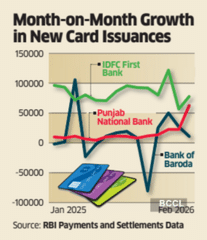
According to the latest data from the Reserve Bank of India, BOBCard’s total cards in force stood at over 31 million as of February. ET’s analysis of the data shows that between February and March 2025, it issued over one lakh cards, the highest month-on-month tally for the year.
The limited-period lifetime-free offers and joining bonuses have led to a rise in sign-ups, but Rai said the company values portfolio stability over growth. “While expanding in the premium segment, we remain focused on responsible portfolio growth, ensuring sustainability in spends and usage rather than purely issuance-led expansion.”
Punjab National Bank, India’s second-largest public sector bank by assets, has upped its premium game with the launch of the metal Luxura card last December, and is among the first on RuPay Ekaa, the top card tier of the payment network owned by the National Payments Corporation of India (NPCI).
Queries sent to NPCI remained unanswered until press time.
In January, PNB also launched the Luxura on Visa Infinite, the US network’s super-premium tier. “Since launch, the Luxura card has witnessed encouraging traction. Between January and March, we have issued more than 13,000 cards. Our benefits are very competitive and better than those of the peer group,” said PNB in an emailed response to ET’s queries.
“The portfolio is growing steadily across both RuPay Ekaa and Visa Infinite platforms, with a balanced mix of customers across metros and emerging cities,” added PNB.
The high-end credit card market is caught in a tug-of-war between users signing up to juice the highest ‘returns on spends’ and banks scrambling to plug the leaks in their P&L accounts. As new entrants pull out all the stops, the good times may continue for users until a devaluation does them part.
Since the start of the calendar year, major devaluations have hit multiple premium and super-premium cards, shocking the high spenders. No card has been spared, be it the ICICI Emeralde Private Metal (removal of some vouchers for accelerated rewards), American Express Platinum Travel (higher spend milestones for bonus rewards), or Axis Bank (removal of three popular transfer partners without advance notice). HDFC Bank, too, has asked its Infinia customers to clock in annual spends of at least Rs 18 lakh or maintain a total relationship value of at least Rs 50 lakh to retain the by-invite-only metal.
While the biggest players, chafing under the weight of rising costs, winnow the ‘wheat’ from the ‘chaff ’, smaller private banks and some large publicsector banks are issuing more premium cards sweetened with attractive offers.
MAKING BIG STRIDES
Since its launch in 2021, IDFC First Bank’s credit card business has seen strong growth, with the number of cards in force touching 4.5 million as of FY26, and the bank says premium cards have been a big contributor.
Also Read: Deposit rates could be headed up in a squeeze for banks
“IDFC First Bank has taken a structurally different approach by unbundling premium features from exclusivity and making them available across a wide portfolio, including through FDbacked secured premium cards. This allows customers to access premium benefits without having to wait to ‘qualify’ in the traditional sense,” the bank told ET.
The bank is betting on the Indianinspired heritage design of its top-end cards, the Gaj and Mayura, to attract customers. “This is supported by clear, tangible value: competitive pricing, zero-forex markup, never-expiring reward points and an open, unrestricted redemption model that is not locked into closed catalogues or forced ecosystems,” the bank said.
The bank says its products offer a compelling proposition for customers reassessing legacy premium cards. “Our approach treats rewards like a currency rather than aconditional privilege, making the model more inclusive, adaptable, and scalable, particularly for affluent customers whose spending extends well beyond travel alone,” the bank said.
THE STODGY TURN AGILE
BOBCard, an arm of the Bank of Baroda which predates larger peer SBI Card, is making a big push with its premium cards.
Also Read: Jio, Bank of Baroda tie up for enabling banking access from feature phones
“BOBCard has seen a steady growth in premium card issuances over the past two to three years, made possible by strong customer interest in flagship offerings such as Eterna and Tiara (for women), as well as the recently launched Etihad Guest credit card,” said Ravindra Rai, MD & CEO of BOBCard.
According to the latest data from the Reserve Bank of India, BOBCard’s total cards in force stood at over 31 million as of February. ET’s analysis of the data shows that between February and March 2025, it issued over one lakh cards, the highest month-on-month tally for the year.
The limited-period lifetime-free offers and joining bonuses have led to a rise in sign-ups, but Rai said the company values portfolio stability over growth. “While expanding in the premium segment, we remain focused on responsible portfolio growth, ensuring sustainability in spends and usage rather than purely issuance-led expansion.”
Punjab National Bank, India’s second-largest public sector bank by assets, has upped its premium game with the launch of the metal Luxura card last December, and is among the first on RuPay Ekaa, the top card tier of the payment network owned by the National Payments Corporation of India (NPCI).
Queries sent to NPCI remained unanswered until press time.
In January, PNB also launched the Luxura on Visa Infinite, the US network’s super-premium tier. “Since launch, the Luxura card has witnessed encouraging traction. Between January and March, we have issued more than 13,000 cards. Our benefits are very competitive and better than those of the peer group,” said PNB in an emailed response to ET’s queries.
“The portfolio is growing steadily across both RuPay Ekaa and Visa Infinite platforms, with a balanced mix of customers across metros and emerging cities,” added PNB.
The high-end credit card market is caught in a tug-of-war between users signing up to juice the highest ‘returns on spends’ and banks scrambling to plug the leaks in their P&L accounts. As new entrants pull out all the stops, the good times may continue for users until a devaluation does them part.
Next Story