
Gulf SWFs may go sovereign with oil revenue set to drop


Dubai: Gulf sovereign wealth funds (SWFs), among the world's largest capital deployers, may redirect investments toward domestic government priorities if disruption in the Strait of Hormuz persists amid the Iran-Israel war, denting oil revenue, according to analysts. Such a shift could slow international investment flows.
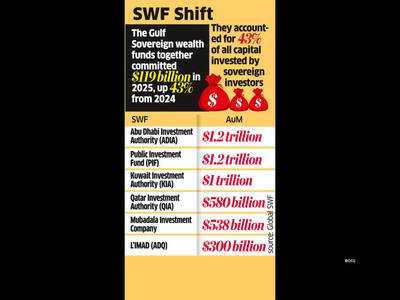
These state-backed funds manage nearly $5 trillion in assets. They invested about $119 billion globally in 2025, accounting for roughly 43% of total sovereign investment flows during the year.
India may also feel the impact. Investment flows from Gulf SWFs into India had shrunk to nearly a third last year to $1.38 billion from $4.32 billion in 2024, as per data platform Global SWF.
"A prolonged disruption of shipping through the Strait of Hormuz would represent a shock to oil and gas-based economies with declining exports, rising insurance costs, and weakening fiscal receipts despite higher prices, since volumes would be unable to reach global markets," said Daniel Brett, head of data and research at Global SWF. In this environment, sovereign priorities would shift toward domestic economic stability and ensure governments meet spending commitments.
The Strait of Hormuz, a 55-km maritime passage between Iran and Oman, has been effectively closed since last Saturday, following the US-Israeli airstrikes on Iran. It is the route for a fifth of the global oil flow.
"Sovereign funds in the Gulf are designed to absorb shocks," said a regional economist, asking not to be named. "They can support government finances during periods of volatility and then redeploy capital globally once fiscal conditions stabilise."
Gulf economies are already facing financial, operational and structural pressure from the ongoing conflict. UAE's stock markets took a major hit, with the Dubai Financial Market ending 4.7% lower Wednesday after a two-day closure, recording the worst performance since May 2022. Tourism, aviation, and foreign direct investments are also expected to face pressure amid travel disruptions and negative sentiment.
"If disruption in the Strait of Hormuz persists, Gulf sovereign wealth funds may temporarily rebalance capital deployment toward domestic priorities," said Arun Iyer, an investment strategist focused on real estate and capital platforms. "In such a scenario, we could see greater allocations into national infrastructure, real estate development and institutional investment platforms that support economic activity and liquidity within the region."
If shipping lines reopen after diplomatic or military de-escalation, the sustained high oil prices due to geopolitical risks may generate a surplus for sovereign investors to deploy additional capital globally, Brett of Global SWF said. He assigns a 40% probability to this scenario and a 25% probability to prolonged conflict.
Redeploying assets
Historically, Gulf SWFs have responded to crises through structured balance-sheet adjustments rather than abrupt portfolio shifts, Global SWF said in a note: 'Gulf SWFs and the Iran Crisis'.
These state-backed funds manage nearly $5 trillion in assets. They invested about $119 billion globally in 2025, accounting for roughly 43% of total sovereign investment flows during the year.
India may also feel the impact. Investment flows from Gulf SWFs into India had shrunk to nearly a third last year to $1.38 billion from $4.32 billion in 2024, as per data platform Global SWF.
"A prolonged disruption of shipping through the Strait of Hormuz would represent a shock to oil and gas-based economies with declining exports, rising insurance costs, and weakening fiscal receipts despite higher prices, since volumes would be unable to reach global markets," said Daniel Brett, head of data and research at Global SWF. In this environment, sovereign priorities would shift toward domestic economic stability and ensure governments meet spending commitments.
The Strait of Hormuz, a 55-km maritime passage between Iran and Oman, has been effectively closed since last Saturday, following the US-Israeli airstrikes on Iran. It is the route for a fifth of the global oil flow.
"Sovereign funds in the Gulf are designed to absorb shocks," said a regional economist, asking not to be named. "They can support government finances during periods of volatility and then redeploy capital globally once fiscal conditions stabilise."
Gulf economies are already facing financial, operational and structural pressure from the ongoing conflict. UAE's stock markets took a major hit, with the Dubai Financial Market ending 4.7% lower Wednesday after a two-day closure, recording the worst performance since May 2022. Tourism, aviation, and foreign direct investments are also expected to face pressure amid travel disruptions and negative sentiment.
"If disruption in the Strait of Hormuz persists, Gulf sovereign wealth funds may temporarily rebalance capital deployment toward domestic priorities," said Arun Iyer, an investment strategist focused on real estate and capital platforms. "In such a scenario, we could see greater allocations into national infrastructure, real estate development and institutional investment platforms that support economic activity and liquidity within the region."
If shipping lines reopen after diplomatic or military de-escalation, the sustained high oil prices due to geopolitical risks may generate a surplus for sovereign investors to deploy additional capital globally, Brett of Global SWF said. He assigns a 40% probability to this scenario and a 25% probability to prolonged conflict.
Redeploying assets
Historically, Gulf SWFs have responded to crises through structured balance-sheet adjustments rather than abrupt portfolio shifts, Global SWF said in a note: 'Gulf SWFs and the Iran Crisis'.
Next Story