
H-1B techie in US had to choose between his children's future and dying mother in India. Trapped by visa rules, he could not see his mother: 'No human being should ever face this'


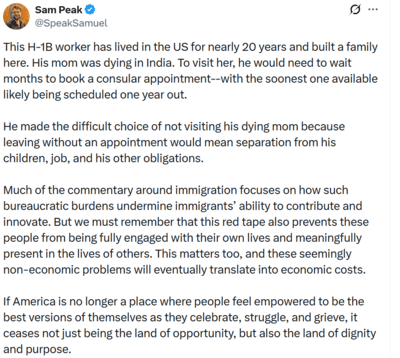
There are decisions that shape careers, and then there are decisions that stay with you for life. Sometimes, the hardest choices are not about ambition or success, but about moments you can never return to. Sam Peak, Labour and Mobility Policy Manager at the Economic Innovation Group in the USA, took to X and shared the story of a tech professional who has brought attention to a quieter, deeply personal cost of global careers, one that rarely makes it into conversations about opportunity, growth, or the promise of building a life far away from home.

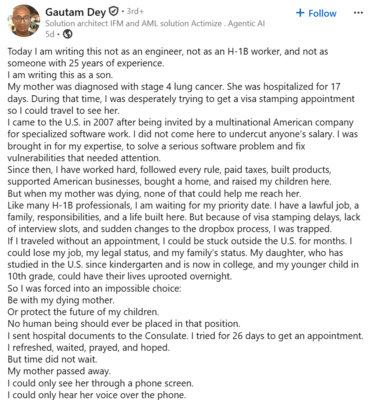
Gautam Dey, a techie, took to social media and shared his experience, not as an engineer or an H-1B worker, but as a son navigating a moment of profound loss. He wrote about his mother being diagnosed with stage 4 lung cancer and being hospitalised for 17 days. During that time, he was trying relentlessly to secure a visa stamping appointment that would allow him to travel from the United States to India to be by her side. Despite his efforts, the process did not move in time.
Dey explained that he had moved to the United States in 2007 after being invited by a multinational American company for specialised software work. He emphasised that his move was based on expertise, not cost advantage, and that he had spent years contributing to the system he became part of. Over the past two decades, he followed regulations, paid taxes, built products, supported businesses, and created a stable life for his family, including buying a home and raising his children in the country.
Yet, when his mother needed him the most, he found himself unable to act freely. Like many professionals on H-1B visas, he is still waiting for his priority date. His situation was complicated by visa stamping delays, limited interview availability, and changes in the dropbox process. Travelling without a confirmed appointment carried serious risks. He could have been stranded outside the United States for months, potentially losing his job, legal status, and the stability of his family.
He described the weight of that decision in deeply personal terms. On one side was his mother, asking for him during her final days. On the other hand was the future of his children, who had grown up in the United States, including a daughter now in college and a younger child in school. Leaving without certainty could have disrupted their entire lives overnight.
Dey shared that he tried everything within his control. He sent hospital documents to the consulate and spent 26 days attempting to secure an appointment, refreshing systems, waiting, hoping, and praying for a breakthrough that never came in time. His mother passed away before he could reach her.
He wrote that he could only see her through a phone screen and hear her voice remotely, a reality that has become his deepest regret. The experience, as he described it, is not about politics or assigning blame, but about the human cost that often remains unspoken in discussions about immigration and opportunity.
He reflected on how many professionals move abroad chasing the promise of growth and stability, contributing meaningfully to the economies they become part of. However, he pointed out that these systems can also create situations where individuals feel trapped at critical moments, unable to respond to personal crises without risking everything they have built.
Dey also addressed younger professionals who aspire to similar paths, encouraging them to think carefully about what success means. He noted that India today offers strong opportunities across technology, product development, and innovation, suggesting that building a meaningful career does not necessarily require leaving home.
His experience ultimately centres on a choice he never wanted to make, between being present for his mother’s final moments and safeguarding the future of his children, a choice he feels no one should ever be forced into, and one he says he will carry with him for the rest of his life.
Gautam Dey, a techie, took to social media and shared his experience, not as an engineer or an H-1B worker, but as a son navigating a moment of profound loss. He wrote about his mother being diagnosed with stage 4 lung cancer and being hospitalised for 17 days. During that time, he was trying relentlessly to secure a visa stamping appointment that would allow him to travel from the United States to India to be by her side. Despite his efforts, the process did not move in time.
Dey explained that he had moved to the United States in 2007 after being invited by a multinational American company for specialised software work. He emphasised that his move was based on expertise, not cost advantage, and that he had spent years contributing to the system he became part of. Over the past two decades, he followed regulations, paid taxes, built products, supported businesses, and created a stable life for his family, including buying a home and raising his children in the country.
Yet, when his mother needed him the most, he found himself unable to act freely. Like many professionals on H-1B visas, he is still waiting for his priority date. His situation was complicated by visa stamping delays, limited interview availability, and changes in the dropbox process. Travelling without a confirmed appointment carried serious risks. He could have been stranded outside the United States for months, potentially losing his job, legal status, and the stability of his family.
He described the weight of that decision in deeply personal terms. On one side was his mother, asking for him during her final days. On the other hand was the future of his children, who had grown up in the United States, including a daughter now in college and a younger child in school. Leaving without certainty could have disrupted their entire lives overnight.
Dey shared that he tried everything within his control. He sent hospital documents to the consulate and spent 26 days attempting to secure an appointment, refreshing systems, waiting, hoping, and praying for a breakthrough that never came in time. His mother passed away before he could reach her.
He wrote that he could only see her through a phone screen and hear her voice remotely, a reality that has become his deepest regret. The experience, as he described it, is not about politics or assigning blame, but about the human cost that often remains unspoken in discussions about immigration and opportunity.
He reflected on how many professionals move abroad chasing the promise of growth and stability, contributing meaningfully to the economies they become part of. However, he pointed out that these systems can also create situations where individuals feel trapped at critical moments, unable to respond to personal crises without risking everything they have built.
Dey also addressed younger professionals who aspire to similar paths, encouraging them to think carefully about what success means. He noted that India today offers strong opportunities across technology, product development, and innovation, suggesting that building a meaningful career does not necessarily require leaving home.
His experience ultimately centres on a choice he never wanted to make, between being present for his mother’s final moments and safeguarding the future of his children, a choice he feels no one should ever be forced into, and one he says he will carry with him for the rest of his life.
Next Story