
Homeward Ho! Indian professionals in West Asia looking east


Bengaluru: The escalating conflict in West Asia is prompting Indian professionals working in the region to reconsider their long-term plans, with several now actively exploring opportunities back home.
Executive search firms say enquiries from senior executives based in West Asia about roles in India have risen by 25% to 30% in recent days as safety concerns and uncertainty surrounding the conflict cloud career decisions.

Professionals ET spoke to said recent geopolitical developments have shaken their perception of the region as a stable career destination. A senior executive in the energy sector in the Middle East, who had earlier declined a chief operating officer role in India when approached by Transearch India, recently contacted the firm again after the conflict began, saying neither he nor his family see a safe future in the region.
"The current war has exploded the myth of the Middle East as a safe haven and there is a flight to safety. The number of Indian executives wanting to move back has surged," said Atul Vohra, managing partner of Transearch India.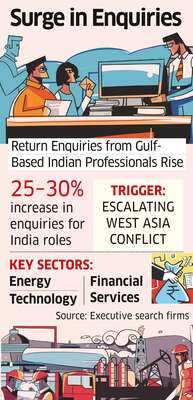 Several Indians in senior roles at another energy company, with operations across several Gulf countries, are seeking transfers to the company's India operations or exploring opportunities outside, said BTI Executive Search.
A mid-level professional working with a technology multinational in Qatar said he has begun applying for jobs in India as his elderly parents are worried about the situation. Another couple who moved to Dubai for work a few years ago are reassessing their future there. Frequent alerts asking civilians to take cover and stay away from windows and balconies are keeping residents on edge. "Although economic fundamentals of Gulf countries remain strong, yet the current situation has certainly pushed many professionals to look for safer harbours due to operational uncertainties and safety concerns," said James Agrawal, MD, BTI Executive Search.
Leena Rajput, head of financial services at Korn Ferry India, said the Middle East has started appearing in conversations with Indian professionals looking to return home. "That's quite interesting because traditionally the Middle East was a geography where candidates from India would ask us to help them find roles. Now, given the current geopolitical environment and the uncertainty it has created, some professionals based there are reconsidering their long-term plans and exploring opportunities back in India," said Rajput.
India's stronger economic growth and the emergence of global-scale leadership roles offering competitive pay have also made returning more attractive than in the past, experts said.
"Compensation is also becoming a major factor supporting this shift," said Rajput.
Earlier, professionals were hesitant to return because the financial gap between global markets and India was too large, but that gap has now narrowed significantly.
"As more global roles get anchored in India-particularly through GCCs-the professional and financial proposition of returning to India is becoming far more compelling," she said.
Executive search firms say enquiries from senior executives based in West Asia about roles in India have risen by 25% to 30% in recent days as safety concerns and uncertainty surrounding the conflict cloud career decisions.
Professionals ET spoke to said recent geopolitical developments have shaken their perception of the region as a stable career destination. A senior executive in the energy sector in the Middle East, who had earlier declined a chief operating officer role in India when approached by Transearch India, recently contacted the firm again after the conflict began, saying neither he nor his family see a safe future in the region.
"The current war has exploded the myth of the Middle East as a safe haven and there is a flight to safety. The number of Indian executives wanting to move back has surged," said Atul Vohra, managing partner of Transearch India.
A mid-level professional working with a technology multinational in Qatar said he has begun applying for jobs in India as his elderly parents are worried about the situation. Another couple who moved to Dubai for work a few years ago are reassessing their future there. Frequent alerts asking civilians to take cover and stay away from windows and balconies are keeping residents on edge. "Although economic fundamentals of Gulf countries remain strong, yet the current situation has certainly pushed many professionals to look for safer harbours due to operational uncertainties and safety concerns," said James Agrawal, MD, BTI Executive Search.
Leena Rajput, head of financial services at Korn Ferry India, said the Middle East has started appearing in conversations with Indian professionals looking to return home. "That's quite interesting because traditionally the Middle East was a geography where candidates from India would ask us to help them find roles. Now, given the current geopolitical environment and the uncertainty it has created, some professionals based there are reconsidering their long-term plans and exploring opportunities back in India," said Rajput.
India's stronger economic growth and the emergence of global-scale leadership roles offering competitive pay have also made returning more attractive than in the past, experts said.
"Compensation is also becoming a major factor supporting this shift," said Rajput.
Earlier, professionals were hesitant to return because the financial gap between global markets and India was too large, but that gap has now narrowed significantly.
"As more global roles get anchored in India-particularly through GCCs-the professional and financial proposition of returning to India is becoming far more compelling," she said.
Next Story