
India, Canada sign $2.6 billion uranium deal, target $50 billion trade by 2030 with CEPA push


New Delhi: India and Canada on Monday signed agreements on supplies of uranium and critical minerals and agreed to soon conclude a comprehensive economic partnership agreement (CEPA), with Prime Minister Narendra Modi and his counterpart Mark Carney finalising terms of reference for strengthening trade ties including targeting a nearly fourfold increase in bilateral annual trade to $50 billion by 2030.
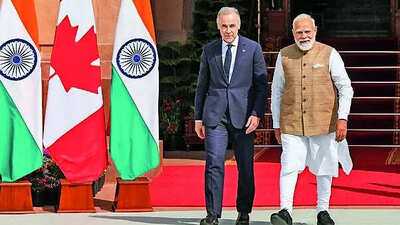
The leaders also pledged to ramp up cooperation in defence, critical technologies, small and modular nuclear reactors, education and renewable energy. Modi said after their wide-ranging talks that the relations between the two countries are now filled with new energy, mutual trust and positivity. The two sides concluded nine agreements, including a 10-year $2.6 billion contract for supply of uranium ore from Canada to India, and terms of reference for the launch of negotiations for an ambitious and mutually beneficial CEPA. Bilateral trade currently amounts to about $13 annually.
"Our goal is to reach USD 50 billion in trade by 2030. Unlocking the full potential of economic cooperation is our priority. Therefore, we have decided to finalise the comprehensive economic partnership agreement soon," Modi said at a joint press conference with Carney.
“This will create new investment and employment opportunities in both countries.” He said the memorandum of understanding on critical minerals will strengthen resilient supply chains.
Canada is known for its significant reservoir of critical minerals and rare earth materials.
Also Read: India, Canada seal $2.6 billion uranium deal, agree on economic partnership framework
The pact on critical minerals entails promotion of investment and identification of projects in both countries and facilitating exchange of technical knowledge and best practices in critical and strategic mineral exploration, mining, beneficiation and processing for efficient extraction.
Modi further said, "Canada's pension funds have invested $100 billion in India. This symbolises their deep belief in India's growth story... In the energy sector, we are building a next-generation partnership, which will focus on hydrocarbons as well as renewable energy, green hydrogen and energy storage... In civil nuclear energy, we have signed a landmark deal for long-term uranium supply. We will also work together on small modular reactors and advanced reactors."
In his remarks, Carney said, "Today, we are launching a strategic energy partnership with significant potential to expand bilateral energy trade. We've signed a new critical minerals partnership spanning development, processing and secure supply chains for clean energy, electric vehicles and advanced manufacturing."
The Canadian PM described the uranium supply agreement as a reflection of shared commitment to clean, reliable energy. "All of these agreements under one planet are the beginning of a new, prosperous relationship that will offer generational opportunities for workers and businesses in both their countries and which will protect the planet for future generations," he said.
Resetting relations
Carney landed in Delhi on Sunday after spending two days in Mumbai, where he met several business leaders. The agreements reached between the two sides marked progression in efforts to reset relations after a prolonged diplomatic standoff following the then Canadian PM Justin Trudeau’s statement in parliament in 2023 alleging a potential Indian link to the killing of a Canadian Sikh separatist in British Columbia, a charge that India dismissed.
The developments also come at a time when Canada is seeking to diversify its trade ties amid tense relations with the US. Modi and Carney welcomed the relaunch of the Canada–India Ministerial Energy Dialogue at India Energy Week 2026 as a key institutional platform to sustain high-level policy dialogue and strengthen strategic cooperation on energy security, diversification of supply and long-term market integration.
They also welcomed the finalisation of a joint action plan under the dialogue. The leaders also highlighted the potential to broaden cooperation across clean energy and climaterelated value chains, including renewable energy, hydrogen and its derivatives, biofuels, sustainable aviation fuel, battery storage and electricity systems modernisation, recognising the central role of these sectors in advancing shared climate objectives and energy transition goals.
The two leaders noted that strengthened institutional engagement would support expanded bilateral energy trade, including in liquefied natural gas (LNG), liquefied petroleum gas (LPG), crude oil, refined petroleum products, potash and uranium supply offtakes.
In this regard, they welcomed the conclusion of a commercial agreement between Cameco and the Department of Atomic Energy for the long-term supply of uranium, contributing to India’s civil nuclear energy generation, clean energy transition objectives and long-term energy security. The leaders noted that Canada is poised to become a major global supplier of LNG and welcomed India’s intention to source LNG from Canada.
The leaders also pledged to ramp up cooperation in defence, critical technologies, small and modular nuclear reactors, education and renewable energy. Modi said after their wide-ranging talks that the relations between the two countries are now filled with new energy, mutual trust and positivity. The two sides concluded nine agreements, including a 10-year $2.6 billion contract for supply of uranium ore from Canada to India, and terms of reference for the launch of negotiations for an ambitious and mutually beneficial CEPA. Bilateral trade currently amounts to about $13 annually.
"Our goal is to reach USD 50 billion in trade by 2030. Unlocking the full potential of economic cooperation is our priority. Therefore, we have decided to finalise the comprehensive economic partnership agreement soon," Modi said at a joint press conference with Carney.
“This will create new investment and employment opportunities in both countries.” He said the memorandum of understanding on critical minerals will strengthen resilient supply chains.
Canada is known for its significant reservoir of critical minerals and rare earth materials.
Also Read: India, Canada seal $2.6 billion uranium deal, agree on economic partnership framework
The pact on critical minerals entails promotion of investment and identification of projects in both countries and facilitating exchange of technical knowledge and best practices in critical and strategic mineral exploration, mining, beneficiation and processing for efficient extraction.
Modi further said, "Canada's pension funds have invested $100 billion in India. This symbolises their deep belief in India's growth story... In the energy sector, we are building a next-generation partnership, which will focus on hydrocarbons as well as renewable energy, green hydrogen and energy storage... In civil nuclear energy, we have signed a landmark deal for long-term uranium supply. We will also work together on small modular reactors and advanced reactors."
In his remarks, Carney said, "Today, we are launching a strategic energy partnership with significant potential to expand bilateral energy trade. We've signed a new critical minerals partnership spanning development, processing and secure supply chains for clean energy, electric vehicles and advanced manufacturing."
The Canadian PM described the uranium supply agreement as a reflection of shared commitment to clean, reliable energy. "All of these agreements under one planet are the beginning of a new, prosperous relationship that will offer generational opportunities for workers and businesses in both their countries and which will protect the planet for future generations," he said.
Resetting relations
Carney landed in Delhi on Sunday after spending two days in Mumbai, where he met several business leaders. The agreements reached between the two sides marked progression in efforts to reset relations after a prolonged diplomatic standoff following the then Canadian PM Justin Trudeau’s statement in parliament in 2023 alleging a potential Indian link to the killing of a Canadian Sikh separatist in British Columbia, a charge that India dismissed.
The developments also come at a time when Canada is seeking to diversify its trade ties amid tense relations with the US. Modi and Carney welcomed the relaunch of the Canada–India Ministerial Energy Dialogue at India Energy Week 2026 as a key institutional platform to sustain high-level policy dialogue and strengthen strategic cooperation on energy security, diversification of supply and long-term market integration.
They also welcomed the finalisation of a joint action plan under the dialogue. The leaders also highlighted the potential to broaden cooperation across clean energy and climaterelated value chains, including renewable energy, hydrogen and its derivatives, biofuels, sustainable aviation fuel, battery storage and electricity systems modernisation, recognising the central role of these sectors in advancing shared climate objectives and energy transition goals.
The two leaders noted that strengthened institutional engagement would support expanded bilateral energy trade, including in liquefied natural gas (LNG), liquefied petroleum gas (LPG), crude oil, refined petroleum products, potash and uranium supply offtakes.
In this regard, they welcomed the conclusion of a commercial agreement between Cameco and the Department of Atomic Energy for the long-term supply of uranium, contributing to India’s civil nuclear energy generation, clean energy transition objectives and long-term energy security. The leaders noted that Canada is poised to become a major global supplier of LNG and welcomed India’s intention to source LNG from Canada.
Next Story