
India is conducting exercise for mapping import reliance


New Delhi: India has begun an exercise to map gaps in its manufacturing base and identify import reliance.
The Department for Promotion of Industry and Internal Trade (DPIIT) is drawing up a list of commonly procured goods across various ministries and departments in which local manufacturing is unavailable to estimate the scale of imports. "To estimate the public procurement of these goods, the DPIIT will collate the data from all ministries," said an official, adding that a consolidated five-year procurement plan for such items would be made.
Also read: India won't be importing 80% of its energy in next decade
India's goods imports in April-January FY26 were almost $650 billion with China being the top source with $108.18 billion of inbound shipments coming from Beijing. "Various departments will also give their inputs to arrive at increased local content thresholds for individual departments and items," the official added.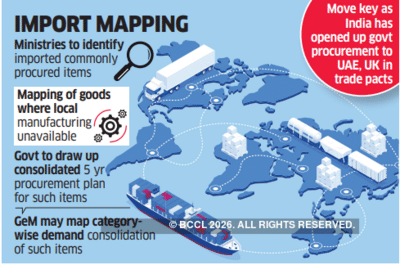 Separately, talks are also on to explore if the Government e-Marketplace (GeM) can develop a system for category-wise demand consolidation of such items, mapped to the relevant import-export tariff code, called HSN code.
Also read: Procurement from GeM portal crosses Rs 4 lakh crore in FY'26, to surpass last year's level: Official
GeM is India's national procurement portal, which was launched on August 9, 2016, in place of Directorate General of Supplies and Disposal. It aims to create an open and transparent procurement platform of commonly used goods and services for all government departments, ministries and public sector firms. Since its launch, over ₹17.33 lakh crore worth of government procurement has happened through it. The exercise to map the imports assumes significance as for the first time, India has opened its central government procurement for the UAE and British companies under the respective trade deals signed with them, subject to certain conditions.
New Delhi will open approximately 40,000 high-value contracts from central ministries and departments in sectors such as transport, green energy and infrastructure to British bidders under its trade deal with the UK. British firms will be allowed to participate through India's Central Public Procurement Portal and the GeM and will be granted national treatment for all covered procurements.
UK-origin goods with just 20% domestic content will be treated as 'Class II' local suppliers under India's Public Procurement Order, a classification previously reserved for Indian suppliers with 20-50% local content under the Comprehensive Economic and Trade Agreement.
The Department for Promotion of Industry and Internal Trade (DPIIT) is drawing up a list of commonly procured goods across various ministries and departments in which local manufacturing is unavailable to estimate the scale of imports. "To estimate the public procurement of these goods, the DPIIT will collate the data from all ministries," said an official, adding that a consolidated five-year procurement plan for such items would be made.
Also read: India won't be importing 80% of its energy in next decade
India's goods imports in April-January FY26 were almost $650 billion with China being the top source with $108.18 billion of inbound shipments coming from Beijing. "Various departments will also give their inputs to arrive at increased local content thresholds for individual departments and items," the official added.
Also read: Procurement from GeM portal crosses Rs 4 lakh crore in FY'26, to surpass last year's level: Official
GeM is India's national procurement portal, which was launched on August 9, 2016, in place of Directorate General of Supplies and Disposal. It aims to create an open and transparent procurement platform of commonly used goods and services for all government departments, ministries and public sector firms. Since its launch, over ₹17.33 lakh crore worth of government procurement has happened through it. The exercise to map the imports assumes significance as for the first time, India has opened its central government procurement for the UAE and British companies under the respective trade deals signed with them, subject to certain conditions.
New Delhi will open approximately 40,000 high-value contracts from central ministries and departments in sectors such as transport, green energy and infrastructure to British bidders under its trade deal with the UK. British firms will be allowed to participate through India's Central Public Procurement Portal and the GeM and will be granted national treatment for all covered procurements.
UK-origin goods with just 20% domestic content will be treated as 'Class II' local suppliers under India's Public Procurement Order, a classification previously reserved for Indian suppliers with 20-50% local content under the Comprehensive Economic and Trade Agreement.
Next Story