
India, US may sign formal trade pact by mid-March


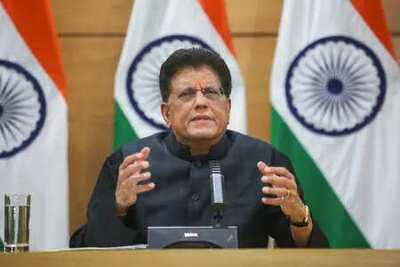
NEW DELHI: India and the US are expected to finalise and sign a joint statement on the first part of the proposed bilateral trade agreement (BTA) in four-five days and aim to conclude a formal, legally binding pact by midMarch, commerce and industry minister Piyush Goyal said Thursday.
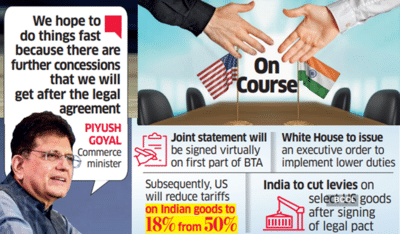
“India and the US are having a meaningful dialogue. The first tranche of the BTA is almost ready. We will finalise and sign the joint statement in fourfive days. Based on the joint statement, the next leg of the partnership will start,” Goyal said.
The formal agreement is being drafted, a process that may take a month or a month and a half. “We plan to sign the formal agreement by mid-March,” he said. The minister ruled out any investment commitments in the pact.
The US will slash tariffs on India to 18% from 50% after the joint statement is signed virtually on the first part of the BTA. Washington will issue an executive order to implement the lower tariffs on India a day or two after the joint statement. “Indian tariff reductions (will happen) only after a legal agreement,” said commerce secretary Rajesh Agrawal. Indian tariffs are most favoured nation (MFN) levies and US import duties are executive tariffs, he said.
A Key Milestone
“We hope to do things fast because there are further concessions that we will get after the legal agreement,” Goyal said.
Also Read: India sets sail to add more trade muscle as it signs FTA terms with Gulf Cooperation Council
Prime Minister Narendra Modi and US president Donald Trump announced the trade deal on Monday. This had been preceded by longdrawn negotiations and marred by Trump’s decision to slap 50% tariffs on Indian goods in August, half of that being a penalty for buying Russian oil that’s also being dropped.
“Out of friendship and respect for Prime Minister Modi and, as per his request, effective immediately, we agreed to a Trade Deal between the United States and India, whereby the United States will charge a reduced Reciprocal Tariff, lowering it from 25% to 18%,” Trump had said in his post on Truth Social Monday.
Modi had welcomed the move.
“Delighted that Made in India products will now have a reduced tariff of 18%,” he posted on X on Monday.
“When two large economies and the world’s largest democracies work together, it benefits our people and unlocks immense opportunities for mutually beneficial cooperation.”
'US-India trade deal in final stages', says Jaishankar; expected to be completed 'soon'
Calling the accord a milestone, Goyal said India has already entered into a record eight trade agreements, and the first part of the BTA with the US will soon become the ninth.
The US is India’s largest export destination. India exported goods worth $86.5 billion to the US in FY25 while importing goods worth $45.6 billion.
$500 BILLION PURCHASES
Purchases of US goods worth $500 billion, which Trump had mentioned in his posts, exclude agriculture, Indian officials said.
The minister said to meet the $500 billion bilateral trade target as set out in February 2025, India will certainly need to step up exports and sourcing.
The US is expected to emerge as a major supplier with a 25% share in India’s estimated procurement of $2 trillion in five years of oil, LPG, LNG, aircraft, smartphones, laptops, semiconductor components and data centre equipment. India currently buys $300 billion of these products annually from several countries.
Given India’s rapid growth pace, the country will need large volumes of energy, data centre equipment, and ICT (information and communication technology) products, Goyal said.
“Our steel capacity will double from today's 140 million tonnes to about 300 million tonnes in the next few years,” Goyal said. “And therefore, when we estimated what we will need from the US, we came to a figure of at least $500 billion. We can clearly see before our eyes the potential that we can procure from the US over the next five years.”
India’s aircraft orders could account for a big chunk.
“Orders placed on Boeing, and yet to be placed but ready, are nearly $70-80 billion. If you add the engines and other spare parts, it will probably cost $100 billion,” Goyal said, while pointing out that the budget had announced substantial concessions for data centres.
“India and the US are having a meaningful dialogue. The first tranche of the BTA is almost ready. We will finalise and sign the joint statement in fourfive days. Based on the joint statement, the next leg of the partnership will start,” Goyal said.
The formal agreement is being drafted, a process that may take a month or a month and a half. “We plan to sign the formal agreement by mid-March,” he said. The minister ruled out any investment commitments in the pact.
The US will slash tariffs on India to 18% from 50% after the joint statement is signed virtually on the first part of the BTA. Washington will issue an executive order to implement the lower tariffs on India a day or two after the joint statement. “Indian tariff reductions (will happen) only after a legal agreement,” said commerce secretary Rajesh Agrawal. Indian tariffs are most favoured nation (MFN) levies and US import duties are executive tariffs, he said.
A Key Milestone
“We hope to do things fast because there are further concessions that we will get after the legal agreement,” Goyal said.
Also Read: India sets sail to add more trade muscle as it signs FTA terms with Gulf Cooperation Council
Prime Minister Narendra Modi and US president Donald Trump announced the trade deal on Monday. This had been preceded by longdrawn negotiations and marred by Trump’s decision to slap 50% tariffs on Indian goods in August, half of that being a penalty for buying Russian oil that’s also being dropped.
“Out of friendship and respect for Prime Minister Modi and, as per his request, effective immediately, we agreed to a Trade Deal between the United States and India, whereby the United States will charge a reduced Reciprocal Tariff, lowering it from 25% to 18%,” Trump had said in his post on Truth Social Monday.
Modi had welcomed the move.
“Delighted that Made in India products will now have a reduced tariff of 18%,” he posted on X on Monday.
“When two large economies and the world’s largest democracies work together, it benefits our people and unlocks immense opportunities for mutually beneficial cooperation.”
'US-India trade deal in final stages', says Jaishankar; expected to be completed 'soon'
Calling the accord a milestone, Goyal said India has already entered into a record eight trade agreements, and the first part of the BTA with the US will soon become the ninth.
The US is India’s largest export destination. India exported goods worth $86.5 billion to the US in FY25 while importing goods worth $45.6 billion.
$500 BILLION PURCHASES
Purchases of US goods worth $500 billion, which Trump had mentioned in his posts, exclude agriculture, Indian officials said.
The minister said to meet the $500 billion bilateral trade target as set out in February 2025, India will certainly need to step up exports and sourcing.
The US is expected to emerge as a major supplier with a 25% share in India’s estimated procurement of $2 trillion in five years of oil, LPG, LNG, aircraft, smartphones, laptops, semiconductor components and data centre equipment. India currently buys $300 billion of these products annually from several countries.
Given India’s rapid growth pace, the country will need large volumes of energy, data centre equipment, and ICT (information and communication technology) products, Goyal said.
“Our steel capacity will double from today's 140 million tonnes to about 300 million tonnes in the next few years,” Goyal said. “And therefore, when we estimated what we will need from the US, we came to a figure of at least $500 billion. We can clearly see before our eyes the potential that we can procure from the US over the next five years.”
India’s aircraft orders could account for a big chunk.
“Orders placed on Boeing, and yet to be placed but ready, are nearly $70-80 billion. If you add the engines and other spare parts, it will probably cost $100 billion,” Goyal said, while pointing out that the budget had announced substantial concessions for data centres.
Next Story