
Microfinance in revival mode; MFIs, private banks expand business in January


Kolkata: Private banks and non-banking financial companies-microfinance institutions (NBFC-MFIs) have expanded their respective cumulative microfinance portfolios in January compared with December, as the sector lending to the bottom of the pyramid appears to have begun a phase of consolidation after an eight-quarter stress.
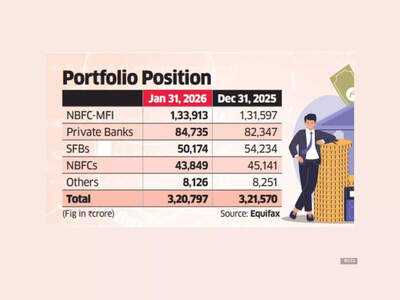
Equifax monthly data reviewed by ET shows that NBFC-MFIs' portfolio rose to '1.34 lakh crore at the end of January, from '1.32 lakh crore a month ago, while the portfolio of private banks increased to '84,735 crore from '82,347 crore.

The overall microfinance market, however, slipped further to '3.21 lakh crore from '3.22 lakh crore as declines at small finance banks and NBFCs offset gains by private banks and NBFC-MFIs, data showed. Although the pace of contraction of the overall market moderated.
"With stabilising asset quality and gradual liquidity normalisation, we expect the overall microfinance market to return to a normal growth trajectory by the end of Q1 FY27," Microfinance Industry Network chief executive Alok Misra told ET.
JM Financial called the current phase an inflection point. "The industry has moved from a phase of rapid balance sheet contraction and stress recognition to one of stabilisation with gradual recovery," it observed in a report. However, while the NBFC-MFIs as a group showed portfolio growth, medium and small entities are struggling. "Large NBFC-MFIs are exhibiting early signs of stabilisation and recovery, whereas medium and small NBFC-MFIs continue to register a sustained decline, indicating that while larger institutions are beginning to regain momentum, funding constraints continue to weigh heavily on small and medium MFIs," Misra said.
The Equifax data also showed improvement in early delinquency while the delinquency ratio for aged loans rose. "Asset quality showed a positive trend with a steady decline in 30+ delinquency across all lender categories. Notably, NBFCs and NBFC-MFIs reported lower delinquency levels compared to the overall industry," the credit bureau said in the January snapshot. The 30+ days past due, which reflects the ratio of loans that remained unpaid for more than 30 days to 179 days, declined 54 basis points month-on-month to 3.4%. The ratio of loans that remained unpaid for more than 180 days however rose 92 basis points to 17%.
"Delinquency trends suggest peak stress is likely behind," JM Financial said. "Early bucket indicators have improved sequentially and now stand at their lowest levels since FY24. The improvement is broad-based across states and lender categories. Regions that exhibited elevated delinquency- in parts of eastern and southern India - have shown meaningful improvement in early-to-mid stage buckets," it added.
Equifax monthly data reviewed by ET shows that NBFC-MFIs' portfolio rose to '1.34 lakh crore at the end of January, from '1.32 lakh crore a month ago, while the portfolio of private banks increased to '84,735 crore from '82,347 crore.
The overall microfinance market, however, slipped further to '3.21 lakh crore from '3.22 lakh crore as declines at small finance banks and NBFCs offset gains by private banks and NBFC-MFIs, data showed. Although the pace of contraction of the overall market moderated.
"With stabilising asset quality and gradual liquidity normalisation, we expect the overall microfinance market to return to a normal growth trajectory by the end of Q1 FY27," Microfinance Industry Network chief executive Alok Misra told ET.
JM Financial called the current phase an inflection point. "The industry has moved from a phase of rapid balance sheet contraction and stress recognition to one of stabilisation with gradual recovery," it observed in a report. However, while the NBFC-MFIs as a group showed portfolio growth, medium and small entities are struggling. "Large NBFC-MFIs are exhibiting early signs of stabilisation and recovery, whereas medium and small NBFC-MFIs continue to register a sustained decline, indicating that while larger institutions are beginning to regain momentum, funding constraints continue to weigh heavily on small and medium MFIs," Misra said.
The Equifax data also showed improvement in early delinquency while the delinquency ratio for aged loans rose. "Asset quality showed a positive trend with a steady decline in 30+ delinquency across all lender categories. Notably, NBFCs and NBFC-MFIs reported lower delinquency levels compared to the overall industry," the credit bureau said in the January snapshot. The 30+ days past due, which reflects the ratio of loans that remained unpaid for more than 30 days to 179 days, declined 54 basis points month-on-month to 3.4%. The ratio of loans that remained unpaid for more than 180 days however rose 92 basis points to 17%.
"Delinquency trends suggest peak stress is likely behind," JM Financial said. "Early bucket indicators have improved sequentially and now stand at their lowest levels since FY24. The improvement is broad-based across states and lender categories. Regions that exhibited elevated delinquency- in parts of eastern and southern India - have shown meaningful improvement in early-to-mid stage buckets," it added.
Next Story