
No cultural taboo: The rich go for gold loan as metal soars


India's gold loan market is going through a structural shift. From a niche, distress-driven product, gold loans have emerged as a mainstream, high-value financing tool used by more affluent borrowers. Loans above ₹5 lakh each now form more than a third of the total value of new loans. This indicates that wealthier borrowers are pledging household jewellery for business and investment, shedding a cultural taboo.

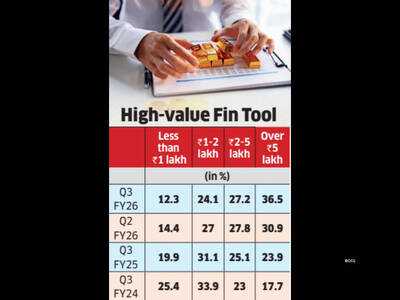
Data published by Crif High Mark showed that the share of loans of more than ₹5 lakh each more than doubled to 36.5% at the end of December 2025 from 17.7% two years earlier.
The share of gold loans in the ₹2.5-5 lakh band increased to 27.2% in the third quarter of this financial year from 23% in the preceding three-month period. Sub-₹1 lakh loans accounted for 12.3% of originations value, down sharply from 25.4% two years ago.
"This is reflecting deeper penetration among wealthier borrowers and greater reliance on higher-ticket loans for business and investment," the credit bureau said.
Another credit score company, Experian, said that the ₹3 lakh-plus ticket size band saw an increase in its share to 56% in December from 44% a year ago. Gold loans from banks and non-bank lenders have seen the biggest surge in the retail loan pie, increasing 44% year-on-year to ₹16.1 lakh crore.
The segment now constitutes 10% of India's retail loans market.
Jefferies estimated that the proportion of household gold stock pledged with organised lenders rose to 8% from 7% in 2023-24.
The growth has largely been driven by increased gold prices, which allowed higher borrowing against the pledged yellow metal.
A shift in demand away from unsecured credit to gold loans and recent regulatory developments affording higher loan-to-value norms and flexibility on branch network expansion will further support growth prospects, said Crisil Ratings director Aparna Kirubakaran.
"Growth remained broad-based across states, with all major markets delivering double-digit year-on-year expansion," Crif High Mark said.
Uttar Pradesh led with 68% growth, followed by Rajasthan (56%) and Telangana (55%). Portfolio quality also improved across most states, with Kerala maintaining one of the lowest credit risks.
Public sector banks remain the largest contributors to originations value, though their share moderated to 46% in the third quarter of this fiscal from 51% in the second quarter.
Non-banking financial companies, meanwhile, captured nearly half of the overall volume of originations, driven particularly by gold-loan focused players.
Data published by Crif High Mark showed that the share of loans of more than ₹5 lakh each more than doubled to 36.5% at the end of December 2025 from 17.7% two years earlier.
The share of gold loans in the ₹2.5-5 lakh band increased to 27.2% in the third quarter of this financial year from 23% in the preceding three-month period. Sub-₹1 lakh loans accounted for 12.3% of originations value, down sharply from 25.4% two years ago.
"This is reflecting deeper penetration among wealthier borrowers and greater reliance on higher-ticket loans for business and investment," the credit bureau said.
Another credit score company, Experian, said that the ₹3 lakh-plus ticket size band saw an increase in its share to 56% in December from 44% a year ago. Gold loans from banks and non-bank lenders have seen the biggest surge in the retail loan pie, increasing 44% year-on-year to ₹16.1 lakh crore.
The segment now constitutes 10% of India's retail loans market.
Jefferies estimated that the proportion of household gold stock pledged with organised lenders rose to 8% from 7% in 2023-24.
The growth has largely been driven by increased gold prices, which allowed higher borrowing against the pledged yellow metal.
A shift in demand away from unsecured credit to gold loans and recent regulatory developments affording higher loan-to-value norms and flexibility on branch network expansion will further support growth prospects, said Crisil Ratings director Aparna Kirubakaran.
"Growth remained broad-based across states, with all major markets delivering double-digit year-on-year expansion," Crif High Mark said.
Uttar Pradesh led with 68% growth, followed by Rajasthan (56%) and Telangana (55%). Portfolio quality also improved across most states, with Kerala maintaining one of the lowest credit risks.
Public sector banks remain the largest contributors to originations value, though their share moderated to 46% in the third quarter of this fiscal from 51% in the second quarter.
Non-banking financial companies, meanwhile, captured nearly half of the overall volume of originations, driven particularly by gold-loan focused players.
Next Story