
US to give yarn, cotton benefits to India, as with Bangladesh: Piyush Goyal


India will get concessional duty access for garments made using American yarn and cotton under its trade agreement with the US, similar to the benefits currently provided to Bangladesh, once the proposed interim trade agreement with Washington is signed, commerce and industry minister Piyush Goyal said on Thursday. He also said US businesses are now looking at India as a trusted partner.
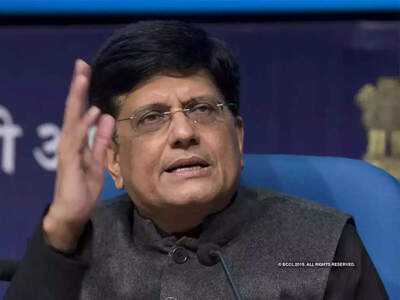
“Whatever Bangladesh has got, India will also get in the final agreement,” said Goyal on the sidelines of a startup event. India and the US have finalised a framework for the first phase of the bilateral trade agreement that’s likely to be implemented in March.
Indian companies that procure yarn from the US to make garments and re-export these back will get duty-free access, just like Bangladeshi companies, he said. That’s part of the US-Bangladesh agreement and “will be in our agreement also,” Goyal said, adding that it will not have any impact on Indian cotton farmers.
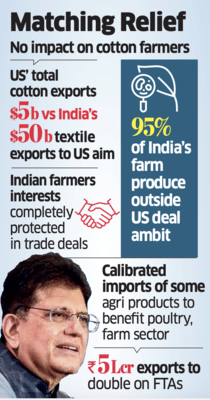 The US has limited cotton production; its exports amount to $5 billion, For India, the target is $50 billion, he noted. “Right now, our framework agreement is being made. When the interim agreement is finalised, then you will get to see this in the fine print,” said the minister.
No Raw Material Imports Quota
“Just as Bangladesh has a facility that if raw material is purchased from America, then if you process it and make cloth and export it, then it will be available at zero reciprocal tariff, India also has the same facility and India will also get it,” said Goyal.
There will be no quota on the import of raw materials such as cotton.
The US-Bangladesh reciprocal trade pact allows tariff-free exports of apparel and textiles to America if the manufacturer uses US-produced cotton or man-made fibre inputs. Under the pact, Washington will lower reciprocal tariffs on Bangladesh to 19% from 20%, a move that halves the tariff differential between New Delhi and Dhaka to 1%.
Bangladesh is the world’s second-largest garment manufacturer and India’s key competitor in the US textile and apparel market apart from China and Vietnam. Bangladesh-made garments now face a 31% levy, of which 12% is for most favoured nation-plus and 19% is the reciprocal tariff. If it uses US fibres, the duty falls to 12%.
“What India needs and what we import even now and items that will not hurt farmers in India in any way, only those items have been opened in a calibrated manner after careful consideration. This will also benefit India in a way and farmers also," the minister added.
“Indian farmers will also get the benefit that many such products will be exported to America, the EU, the UK, Switzerland, Norway, and Australia in large quantities,” Goyal said.
“The Rs 5 lakh crore that we export today will become an export of Rs 10 lakh crore.” The minister said the interests of India and its farmers have been fully protected in the US-India trade deal. “Almost 90- 95% of the produce of farmers is outside the US trade deal and which is the need of India, which we import even today,” he said. Most of the products of Indian farmers, dairy, poultry, rice, wheat, soyabean and maize, banana, strawberry, cherry, orange, vegetables, ethanol, tobacco, meat, pulses, millets, bajra, ragi are out of the ambit of the deal, he said.
Goyal said, “In a way, a very good US trade deal is made in the interests of farmers.”
ENTREPRENEURIAL & TECH TALK
In his address at the startup event, Goyal said India’s trade agreements now cover 70% of the world's gross domestic product. He asked the industry for suggestions on ways in which founders can retain greater equity ownership.
“The original startups are left with low equity and in the success story, they get a low share,” Goyal said.
He also said free trade agreements (FTAs) will provide substantial market access at concessional duties to the domestic medical devices industry. Certain Indian medical devices will also get duty concessions in some pacts.
“We are opening developed markets through the nine FTAs, which cover 38 countries with rich people and high per capita incomes,” the minister said.
He suggested states such as Rajasthan and Uttar Pradesh look for sites to establish a medtech zone similar to the AMTZ in Andhra Pradesh. Goyal added that the National Industrial Corridor Development Corp can look at reserving 50-100 acres for medical device units.
At a separate event on Niti Frontier Tech Hub’s roadmap report, he said India should be hosting the maximum data centre capacity in the world.
Referring to countries who are offering data centres powered by clean energy and talking of the feed-in banking of energy, or feed-in energy worth equivalent of 24-hour consumption, he said, “If I was to be allowed to do that, I would never have to pay a carbon border adjustment mechanism, because everything I sell to Europe would have been out of that 250 gigawatt of renewable power, I'll say, I banked all of that and use it to produce for Europe…India is offering is 24-hour clean energy round the clock.”
On artificial intelligence, he said, “I've told all my team, spend whatever it takes, but remain abreast with the most modern version…So even in my in my talking points, on two or three occasions, they've attributed it to Perplexity.”
“Whatever Bangladesh has got, India will also get in the final agreement,” said Goyal on the sidelines of a startup event. India and the US have finalised a framework for the first phase of the bilateral trade agreement that’s likely to be implemented in March.
Indian companies that procure yarn from the US to make garments and re-export these back will get duty-free access, just like Bangladeshi companies, he said. That’s part of the US-Bangladesh agreement and “will be in our agreement also,” Goyal said, adding that it will not have any impact on Indian cotton farmers.
No Raw Material Imports Quota
“Just as Bangladesh has a facility that if raw material is purchased from America, then if you process it and make cloth and export it, then it will be available at zero reciprocal tariff, India also has the same facility and India will also get it,” said Goyal.
There will be no quota on the import of raw materials such as cotton.
The US-Bangladesh reciprocal trade pact allows tariff-free exports of apparel and textiles to America if the manufacturer uses US-produced cotton or man-made fibre inputs. Under the pact, Washington will lower reciprocal tariffs on Bangladesh to 19% from 20%, a move that halves the tariff differential between New Delhi and Dhaka to 1%.
Bangladesh is the world’s second-largest garment manufacturer and India’s key competitor in the US textile and apparel market apart from China and Vietnam. Bangladesh-made garments now face a 31% levy, of which 12% is for most favoured nation-plus and 19% is the reciprocal tariff. If it uses US fibres, the duty falls to 12%.
“What India needs and what we import even now and items that will not hurt farmers in India in any way, only those items have been opened in a calibrated manner after careful consideration. This will also benefit India in a way and farmers also," the minister added.
“Indian farmers will also get the benefit that many such products will be exported to America, the EU, the UK, Switzerland, Norway, and Australia in large quantities,” Goyal said.
“The Rs 5 lakh crore that we export today will become an export of Rs 10 lakh crore.” The minister said the interests of India and its farmers have been fully protected in the US-India trade deal. “Almost 90- 95% of the produce of farmers is outside the US trade deal and which is the need of India, which we import even today,” he said. Most of the products of Indian farmers, dairy, poultry, rice, wheat, soyabean and maize, banana, strawberry, cherry, orange, vegetables, ethanol, tobacco, meat, pulses, millets, bajra, ragi are out of the ambit of the deal, he said.
Goyal said, “In a way, a very good US trade deal is made in the interests of farmers.”
ENTREPRENEURIAL & TECH TALK
In his address at the startup event, Goyal said India’s trade agreements now cover 70% of the world's gross domestic product. He asked the industry for suggestions on ways in which founders can retain greater equity ownership.
“The original startups are left with low equity and in the success story, they get a low share,” Goyal said.
He also said free trade agreements (FTAs) will provide substantial market access at concessional duties to the domestic medical devices industry. Certain Indian medical devices will also get duty concessions in some pacts.
“We are opening developed markets through the nine FTAs, which cover 38 countries with rich people and high per capita incomes,” the minister said.
He suggested states such as Rajasthan and Uttar Pradesh look for sites to establish a medtech zone similar to the AMTZ in Andhra Pradesh. Goyal added that the National Industrial Corridor Development Corp can look at reserving 50-100 acres for medical device units.
At a separate event on Niti Frontier Tech Hub’s roadmap report, he said India should be hosting the maximum data centre capacity in the world.
Referring to countries who are offering data centres powered by clean energy and talking of the feed-in banking of energy, or feed-in energy worth equivalent of 24-hour consumption, he said, “If I was to be allowed to do that, I would never have to pay a carbon border adjustment mechanism, because everything I sell to Europe would have been out of that 250 gigawatt of renewable power, I'll say, I banked all of that and use it to produce for Europe…India is offering is 24-hour clean energy round the clock.”
On artificial intelligence, he said, “I've told all my team, spend whatever it takes, but remain abreast with the most modern version…So even in my in my talking points, on two or three occasions, they've attributed it to Perplexity.”
Next Story