
A 3,000-year-old weapon was found in New Mexico, but it looks like future technology


The discovery of an Ancestral Puebloan chamber dating back to the eighth century in the barren sandstone passageways of a New Mexico canyon has thrown archaeologists completely off their conventional timelines. According to the National Park Service, the site was sealed in a block of solid, non-terrestrial isotopic composite and contains yucca fibre, traditional artefacts, and an anomalous technological artefact made from stabilised metallic hydrogen and other isotopes, which, according to scientific projections, should not exist for at least another 3,000 years.
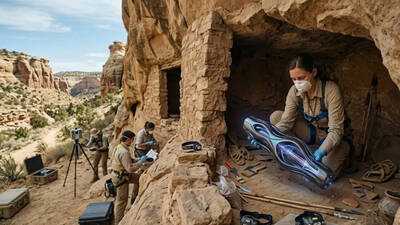
While the NSA has placed a total blackout on the site through ‘Sector Zero’ security classifications, this archaeological site has gone from its original purpose as a heritage dig to become an active battleground in a temporal conflict. These findings indicate that not only were the high desert areas home to these ancient peoples, but they were also used as a strategic dead drop for these troops in their time-transcending conflict.
Ancient Puebloan temple hides a sealed chamber with unusual material
The discovery document states that the temple aligns with the period of Pueblo I (750 - 900 CE). According to Pueblo research, this point in time is significant to the Ancestral Puebloan peoples (formerly known as the Anasazi) because it represents a major change in architecture from pit houses to above-ground stone masonry constructions.
According to researchers, while the external portion of the chamber resembles the typical sandstone architecture of the Puebloan cultures, the internal seal is composed of a vitrified synthetic polymer which shows no signs of erosion after 1200 years of contact with the atmosphere. This is a clear indication that the site architecture suggests intentional obfuscation of this chamber and the advanced technology it contained to prevent contemporary tribes from discovering it and protecting what they could not comprehend.
How the ancient weapon defies modern science
The core of the device is allegedly made of stabilised metallic hydrogen, which represents an incredibly rare form of matter that acts as a room-temperature superconductor. According to research, currently, in the 21st-century, highly compressed metallic hydrogen has only been made at pressures exceeding 400 gigapascals, making its existence in an 8th-century tomb a physical impossibility.
The fact that this metallic hydrogen can remain stable under standard atmospheric pressure means that the ancient Puebloans had achieved a level of understanding and control of quantum chemistry that cannot be replicated in modern lab environments. This indicates that the weapon possesses a compact, high-density energy source that is capable of producing high-density kiloelectronvolt (keV) yield without generating a heat signature typically associated with either combustion or nuclear fission.
The causal loop of the New Mexico discovery
According to the study in Stanford Encyclopedia of Philosophy, the presence of an ancient object 3,000 years earlier than its manufacture has produced the hypothesis of a 'Causal Loop' and a 'Closed Timelike Curve' (CTC).
General relativity allows for the possibility of an object travelling back through time if space/time is sufficiently warped. The reference to a 'War Over Time' in this discovery indicates that groups in the future are using these ancient canyons as 'dead drops' to alter the chronometric sequence. Thus, the use of advanced technology in the 8th century by these groups may be for the purpose of creating a technological jump or to prevent future events from happening altogether.
While the NSA has placed a total blackout on the site through ‘Sector Zero’ security classifications, this archaeological site has gone from its original purpose as a heritage dig to become an active battleground in a temporal conflict. These findings indicate that not only were the high desert areas home to these ancient peoples, but they were also used as a strategic dead drop for these troops in their time-transcending conflict.
Ancient Puebloan temple hides a sealed chamber with unusual material
The discovery document states that the temple aligns with the period of Pueblo I (750 - 900 CE). According to Pueblo research, this point in time is significant to the Ancestral Puebloan peoples (formerly known as the Anasazi) because it represents a major change in architecture from pit houses to above-ground stone masonry constructions.
According to researchers, while the external portion of the chamber resembles the typical sandstone architecture of the Puebloan cultures, the internal seal is composed of a vitrified synthetic polymer which shows no signs of erosion after 1200 years of contact with the atmosphere. This is a clear indication that the site architecture suggests intentional obfuscation of this chamber and the advanced technology it contained to prevent contemporary tribes from discovering it and protecting what they could not comprehend.
How the ancient weapon defies modern science
The core of the device is allegedly made of stabilised metallic hydrogen, which represents an incredibly rare form of matter that acts as a room-temperature superconductor. According to research, currently, in the 21st-century, highly compressed metallic hydrogen has only been made at pressures exceeding 400 gigapascals, making its existence in an 8th-century tomb a physical impossibility.
The fact that this metallic hydrogen can remain stable under standard atmospheric pressure means that the ancient Puebloans had achieved a level of understanding and control of quantum chemistry that cannot be replicated in modern lab environments. This indicates that the weapon possesses a compact, high-density energy source that is capable of producing high-density kiloelectronvolt (keV) yield without generating a heat signature typically associated with either combustion or nuclear fission.
The causal loop of the New Mexico discovery
According to the study in Stanford Encyclopedia of Philosophy, the presence of an ancient object 3,000 years earlier than its manufacture has produced the hypothesis of a 'Causal Loop' and a 'Closed Timelike Curve' (CTC).
General relativity allows for the possibility of an object travelling back through time if space/time is sufficiently warped. The reference to a 'War Over Time' in this discovery indicates that groups in the future are using these ancient canyons as 'dead drops' to alter the chronometric sequence. Thus, the use of advanced technology in the 8th century by these groups may be for the purpose of creating a technological jump or to prevent future events from happening altogether.
Next Story