
Can Plants Hear Rain? New Study Suggests Seeds Respond to Sound in Surprising Ways

Picture a quiet afternoon during peak summer. You are resting when the soft sound of rain begins to tap against your window. That gentle rhythm pulls you out of sleep. Now imagine a tiny seed buried deep in the soil. It sits in darkness, waiting. Then comes the faint sound of raindrops hitting the ground. For that seed, it may not just be a sound. It could be a signal.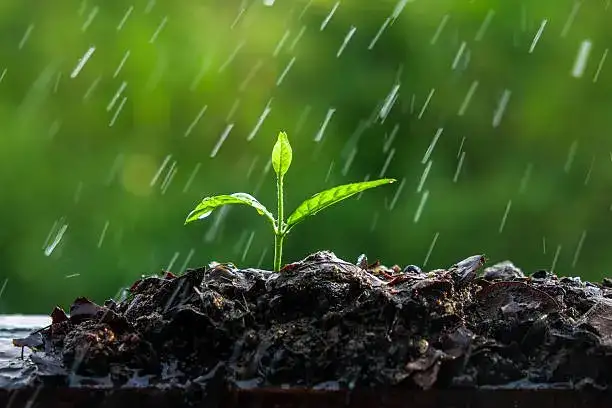
A new study by researchers at the Massachusetts Institute of Technology suggests that this idea could be real. According to findings published in Scientific Reports, plants may be able to sense the sound of rain and use it to trigger growth.
Seeds That Respond to Rain Sounds
The study reveals that some seeds can react to the sound vibrations produced by falling raindrops. In experiments conducted on rice seeds, researchers found that exposure to these sounds helped seeds come out of dormancy faster.
Seeds that were exposed to rain-like vibrations germinated more quickly compared to those that were not. This is the first clear evidence showing that plant seeds and young seedlings can detect natural sounds in their environment.
“The energy of the rain sound is enough to accelerate a seed’s growth,” study author Nicholas Makris said in a release.
How Sound Helps Seeds Decide When to Grow
The idea behind this discovery lies in how sound travels. When raindrops hit the ground or water, they create vibrations that move through soil and liquid. These vibrations carry energy that can influence tiny structures inside seeds.
Researchers believe that these vibrations may affect statoliths, which are small internal components that help plants sense gravity. If sound waves can move these structures, they may help seeds determine the right conditions for growth.
Makris and his co-author Cadine Navarro believe that the sound of rain could be similar to other natural vibrations such as wind, opening up new possibilities for understanding plant behaviour.
A Closer Look at the Science
Makris explained how powerful these sound vibrations can be, especially beneath the surface:
“I went back to look at work done by colleagues in the 1980s, who measured the sound of rain underwater. If you check, you'll see it's much greater than in the air. It has to do with the fact that water is denser than air, so the same drop makes larger pressure waves underwater. So if you’re a seed that’s within a few centimetres of a raindrop’s impact, the kind of sound pressures that you would experience in water or in the ground are equivalent to what you’d be subject to within a few metres of a jet engine in the air,” Makris explained.
This insight highlights how even a simple raindrop can create strong signals underground, strong enough to influence a seed’s behaviour.
What the Experiments Found
To test their theory, researchers carried out detailed experiments using around 8,000 rice seeds placed in shallow water. They recreated different rainfall conditions by varying droplet size and height to simulate light, moderate, and heavy rain.
The results were clear:
The team also used specialised instruments to measure the acoustic vibrations, confirming that the sound energy from water droplets was strong enough to affect the seeds.
Plants Are More Aware Than They Seem
Plants may not have ears, but they are highly responsive to their environment. Over time, they have developed ways to sense and react to different stimuli.
This study adds sound to the list, suggesting that plants may use it as another tool for survival.
A New Perspective on Nature
The findings challenge traditional ideas about how plants grow and respond to their surroundings. Instead of relying only on moisture and light, seeds may also be listening to subtle environmental cues.
“Brilliant research has been done around the world to reveal the mechanisms behind the ability of plants to sense gravity. Our study has shown that these same mechanisms seem to be providing plant seeds with a means of perceiving submergence depths in the soil or water that are beneficial to their survival by sensing the sound of rain. It gives new meaning to the fourth Japanese microseason, entitled ‘Falling rain awakens the soil,’” Makris concluded.
The idea that plants can sense the sound of rain adds a fascinating new layer to our understanding of nature. For a seed waiting beneath the soil, the gentle patter of rain may not just be background noise. It could be the signal that conditions are right to begin life.
As scientists continue to explore how plants interact with their environment, discoveries like this remind us that even the simplest natural events can hold deeper meaning than we ever imagined.
A new study by researchers at the Massachusetts Institute of Technology suggests that this idea could be real. According to findings published in Scientific Reports, plants may be able to sense the sound of rain and use it to trigger growth.
Seeds That Respond to Rain Sounds
The study reveals that some seeds can react to the sound vibrations produced by falling raindrops. In experiments conducted on rice seeds, researchers found that exposure to these sounds helped seeds come out of dormancy faster.Seeds that were exposed to rain-like vibrations germinated more quickly compared to those that were not. This is the first clear evidence showing that plant seeds and young seedlings can detect natural sounds in their environment.
“The energy of the rain sound is enough to accelerate a seed’s growth,” study author Nicholas Makris said in a release.
How Sound Helps Seeds Decide When to Grow
The idea behind this discovery lies in how sound travels. When raindrops hit the ground or water, they create vibrations that move through soil and liquid. These vibrations carry energy that can influence tiny structures inside seeds. Researchers believe that these vibrations may affect statoliths, which are small internal components that help plants sense gravity. If sound waves can move these structures, they may help seeds determine the right conditions for growth.
Makris and his co-author Cadine Navarro believe that the sound of rain could be similar to other natural vibrations such as wind, opening up new possibilities for understanding plant behaviour.
A Closer Look at the Science
Makris explained how powerful these sound vibrations can be, especially beneath the surface:“I went back to look at work done by colleagues in the 1980s, who measured the sound of rain underwater. If you check, you'll see it's much greater than in the air. It has to do with the fact that water is denser than air, so the same drop makes larger pressure waves underwater. So if you’re a seed that’s within a few centimetres of a raindrop’s impact, the kind of sound pressures that you would experience in water or in the ground are equivalent to what you’d be subject to within a few metres of a jet engine in the air,” Makris explained.
This insight highlights how even a simple raindrop can create strong signals underground, strong enough to influence a seed’s behaviour.
What the Experiments Found
To test their theory, researchers carried out detailed experiments using around 8,000 rice seeds placed in shallow water. They recreated different rainfall conditions by varying droplet size and height to simulate light, moderate, and heavy rain. The results were clear:
- Seeds exposed to rain sounds germinated 30 to 40 percent faster
- Seeds closer to the surface responded more quickly
- Seeds further away or deeper in water showed slower growth
The team also used specialised instruments to measure the acoustic vibrations, confirming that the sound energy from water droplets was strong enough to affect the seeds.
Plants Are More Aware Than They Seem
Plants may not have ears, but they are highly responsive to their environment. Over time, they have developed ways to sense and react to different stimuli.- Some plants close their leaves when touched
- Many grow towards light sources
- Roots respond to gravity to guide their direction
- Certain plants react to chemicals in their surroundings
This study adds sound to the list, suggesting that plants may use it as another tool for survival.
A New Perspective on Nature
The findings challenge traditional ideas about how plants grow and respond to their surroundings. Instead of relying only on moisture and light, seeds may also be listening to subtle environmental cues. “Brilliant research has been done around the world to reveal the mechanisms behind the ability of plants to sense gravity. Our study has shown that these same mechanisms seem to be providing plant seeds with a means of perceiving submergence depths in the soil or water that are beneficial to their survival by sensing the sound of rain. It gives new meaning to the fourth Japanese microseason, entitled ‘Falling rain awakens the soil,’” Makris concluded.
The idea that plants can sense the sound of rain adds a fascinating new layer to our understanding of nature. For a seed waiting beneath the soil, the gentle patter of rain may not just be background noise. It could be the signal that conditions are right to begin life.
As scientists continue to explore how plants interact with their environment, discoveries like this remind us that even the simplest natural events can hold deeper meaning than we ever imagined.
Next Story