
Is There Really a Black Hole at the Milky Way’s Centre? New Study Suggests Dark Matter Core

A fresh cosmic rethink is challenging one of astronomy’s most accepted ideas, as scientists revisit what truly lies at the centre of our galaxy. For decades, the Milky Way’s core has been believed to host a supermassive black hole. Now, a new study suggests a very different possibility, that a dense concentration of dark matter could be responsible for the powerful gravitational effects seen in that region.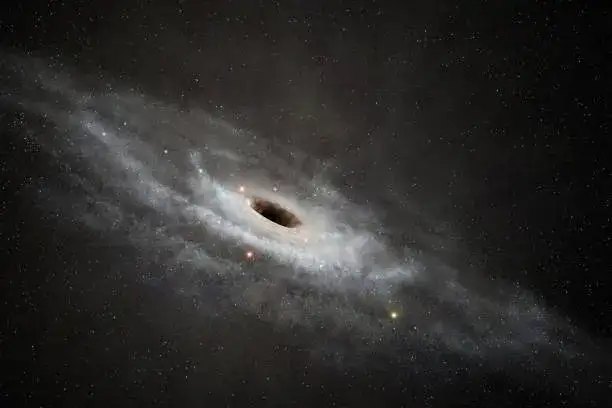
The findings offer a new perspective on how the centre of our galaxy behaves and what might truly exist in one of the most mysterious regions of space.
Rethinking the Milky Way’s Core
For many years, the object known as Sagittarius A* has been identified as a supermassive black hole with a mass about four million times that of the Sun. This conclusion is based on the motion of nearby stars, especially a group known as S-stars, which orbit the centre at extremely high speeds.
Their rapid movement has long been considered strong evidence of an invisible but extremely powerful gravitational force, consistent with a black hole.
A New Model Based on Dark Matter
The new study proposes an alternative explanation that does not require a traditional black hole. Instead, researchers suggest that the centre of the Milky Way could be made up of a highly compact core of fermionic dark matter.
The study, published in the Monthly Notices of the Royal Astronomical Society, explains that this dense dark matter core could produce gravitational effects similar to those of a black hole. It could also account for both the fast motion of stars near the centre and the overall rotation of the galaxy.
According to co-author Dr. Carlos Arguelles, this model stands out because it is able to explain both large-scale and small-scale galactic behaviour at the same time.
He explained, “This is the first time a dark matter model has been able to simultaneously explain both the galaxy's large-scale rotation and the motion of stars near its centre.”
Dr. Arguelles also clarified that the idea does not completely reject the black hole concept but instead suggests a deeper connection between the galaxy’s core and its surrounding dark matter structure.
How a Dark Matter Core Could Replace a Black Hole
In this theory, fermionic dark matter could gather into an extremely dense central region, surrounded by a broader halo of less concentrated dark matter. This dense core would create such a strong gravitational field that it could mimic the effects typically attributed to a black hole.
It would influence the movement of nearby stars and even bend light passing close to it. This bending of light is especially important because it may help explain images captured by the Event Horizon Telescope in 2022.
Lead author Valentina Crespi described this effect, explaining, “This dense dark matter core could bend light so strongly that it creates a dark region in the centre and a bright ring around it.”
This phenomenon could produce an image that closely resembles what astronomers currently interpret as a black hole shadow surrounded by glowing gas.
What This Means for Our Understanding of Galaxies
If this theory proves correct, it could reshape how scientists understand the structure and evolution of galaxies. Instead of a single black hole at the centre, the Milky Way might be part of a continuous system of dark matter extending from its core to its outer edges.
This would represent a major shift in astrophysics, changing long-standing assumptions about how galaxies form and what powers their motion.
A New Frontier in Space Science
While the black hole model remains widely accepted, this new research highlights how much is still unknown about dark matter and the universe’s hidden structure. It opens the door to new questions about whether black holes are truly isolated objects or part of a larger cosmic framework.
As scientists continue to study the centre of our galaxy, one thing is clear. The Milky Way may still be hiding secrets that could transform our understanding of the universe.
The findings offer a new perspective on how the centre of our galaxy behaves and what might truly exist in one of the most mysterious regions of space.
Rethinking the Milky Way’s Core
For many years, the object known as Sagittarius A* has been identified as a supermassive black hole with a mass about four million times that of the Sun. This conclusion is based on the motion of nearby stars, especially a group known as S-stars, which orbit the centre at extremely high speeds.Their rapid movement has long been considered strong evidence of an invisible but extremely powerful gravitational force, consistent with a black hole.
A New Model Based on Dark Matter
The new study proposes an alternative explanation that does not require a traditional black hole. Instead, researchers suggest that the centre of the Milky Way could be made up of a highly compact core of fermionic dark matter.The study, published in the Monthly Notices of the Royal Astronomical Society, explains that this dense dark matter core could produce gravitational effects similar to those of a black hole. It could also account for both the fast motion of stars near the centre and the overall rotation of the galaxy.
According to co-author Dr. Carlos Arguelles, this model stands out because it is able to explain both large-scale and small-scale galactic behaviour at the same time.
He explained, “This is the first time a dark matter model has been able to simultaneously explain both the galaxy's large-scale rotation and the motion of stars near its centre.”
Dr. Arguelles also clarified that the idea does not completely reject the black hole concept but instead suggests a deeper connection between the galaxy’s core and its surrounding dark matter structure.
You may also like
- Rights groups slam Islamabad's "anti-poor" demolition drives, accuse state of defying court orders
- North Korea's economy entering recovery phase amid closer ties with Russia, China: Seoul
- Survivors of Iranian naval vessel depart Sri Lanka
- Pakistan: Mpox cases in Sindh rise to 25 after two new infections
- US-blacklisted tanker crossed Hormuz with tracker on, Iran claims
How a Dark Matter Core Could Replace a Black Hole
In this theory, fermionic dark matter could gather into an extremely dense central region, surrounded by a broader halo of less concentrated dark matter. This dense core would create such a strong gravitational field that it could mimic the effects typically attributed to a black hole. It would influence the movement of nearby stars and even bend light passing close to it. This bending of light is especially important because it may help explain images captured by the Event Horizon Telescope in 2022.
Lead author Valentina Crespi described this effect, explaining, “This dense dark matter core could bend light so strongly that it creates a dark region in the centre and a bright ring around it.”
This phenomenon could produce an image that closely resembles what astronomers currently interpret as a black hole shadow surrounded by glowing gas.
What This Means for Our Understanding of Galaxies
If this theory proves correct, it could reshape how scientists understand the structure and evolution of galaxies. Instead of a single black hole at the centre, the Milky Way might be part of a continuous system of dark matter extending from its core to its outer edges.This would represent a major shift in astrophysics, changing long-standing assumptions about how galaxies form and what powers their motion.
A New Frontier in Space Science
While the black hole model remains widely accepted, this new research highlights how much is still unknown about dark matter and the universe’s hidden structure. It opens the door to new questions about whether black holes are truly isolated objects or part of a larger cosmic framework. As scientists continue to study the centre of our galaxy, one thing is clear. The Milky Way may still be hiding secrets that could transform our understanding of the universe.






More from our partners


Loving Newspoint? Download the app now
