
Map quest: Virginia vote leaves Trump seeing red – and blue


WASHINGTON: While India is in the throes of a delimitation debate that is pitting mostly southern states against some northern states, the United States has plunged into a redistricting rumble that is defining the Republican red v Democrat blue divide even more starkly. Voters in Virginia on Tuesday narrowly approved a high-stakes referendum that essentially gives the Democratic-controlled state legislature power to redraw the state’s congressional maps, turning a 6-5 edge Democrats had into a 10-1 dominance. This follows Republican efforts to do the same in Texas, which in turn was countered by Democrats in California.
To understand why everyone, including President Trump in the midst of the Iran debacle, is flipping out over the Virginia outcome (which could result in Republicans losing the House of Representative in November), one must look back to 1812 and a man named Elbridge Gerry, the Governor of Massachusetts. Gerry engineered the dark political art (or science) of "packing and cracking" a district (constituency in Indian parlance) in such a way that voters opposed to him were consigned to one or two redrawn sacrificial districts so that their surplus votes are wasted, while packing supporters into districts he could win easily. By clustering opposition voters into a few districts (“packing”) or spreading them thin across many (“cracking”), he could tilt the electoral field without changing a single vote.
The district Gerry conjured up was so twisted and jagged it looked like a salamander. A local illustrator added wings and claws to the map and thus was born the term gerrymandering—the fine art of drawing electoral boundaries so artfully that politicians end up choosing their voters, rather than the other way around. In simple terms, imagine if a cricket captain could redraw the boundary ropes mid-match to suit his team’s batting or bowling strengths.
This latest bout of map-making madness was triggered by an "arms race" that President Trump himself ignited. Last year, at Trump’s urging, Texas Republicans aggressively redrew their maps to shore up GOP seats. Democrats quickly realized that bringing a bouquet of flowers to a knife fight was a losing strategy. In California, a blue state, they worked to sharpen the Democratic advantage. Virginia, its 11 districts leaning Democrat 6-5, followed suit, turning the state into a 10-1 dominance with some artful redrawing.
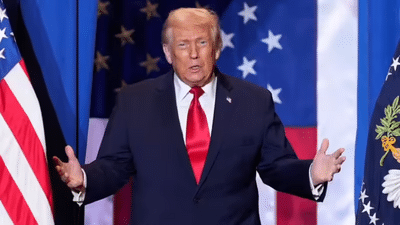
Trump, never one to stay away from a mudfight or suffer a setback in silence, spent the eve of the vote pleading with Virginians to "just vote no" (amid the Iran crisis). When the "Yes" votes triumphed by a narrow 3 per cent, his reaction was predictably scorched-earth, as he lashed out at Democrats, wind farms, the Supreme Court when he was not raging about Iran.
The reason: Implications of the Virginia redrawing is seismic for the November mid-terms. The Republican majority in the U.S. House of Representatives is currently a narrow 217-214. By gaining four seats in Virginia (10-1, instead of 6-5) and offsetting GOP gains in Texas, Democrats are suddenly within striking distance of winning the House.
For the Trump Presidency, losing the House would be more than a "setback"—it would be a legislative nightmare. A Democrat-majority House means Congressional inquiries, subpoenas, hearings, blocked budgets… and a lame duck Presidency.
To understand why everyone, including President Trump in the midst of the Iran debacle, is flipping out over the Virginia outcome (which could result in Republicans losing the House of Representative in November), one must look back to 1812 and a man named Elbridge Gerry, the Governor of Massachusetts. Gerry engineered the dark political art (or science) of "packing and cracking" a district (constituency in Indian parlance) in such a way that voters opposed to him were consigned to one or two redrawn sacrificial districts so that their surplus votes are wasted, while packing supporters into districts he could win easily. By clustering opposition voters into a few districts (“packing”) or spreading them thin across many (“cracking”), he could tilt the electoral field without changing a single vote.
The district Gerry conjured up was so twisted and jagged it looked like a salamander. A local illustrator added wings and claws to the map and thus was born the term gerrymandering—the fine art of drawing electoral boundaries so artfully that politicians end up choosing their voters, rather than the other way around. In simple terms, imagine if a cricket captain could redraw the boundary ropes mid-match to suit his team’s batting or bowling strengths.
This latest bout of map-making madness was triggered by an "arms race" that President Trump himself ignited. Last year, at Trump’s urging, Texas Republicans aggressively redrew their maps to shore up GOP seats. Democrats quickly realized that bringing a bouquet of flowers to a knife fight was a losing strategy. In California, a blue state, they worked to sharpen the Democratic advantage. Virginia, its 11 districts leaning Democrat 6-5, followed suit, turning the state into a 10-1 dominance with some artful redrawing.
Trump, never one to stay away from a mudfight or suffer a setback in silence, spent the eve of the vote pleading with Virginians to "just vote no" (amid the Iran crisis). When the "Yes" votes triumphed by a narrow 3 per cent, his reaction was predictably scorched-earth, as he lashed out at Democrats, wind farms, the Supreme Court when he was not raging about Iran.
The reason: Implications of the Virginia redrawing is seismic for the November mid-terms. The Republican majority in the U.S. House of Representatives is currently a narrow 217-214. By gaining four seats in Virginia (10-1, instead of 6-5) and offsetting GOP gains in Texas, Democrats are suddenly within striking distance of winning the House.
For the Trump Presidency, losing the House would be more than a "setback"—it would be a legislative nightmare. A Democrat-majority House means Congressional inquiries, subpoenas, hearings, blocked budgets… and a lame duck Presidency.
Next Story