
Scientists Discover Molten 'Liquid Planet' With Lava Oceans and Toxic Atmosphere

Space just got a little stranger. Scientists have identified a completely new type of planet that does not fit into the usual categories we know. Instead of being rocky like Earth or covered in deep oceans, this world exists in a constant molten state, more like a giant sea of lava than a solid planet.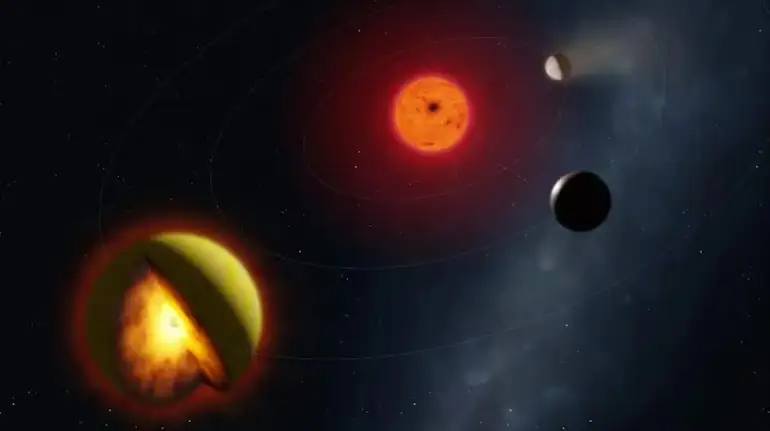
The discovery points to a new class of “liquid planets” that are neither typical gas-rich worlds nor water-covered ones. These planets are made up of flowing, semi-molten rock, giving them a thick, mushy consistency.
Meet L 98-59 d
One of the best examples of this new category is a planet called L 98-59 d, located about 35 light-years away from Earth. It was studied using the James Webb Space Telescope, which has been helping scientists explore distant worlds in greater detail.
This planet is slightly larger and heavier than Earth, but its surface conditions are far more extreme. Temperatures on L 98-59 d can reach nearly 1,900 degrees Celsius, hot enough to melt rock into a flowing state. Instead of a solid surface, the planet likely has a global ocean of molten material.
Scientists describe its interior as being in a “mushy, molten state,” similar to thick liquid. The mantle is believed to be made of molten silicate, with a core that may also be in a liquid state.
A World That Would Smell Unpleasant
As if the extreme heat was not enough, the planet’s atmosphere adds another unusual detail. It is thought to be rich in hydrogen sulfide, a gas known for its strong smell of rotten eggs. If anyone could somehow visit, the experience would not just be hot but also extremely unpleasant.
Why This Planet Never Cools Down
Unlike Earth, which cooled over billions of years, this planet has remained in its molten state. One of the main reasons is a strong greenhouse effect. Its thick atmosphere traps heat and prevents it from escaping into space.
In addition, nearby planets exert gravitational forces that create tidal heating inside L 98-59 d. This constant pulling and stretching generates extra heat, keeping the planet’s interior active and molten. These forces may even cause waves to move across its lava-filled surface.
What This Means for Space Research
“This discovery suggests that the categories astronomers currently use to describe small planets may be too simple. While this molten planet is unlikely to support life, it reflects the wide diversity of the worlds that exist beyond the solar system. We may then ask: what other types of planets are waiting to be uncovered?” Harrison Nicholls said in a statement.
“If there are aliens out there that could live in lava, that would be amazing, but I don't think it's likely that it's habitable. It's nice to revel in the alienness of the planet itself,” Nicholls added.
The finding is important because it changes how scientists think about planets beyond our solar system. Some worlds that were earlier believed to be covered in water might actually belong to this molten category instead.
These lava-like planets also offer a glimpse into Earth’s distant past, when our planet was once covered in molten rock before it cooled and formed a solid surface.
Discoveries like this remind us that space is full of surprises. With advanced tools like the James Webb Space Telescope, scientists are just beginning to uncover how diverse and unusual other worlds can be.
The discovery points to a new class of “liquid planets” that are neither typical gas-rich worlds nor water-covered ones. These planets are made up of flowing, semi-molten rock, giving them a thick, mushy consistency.
Meet L 98-59 d
One of the best examples of this new category is a planet called L 98-59 d, located about 35 light-years away from Earth. It was studied using the James Webb Space Telescope, which has been helping scientists explore distant worlds in greater detail.This planet is slightly larger and heavier than Earth, but its surface conditions are far more extreme. Temperatures on L 98-59 d can reach nearly 1,900 degrees Celsius, hot enough to melt rock into a flowing state. Instead of a solid surface, the planet likely has a global ocean of molten material.
Scientists describe its interior as being in a “mushy, molten state,” similar to thick liquid. The mantle is believed to be made of molten silicate, with a core that may also be in a liquid state.
You may also like
- UN Special Rapporteur 'dismayed' by Pak's strike in Kabul, urges de-escalation
- "To create additional security against Hezbollah's threat": Israel deploys additional troops in Lebanon
- Two Baloch civilians extrajudicially killed, other 2 abducted by Pakistani forces
- Is Iran's Mojtaba Khamenei secretly recuperating at Putin's Moscow residence?
- All consular services at Indian embassy in Kuwait continue as usual during Ramadan
A World That Would Smell Unpleasant
As if the extreme heat was not enough, the planet’s atmosphere adds another unusual detail. It is thought to be rich in hydrogen sulfide, a gas known for its strong smell of rotten eggs. If anyone could somehow visit, the experience would not just be hot but also extremely unpleasant. Why This Planet Never Cools Down
Unlike Earth, which cooled over billions of years, this planet has remained in its molten state. One of the main reasons is a strong greenhouse effect. Its thick atmosphere traps heat and prevents it from escaping into space. In addition, nearby planets exert gravitational forces that create tidal heating inside L 98-59 d. This constant pulling and stretching generates extra heat, keeping the planet’s interior active and molten. These forces may even cause waves to move across its lava-filled surface.
What This Means for Space Research
“This discovery suggests that the categories astronomers currently use to describe small planets may be too simple. While this molten planet is unlikely to support life, it reflects the wide diversity of the worlds that exist beyond the solar system. We may then ask: what other types of planets are waiting to be uncovered?” Harrison Nicholls said in a statement.“If there are aliens out there that could live in lava, that would be amazing, but I don't think it's likely that it's habitable. It's nice to revel in the alienness of the planet itself,” Nicholls added.
The finding is important because it changes how scientists think about planets beyond our solar system. Some worlds that were earlier believed to be covered in water might actually belong to this molten category instead.
These lava-like planets also offer a glimpse into Earth’s distant past, when our planet was once covered in molten rock before it cooled and formed a solid surface.
Discoveries like this remind us that space is full of surprises. With advanced tools like the James Webb Space Telescope, scientists are just beginning to uncover how diverse and unusual other worlds can be.






More from our partners


Loving Newspoint? Download the app now
