
Mysterious Object Spotted on Mars: Scientists Call for Investigation

A small, shiny object spotted on Mars has reignited curiosity and debate among scientists and space enthusiasts. The unusual find, captured in images by NASA’s Curiosity Rover, may look simple at first glance, but it has raised questions about its origin and whether it deserves a closer look.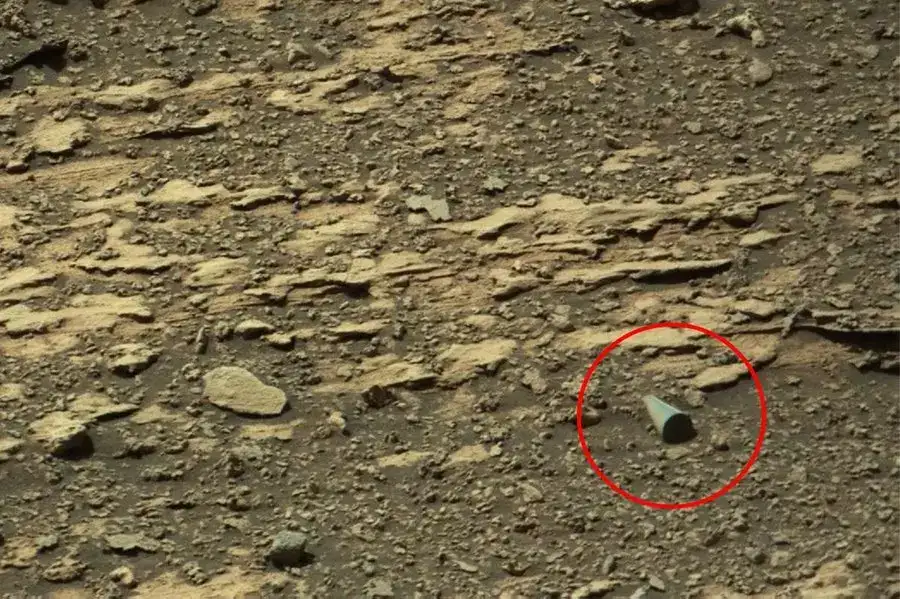
A curious find on Mars
The object appears cone-shaped, almost like a tiny party hat, with a flat base and a slightly reflective surface. It is estimated to be around 20 centimetres long. The image was originally taken in 2022 when the rover was exploring Gale Crater, one of the most studied regions on the planet due to its rich geological history.
The discovery came from a vast archive of Mars images that are publicly available. An amateur researcher first noticed the object while reviewing these images, showing how even small details can spark big conversations when space data is open to everyone.
Renewed attention and key questions
Interest in the object picked up again after Avi Loeb highlighted it and raised an important question about how it should be treated.
"Should we just assume that the mysterious cylinder is human-made debris and move on or turn back the rover to figure out whether its origin is different?"
His question reflects a broader scientific dilemma. When something unusual appears, should it be investigated further or considered part of known processes?
A case for investigation
Loeb believes the object is worth a closer look. At the time the image was captured, the rover was operating on the slopes of Mount Sharp, roughly five miles away from where the object was seen.
He suggested that redirecting the rover, even briefly, could help scientists better understand what the object is and where it came from. In his view, studying it could offer valuable insight, whether the explanation turns out to be ordinary or something unexpected.
"The most likely explanation is that it corresponds to man-made debris," Loeb wrote.
Even with this possibility in mind, he emphasised the importance of confirming the origin rather than assuming it.
He also pointed out the public interest angle tied to such missions.
"NASA is funded by taxpayers, and if we asked them, they would likely agree that understanding the origin of the mysterious cylinder should be the top priority of Curiosity," he said.
A simpler explanation
Despite the intrigue, there is a strong possibility that the object is not unusual at all. It may simply be a fragment from the rover itself. Space missions often involve years of travel across harsh terrain, and small parts can occasionally detach over time.
The Curiosity Rover has been exploring Mars since 2012, navigating rocky landscapes and extreme conditions. Over such a long journey, minor wear and tear is expected, making debris a plausible explanation.
The bigger picture
The rover’s primary mission remains unchanged. It continues to study rocks, soil, and atmospheric conditions to understand whether Mars once had an environment that could support microbial life.
While the shiny object has sparked fresh interest, mission teams must carefully balance curiosity with broader scientific goals. Redirecting the rover is not always simple, as every move is planned to maximise long-term research outcomes.
Why discoveries like this matter
Even if the object turns out to be something ordinary, the discussion around it highlights the excitement of space exploration. A single image can lead to questions, debates, and new ideas.
It also shows how collaboration between professional scientists and independent observers can bring hidden details to light. Public access to space data continues to play a key role in making discoveries more inclusive.
For now, the object remains an open question. Whether it is just a piece of debris or something that deserves closer study, it serves as a reminder that Mars still holds many surprises waiting to be explored.
A curious find on Mars
The object appears cone-shaped, almost like a tiny party hat, with a flat base and a slightly reflective surface. It is estimated to be around 20 centimetres long. The image was originally taken in 2022 when the rover was exploring Gale Crater, one of the most studied regions on the planet due to its rich geological history. The discovery came from a vast archive of Mars images that are publicly available. An amateur researcher first noticed the object while reviewing these images, showing how even small details can spark big conversations when space data is open to everyone.
Renewed attention and key questions
Interest in the object picked up again after Avi Loeb highlighted it and raised an important question about how it should be treated. "Should we just assume that the mysterious cylinder is human-made debris and move on or turn back the rover to figure out whether its origin is different?"
His question reflects a broader scientific dilemma. When something unusual appears, should it be investigated further or considered part of known processes?
A case for investigation
Loeb believes the object is worth a closer look. At the time the image was captured, the rover was operating on the slopes of Mount Sharp, roughly five miles away from where the object was seen. He suggested that redirecting the rover, even briefly, could help scientists better understand what the object is and where it came from. In his view, studying it could offer valuable insight, whether the explanation turns out to be ordinary or something unexpected.
"The most likely explanation is that it corresponds to man-made debris," Loeb wrote.
Even with this possibility in mind, he emphasised the importance of confirming the origin rather than assuming it.
He also pointed out the public interest angle tied to such missions.
"NASA is funded by taxpayers, and if we asked them, they would likely agree that understanding the origin of the mysterious cylinder should be the top priority of Curiosity," he said.
A simpler explanation
Despite the intrigue, there is a strong possibility that the object is not unusual at all. It may simply be a fragment from the rover itself. Space missions often involve years of travel across harsh terrain, and small parts can occasionally detach over time.The Curiosity Rover has been exploring Mars since 2012, navigating rocky landscapes and extreme conditions. Over such a long journey, minor wear and tear is expected, making debris a plausible explanation.
The bigger picture
The rover’s primary mission remains unchanged. It continues to study rocks, soil, and atmospheric conditions to understand whether Mars once had an environment that could support microbial life. While the shiny object has sparked fresh interest, mission teams must carefully balance curiosity with broader scientific goals. Redirecting the rover is not always simple, as every move is planned to maximise long-term research outcomes.
Why discoveries like this matter
Even if the object turns out to be something ordinary, the discussion around it highlights the excitement of space exploration. A single image can lead to questions, debates, and new ideas. It also shows how collaboration between professional scientists and independent observers can bring hidden details to light. Public access to space data continues to play a key role in making discoveries more inclusive.
For now, the object remains an open question. Whether it is just a piece of debris or something that deserves closer study, it serves as a reminder that Mars still holds many surprises waiting to be explored.
Next Story