
NASA Reveals Breathtaking Image Of Cosmic 'Brain' Around Dying Star

Space continues to surprise us with visuals that look almost unreal. Recently, NASA unveiled a breathtaking image of what appears to be a giant cosmic "brain" glowing in the darkness of space. The remarkable structure surrounds a dying star and offers scientists a rare and detailed look at the final phase of stellar evolution.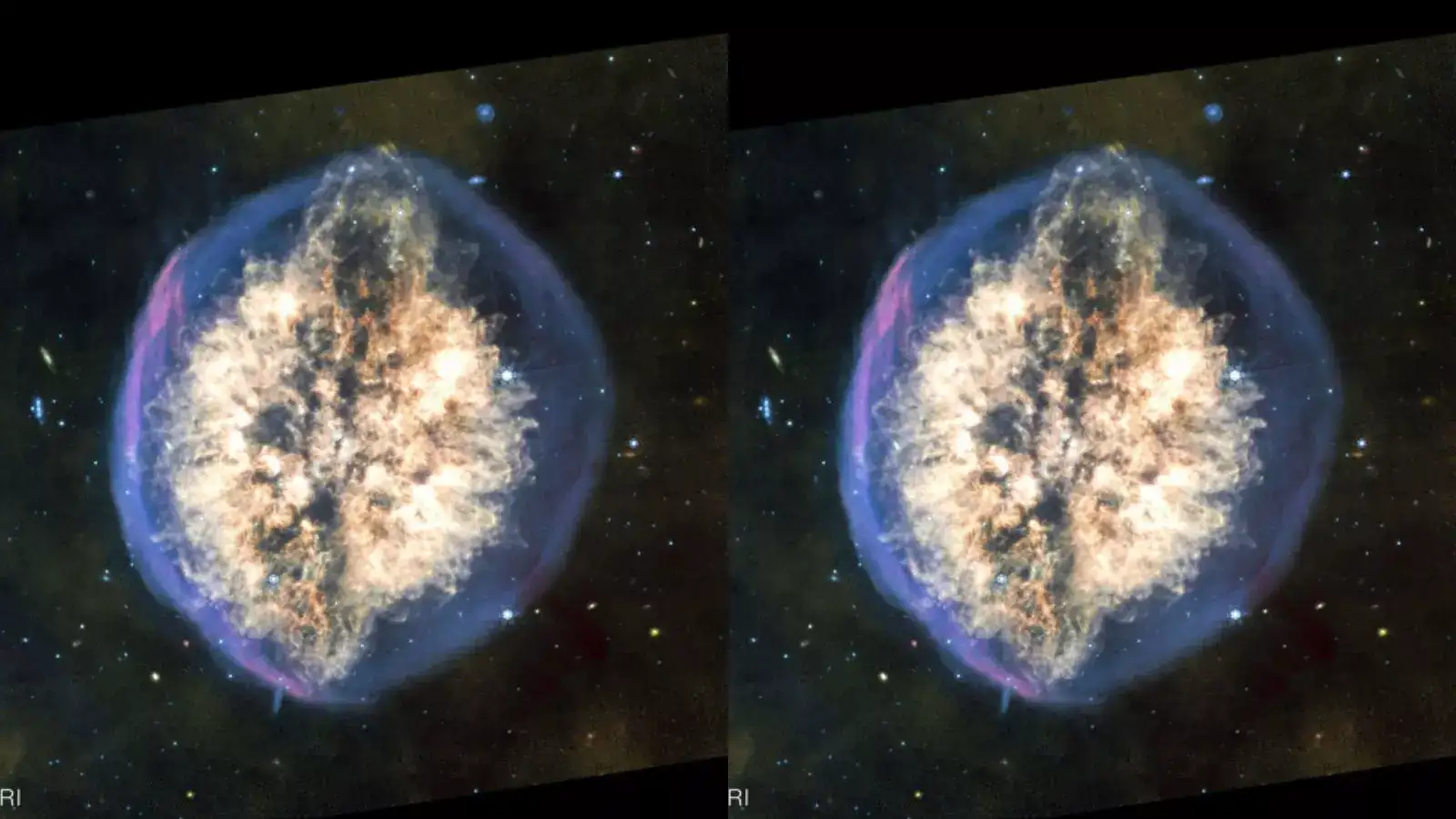
The image was captured by the highly advanced James Webb Space Telescope. With its powerful infrared instruments, Webb can peer through thick clouds of dust and gas, revealing details that were once impossible to see. The nebula, officially known as PMR 1, has earned the nickname the "Exposed Cranium" nebula because its swirling layers strongly resemble a brain inside a transparent skull.
This fascinating object was not entirely unknown to scientists. It was first observed in infrared light by NASA’s retired Spitzer Space Telescope more than a decade ago. However, the earlier images lacked the sharp detail that Webb now provides. With clearer resolution and deeper imaging, the brain-like patterns within the nebula have become far more distinct and visually dramatic.
So what exactly are we looking at? PMR 1 is a massive cloud of gas and dust formed by a star that is nearing the end of its life. As stars exhaust their nuclear fuel, they enter a final stage where they begin to expel their outer layers into space. While this may sound like a slow process, in cosmic terms it happens relatively quickly. Webb managed to capture a precise moment in this transformation, freezing a short yet powerful phase in the star’s collapse.
The ultimate fate of a star depends on its mass. Very massive stars often end their lives in spectacular explosions known as supernovae, scattering elements across the universe. Smaller stars, similar to our Sun, follow a gentler path. They gradually shed their outer layers and leave behind a dense core called a white dwarf. Over billions of years, this white dwarf slowly cools and fades.
Beyond its striking appearance, the cosmic "brain" holds scientific value. Planetary nebulae like PMR 1 play a key role in enriching the universe with elements that later become part of new stars, planets, and even life itself. Each observation helps researchers understand how stars evolve and how matter is recycled across the cosmos.
With discoveries like this, the James Webb Space Telescope continues to expand our view of the universe. What looks like a glowing cosmic "brain" is actually a beautiful reminder of the life cycle of stars and the ever changing story of space.
The image was captured by the highly advanced James Webb Space Telescope. With its powerful infrared instruments, Webb can peer through thick clouds of dust and gas, revealing details that were once impossible to see. The nebula, officially known as PMR 1, has earned the nickname the "Exposed Cranium" nebula because its swirling layers strongly resemble a brain inside a transparent skull.
This fascinating object was not entirely unknown to scientists. It was first observed in infrared light by NASA’s retired Spitzer Space Telescope more than a decade ago. However, the earlier images lacked the sharp detail that Webb now provides. With clearer resolution and deeper imaging, the brain-like patterns within the nebula have become far more distinct and visually dramatic.
So what exactly are we looking at? PMR 1 is a massive cloud of gas and dust formed by a star that is nearing the end of its life. As stars exhaust their nuclear fuel, they enter a final stage where they begin to expel their outer layers into space. While this may sound like a slow process, in cosmic terms it happens relatively quickly. Webb managed to capture a precise moment in this transformation, freezing a short yet powerful phase in the star’s collapse.
The ultimate fate of a star depends on its mass. Very massive stars often end their lives in spectacular explosions known as supernovae, scattering elements across the universe. Smaller stars, similar to our Sun, follow a gentler path. They gradually shed their outer layers and leave behind a dense core called a white dwarf. Over billions of years, this white dwarf slowly cools and fades.
Beyond its striking appearance, the cosmic "brain" holds scientific value. Planetary nebulae like PMR 1 play a key role in enriching the universe with elements that later become part of new stars, planets, and even life itself. Each observation helps researchers understand how stars evolve and how matter is recycled across the cosmos.
With discoveries like this, the James Webb Space Telescope continues to expand our view of the universe. What looks like a glowing cosmic "brain" is actually a beautiful reminder of the life cycle of stars and the ever changing story of space.
Next Story