
NASA Discovers New Insights Into 2,000-Year-Old Supernova Explosion

Scientists have uncovered fresh clues about a distant and ancient supernova, offering a deeper look into how these powerful cosmic events evolve over time. Using advanced observations from NASA’s Imaging X-ray Polarimetry Explorer, researchers have gained new insights into the supernova known as RCW 86.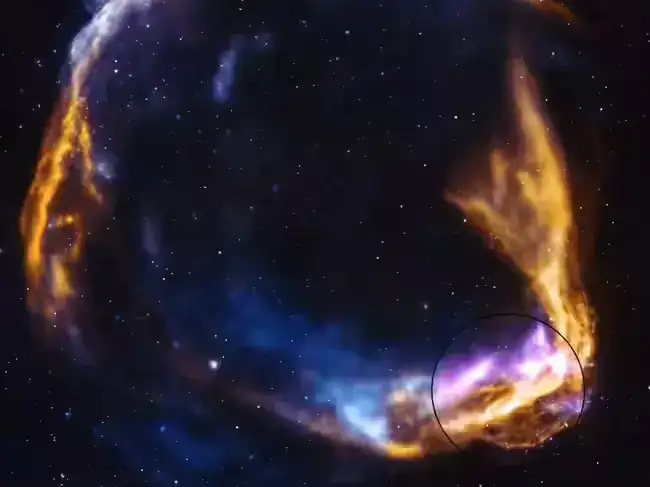
RCW 86 is believed to be around 2,000 years old and has long fascinated astronomers due to its unusual shape and behavior. Earlier studies using the Chandra X-ray Observatory had revealed that the supernova is surrounded by a large, low-density cavity. This space allowed the explosion to expand much faster than expected, shaping its distinct structure.
The latest observations from IXPE focused on the outer edges of the supernova. Scientists discovered that once the expanding material reached the boundary of this cavity, it began to slow down. This interaction created what is known as a reflected shock, a process where energy bounces back inward after hitting a denser region. This effect adds a new layer of understanding to how the remnant continues to evolve.
To build a clearer picture, researchers combined data from multiple sources. Along with IXPE and Chandra, observations from the European Space Agency’s XMM-Newton were used. The final composite image highlights different energy levels, with yellow tones showing lower-energy X-rays and blue tones representing higher-energy emissions.
The background star field in the image comes from the National Optical-Infrared Astronomy Research Laboratory, supported by the National Science Foundation. This combination of data from different observatories allows scientists to study the supernova in greater detail than ever before.
These findings help researchers better understand how supernova remnants interact with their surroundings. By studying objects like RCW 86, scientists can learn more about the life cycle of stars and the forces that shape our universe.
With each new observation, space missions continue to reveal how dynamic and complex the cosmos truly is.
RCW 86 is believed to be around 2,000 years old and has long fascinated astronomers due to its unusual shape and behavior. Earlier studies using the Chandra X-ray Observatory had revealed that the supernova is surrounded by a large, low-density cavity. This space allowed the explosion to expand much faster than expected, shaping its distinct structure.
The latest observations from IXPE focused on the outer edges of the supernova. Scientists discovered that once the expanding material reached the boundary of this cavity, it began to slow down. This interaction created what is known as a reflected shock, a process where energy bounces back inward after hitting a denser region. This effect adds a new layer of understanding to how the remnant continues to evolve.
To build a clearer picture, researchers combined data from multiple sources. Along with IXPE and Chandra, observations from the European Space Agency’s XMM-Newton were used. The final composite image highlights different energy levels, with yellow tones showing lower-energy X-rays and blue tones representing higher-energy emissions.
The background star field in the image comes from the National Optical-Infrared Astronomy Research Laboratory, supported by the National Science Foundation. This combination of data from different observatories allows scientists to study the supernova in greater detail than ever before.
These findings help researchers better understand how supernova remnants interact with their surroundings. By studying objects like RCW 86, scientists can learn more about the life cycle of stars and the forces that shape our universe.
With each new observation, space missions continue to reveal how dynamic and complex the cosmos truly is.
Next Story