
Pakistan defence push: Islamabad claims Iraq shows interest in JF-17 Thunder jets; air chiefs hold talks


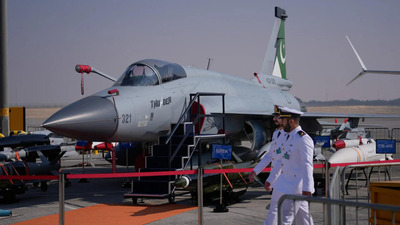
Pakistan on Saturday claimed that Iraq has expressed “keen interest” in acquiring JF-17 Thunder fighter jets and Super Mushshak training aircraft, following talks between the air chiefs of the two countries.
According to a statement issued by the Pakistan Army, air chief marshal Zaheer Ahmed Baber Sidhu, chief of air staff of the Pakistan Air Force (PAF), met lieutenant general staff pilot Mohanad Ghalib Mohammed Radi Al-Asadi, commander of the Iraqi Air Force, during an official visit to Iraq.
 Video
Video
The discussions focused on enhancing bilateral military cooperation, including joint training, capacity building and operational coordination.
“The Iraqi air chief praised PAF’s professionalism and technological advancement, expressed interest in benefiting from PAF’s world-class training and expressed keen interest in JF-17 Thunder fighter jets and Super Mushshak trainer aircraft,” the statement said, as quoted by news agency PTI.
Both sides also agreed to pursue joint exercises and training initiatives to strengthen interoperability between the two air forces.
The JF-17 Thunder is a single-engine, lightweight combat aircraft jointly developed by China’s Chengdu Aircraft Corporation and the Pakistan Aeronautical Complex.
Pakistan has claimed that the aircraft proved its capabilities during last year’s conflict with India, although its effectiveness remains disputed.
Pakistan had also deployed Chinese-origin J-10 fighter jets during the May 7–10 hostilities with India.
The development comes days after Pakistan and Bangladesh air chiefs held talks on the “potential procurement” of JF-17 jets by Dhaka. However, Bangladesh has not officially confirmed any such plan.
Pakistan’s defence minister Khawaja Asif recently claimed that the country has seen increased interest in its fighter aircraft following the May 2025 standoff with India. Reports have also suggested that Pakistan is exploring similar defence deals with other countries, including Saudi Arabia, amid ongoing financial pressures.
Notably, Pakistan has repeatedly relied on International Monetary Fund support in recent years, with the IMF approving a $7 billion bailout in September 2024 and an additional $1.4 billion loan in May 2025.
According to a statement issued by the Pakistan Army, air chief marshal Zaheer Ahmed Baber Sidhu, chief of air staff of the Pakistan Air Force (PAF), met lieutenant general staff pilot Mohanad Ghalib Mohammed Radi Al-Asadi, commander of the Iraqi Air Force, during an official visit to Iraq.
The discussions focused on enhancing bilateral military cooperation, including joint training, capacity building and operational coordination.
“The Iraqi air chief praised PAF’s professionalism and technological advancement, expressed interest in benefiting from PAF’s world-class training and expressed keen interest in JF-17 Thunder fighter jets and Super Mushshak trainer aircraft,” the statement said, as quoted by news agency PTI.
Both sides also agreed to pursue joint exercises and training initiatives to strengthen interoperability between the two air forces.
The JF-17 Thunder is a single-engine, lightweight combat aircraft jointly developed by China’s Chengdu Aircraft Corporation and the Pakistan Aeronautical Complex.
Pakistan has claimed that the aircraft proved its capabilities during last year’s conflict with India, although its effectiveness remains disputed.
Pakistan had also deployed Chinese-origin J-10 fighter jets during the May 7–10 hostilities with India.
The development comes days after Pakistan and Bangladesh air chiefs held talks on the “potential procurement” of JF-17 jets by Dhaka. However, Bangladesh has not officially confirmed any such plan.
Pakistan’s defence minister Khawaja Asif recently claimed that the country has seen increased interest in its fighter aircraft following the May 2025 standoff with India. Reports have also suggested that Pakistan is exploring similar defence deals with other countries, including Saudi Arabia, amid ongoing financial pressures.
Notably, Pakistan has repeatedly relied on International Monetary Fund support in recent years, with the IMF approving a $7 billion bailout in September 2024 and an additional $1.4 billion loan in May 2025.
Next Story