
Space Discovery: New Moons Around Saturn and Jupiter Revealed

The outer solar system just got a little busier. Astronomers have discovered new moons around Saturn and Jupiter, pushing the total number of known natural satellites in our solar system to an impressive 442.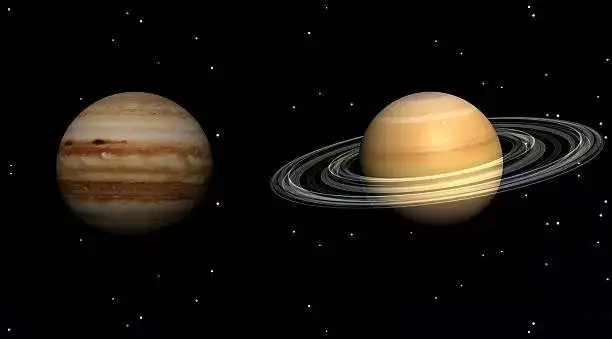
Saturn has strengthened its lead as the planet with the most moons, with 11 new additions bringing its total to 285. Jupiter, not far behind, has crossed a major milestone. With four newly identified moons, its count has now reached 101, marking the first time it has gone past the 100 mark.
These newly spotted moons are not the large, well-known ones like Titan or Europa. Instead, they fall into a category called “irregular” satellites. These are tiny objects, usually just a few kilometres wide, that orbit far away from their parent planets in unusual and stretched-out paths. They are also extremely faint, far beyond what amateur telescopes can detect.
To find these elusive objects, astronomers rely on a clever imaging technique known as “shift and stack.” This method involves capturing multiple images of the same region of space and layering them to highlight faint moving objects. It allows scientists to spot moons that would otherwise remain invisible.
The discoveries were made by different research teams. A group led by Edward Ashton identified Saturn’s new moons, while Scott Sheppard and David Tholen were behind Jupiter’s latest additions.
Because these moons are so small and scientifically limited in detail, they have not been given traditional names. Instead, they carry alphanumeric labels assigned under international naming guidelines.
Here is how the updated moon count across the solar system looks now:
So why does the number keep growing? The answer lies in better technology. Modern telescopes, combined with advanced image processing techniques, are making it easier to detect faint objects that were previously missed. Many of these small moons are thought to be captured asteroids or fragments left behind from ancient cosmic collisions.
With every new discovery, our understanding of the solar system becomes richer and more detailed. And if current trends continue, the moon count is likely to keep climbing in the years ahead.
Saturn has strengthened its lead as the planet with the most moons, with 11 new additions bringing its total to 285. Jupiter, not far behind, has crossed a major milestone. With four newly identified moons, its count has now reached 101, marking the first time it has gone past the 100 mark.
These newly spotted moons are not the large, well-known ones like Titan or Europa. Instead, they fall into a category called “irregular” satellites. These are tiny objects, usually just a few kilometres wide, that orbit far away from their parent planets in unusual and stretched-out paths. They are also extremely faint, far beyond what amateur telescopes can detect.
You may also like
- US visas to Indians, Chinese plummet under Donald Trump
- OPT protection bill introduced in US; over 1.43 lakh Indian students in post-study work programme
- India-Russia committed to increase trade to USD 100 billion: Jaishankar hails Special and Privileged Strategic Partnership
- Baloch activists allege rights violations by Pakistan at protest in Busan
- Surge in foreign tourists visiting Afghanistan in 2025
To find these elusive objects, astronomers rely on a clever imaging technique known as “shift and stack.” This method involves capturing multiple images of the same region of space and layering them to highlight faint moving objects. It allows scientists to spot moons that would otherwise remain invisible.
The discoveries were made by different research teams. A group led by Edward Ashton identified Saturn’s new moons, while Scott Sheppard and David Tholen were behind Jupiter’s latest additions.
Because these moons are so small and scientifically limited in detail, they have not been given traditional names. Instead, they carry alphanumeric labels assigned under international naming guidelines.
Here is how the updated moon count across the solar system looks now:
- Saturn: 285 moons
- Jupiter: 101 moons
- Uranus: 28 moons
- Neptune: 16 moons
- Mars: 2 moons
- Earth: 1 moon
- Mercury and Venus: No moons
So why does the number keep growing? The answer lies in better technology. Modern telescopes, combined with advanced image processing techniques, are making it easier to detect faint objects that were previously missed. Many of these small moons are thought to be captured asteroids or fragments left behind from ancient cosmic collisions.
With every new discovery, our understanding of the solar system becomes richer and more detailed. And if current trends continue, the moon count is likely to keep climbing in the years ahead.






More from our partners


Loving Newspoint? Download the app now
