
Why Indian Trucks Say 'Horn OK Please': The Real Story Behind the Phrase

Three words on the back of a truck. You have seen them so many times they have become wallpaper. But stop at any dhaba on a national highway and ask the driver sitting across from you where 'Horn OK Please' comes from, and you will get a confident answer that disagrees completely with the confident answer from the driver at the next table.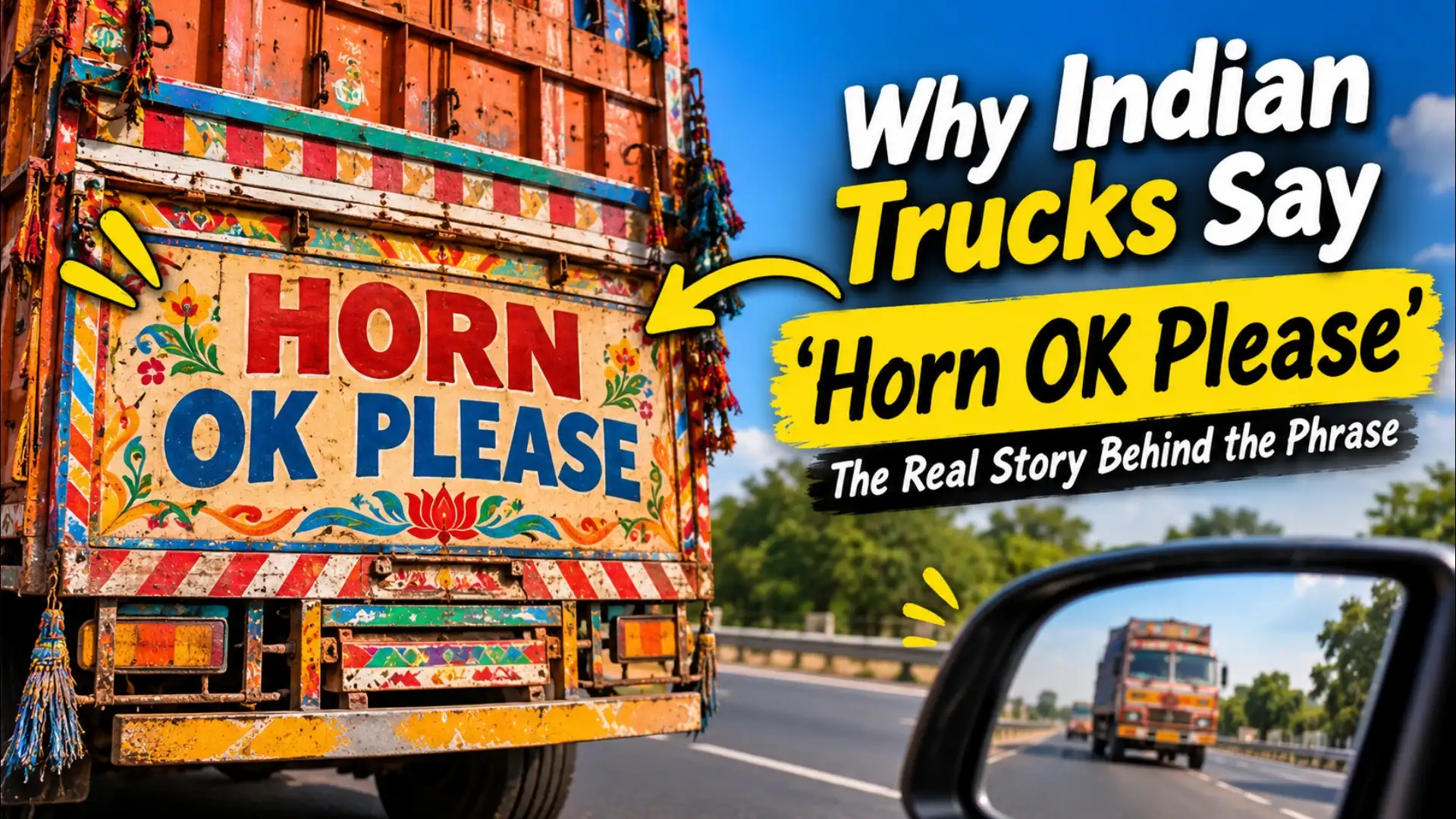
A driver who did not know was a wall. Honking before overtaking was a signal: I am here, I am coming, please make space. 'Horn OK Please' is a request addressed to the vehicle behind. Horn first. Then, if it is safe, the truck will signal OK, and the overtake can proceed. 'Please' is courtesy, or at least the performance of it. That much most people agree on.
To warn following vehicles to keep a safe distance from a potentially flammable load, operators stencilled 'OK' on the back, standing, in this version, for 'On Kerosene'. Over time, 'Horn' and 'Please' attached themselves to the warning, and the phrase became a compound of two separate instructions collapsed into one line.
This is a tidy story. It has a specific historical moment, a logical chain, and an acronym to anchor it. It is also unverified. No contemporary wartime document, no transport ministry circular, no period photograph of a truck with 'On Kerosene' stencilled on it has surfaced to confirm it. The story may be true. It may be a folk etymology that spread because it sounded plausible. Historians of Indian road transport have not settled it either way.
Tata Motors has neither confirmed nor denied this account in any statement that can be traced. The theory is plausible because Tata's market dominance would explain why a brand mark became a universal convention, but plausibility is not evidence. It remains one of several competing stories, not the settled explanation.
Once a phrase enters that tradition, its origin becomes less important than its presence. A new truck owner paints it because every truck has it. A painter stencils it because that is what goes there. The phrase has outlived whatever specific instruction or mark it may once have been, and become something closer to a signature of Indian road culture itself.
The competing explanations are not a failure of research. They are what happens when a phrase passes through enough hands, enough decades, and enough coats of paint that its beginning dissolves into use. The trucks keep moving. The words stay on.
Each theory holds a piece of something real, the practical logic of overtaking, the material constraints of a particular era, the commercial weight of a dominant manufacturer. None of them alone closes the case. That is not a reason to pick the most colourful one and call it settled. It is a reason to read the back of the next truck you follow on a highway and sit with the fact that some of the most familiar things carry the most unresolved histories.
What the Phrase Is Actually Asking
Start with the part that is not in dispute. The instruction is practical. Indian highways, especially before road-widening projects changed the landscape, were narrow enough that overtaking a heavy truck was a genuine negotiation. A truck driver who knew someone was behind him and ready to pass could ease left and give room.A driver who did not know was a wall. Honking before overtaking was a signal: I am here, I am coming, please make space. 'Horn OK Please' is a request addressed to the vehicle behind. Horn first. Then, if it is safe, the truck will signal OK, and the overtake can proceed. 'Please' is courtesy, or at least the performance of it. That much most people agree on.
The World War II Kerosene Theory
The explanation that circulates most widely online, and in enough print that it has acquired a patina of authority, connects the phrase to the Second World War. Petrol was rationed and scarce. Many trucks ran on kerosene instead, which is more volatile and carries a higher fire risk.To warn following vehicles to keep a safe distance from a potentially flammable load, operators stencilled 'OK' on the back, standing, in this version, for 'On Kerosene'. Over time, 'Horn' and 'Please' attached themselves to the warning, and the phrase became a compound of two separate instructions collapsed into one line.
You may also like
- Mercedes GLC: Launch priced at Rs 78.50 lakh, but will it reshape India's luxury EV market?
- VinFast India: Strategy Features EVs and Free Charging Offers
- VinFast VF MPV 7 Gets a ₹4.10 Lakh Price Cut in India: New Price Starts at ₹20.39 Lakh
- Indian Car Buyers Are Changing Preferences: SUVs, CNG and EVs Gain Popularity as ₹12–20 Lakh Cars Lead Sales Growth
- Hero Xpulse 450 Unveiled at EICMA 2026: Gets 421cc Engine, Adjustable Suspension and 7-Inch Smart Display
This is a tidy story. It has a specific historical moment, a logical chain, and an acronym to anchor it. It is also unverified. No contemporary wartime document, no transport ministry circular, no period photograph of a truck with 'On Kerosene' stencilled on it has surfaced to confirm it. The story may be true. It may be a folk etymology that spread because it sounded plausible. Historians of Indian road transport have not settled it either way.
The Tata Motors Brand Theory
A second explanation points to Tata Motors, which has dominated Indian commercial vehicle manufacturing for most of the country's post-independence history. In this version, 'OK' was a Tata quality mark, a stamp of approval applied to vehicles that had passed inspection at the factory or at a service point. Truck owners and drivers, seeing the mark on their vehicles and wanting to display it, began incorporating it into the decorative painting that has always been a feature of Indian truck culture. 'Horn' and 'Please' were already in circulation as road instructions, and the three elements fused.Tata Motors has neither confirmed nor denied this account in any statement that can be traced. The theory is plausible because Tata's market dominance would explain why a brand mark became a universal convention, but plausibility is not evidence. It remains one of several competing stories, not the settled explanation.
Truck Art and the Life of a Phrase
Whatever its origin, 'Horn OK Please' survived and spread because of something that has nothing to do with kerosene or quality stamps: the tradition of truck art. Indian trucks are among the most elaborately decorated commercial vehicles in the world. Owners commission painters to cover cabins, mudguards, and tailgates with gods, film stars, mountains, peacocks, and slogans. The back of the truck is a canvas, and 'Horn OK Please' became a fixture on that canvas the way certain phrases become fixtures in folk songs, repeated until they are no longer questioned, only decorated.Once a phrase enters that tradition, its origin becomes less important than its presence. A new truck owner paints it because every truck has it. A painter stencils it because that is what goes there. The phrase has outlived whatever specific instruction or mark it may once have been, and become something closer to a signature of Indian road culture itself.
Why the Uncertainty Is the Honest Answer
It would be satisfying to end with a single confirmed origin. The phrase does not offer one. What it offers instead is a case study in how everyday language works on the road: a practical instruction, possibly a wartime adaptation, possibly a brand mark, definitely a piece of folk art, and now an idiom so embedded that it has appeared on T-shirts, ceramics, and the backs of auto-rickshaws in cities where trucks rarely go.The competing explanations are not a failure of research. They are what happens when a phrase passes through enough hands, enough decades, and enough coats of paint that its beginning dissolves into use. The trucks keep moving. The words stay on.
Each theory holds a piece of something real, the practical logic of overtaking, the material constraints of a particular era, the commercial weight of a dominant manufacturer. None of them alone closes the case. That is not a reason to pick the most colourful one and call it settled. It is a reason to read the back of the next truck you follow on a highway and sit with the fact that some of the most familiar things carry the most unresolved histories.






Loving Newspoint? Download the app now
