
Why the Same Car Gives Different Mileage to Different Drivers: 7 Key Reasons

When auto manufacturers launch a new vehicle, they proudly advertise official fuel consumption figures calculated under controlled laboratory testing conditions. Two neighbors can buy the exact same car model, use the same fuel brand, and drive on similar roads, yet end up with dramatically different fuel bills at the end of the month.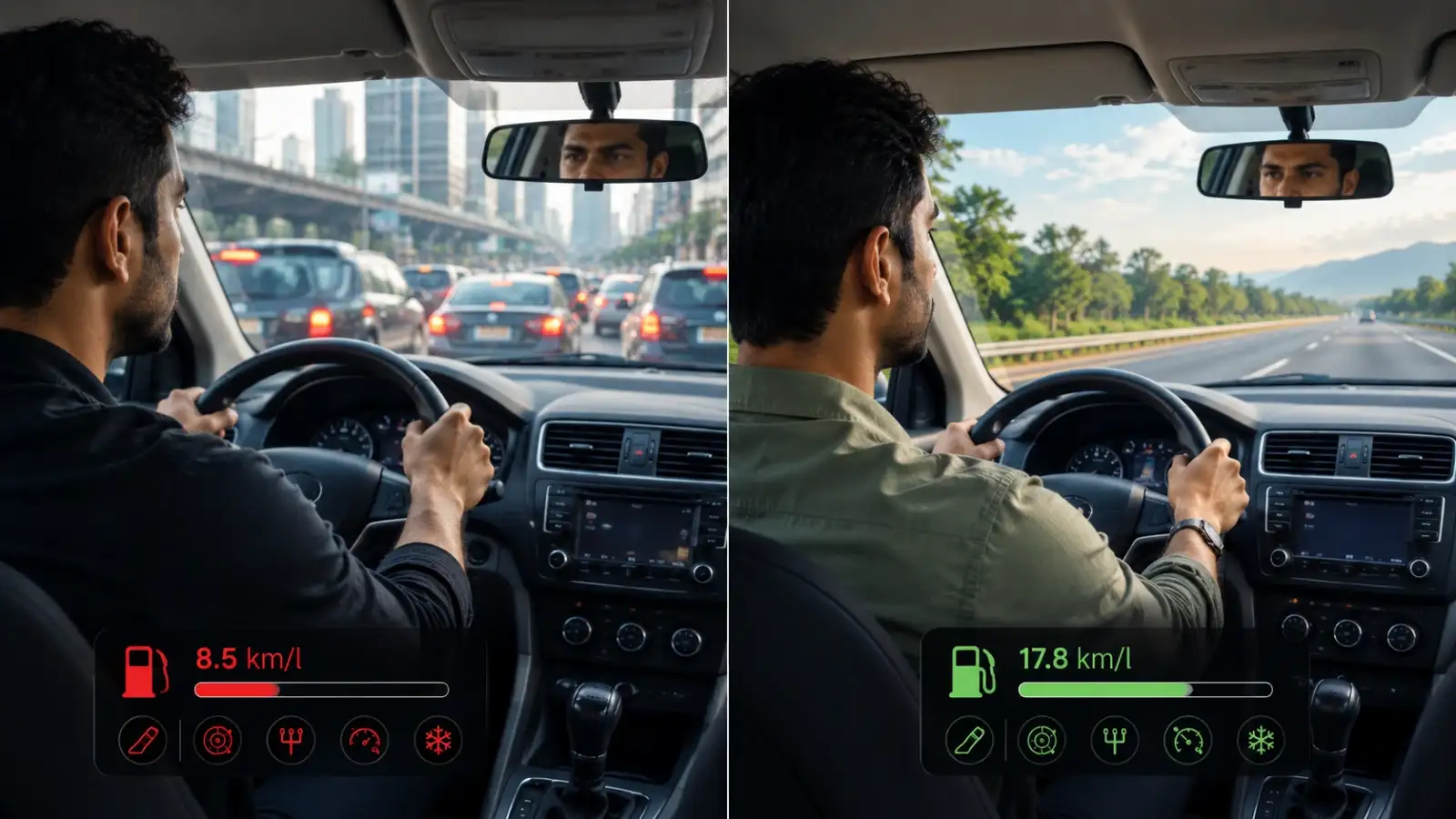
One driver consistently achieves impressive fuel savings, while the other struggles to reach even basic efficiency targets. It is easy to suspect a mechanical fault or a faulty sensor, but the primary variable is rarely the machinery itself. Exploring why the same car gives different mileage to different drivers reveals how acceleration habits, braking patterns, gear management, speed selection, and daily cabin habits directly impact fuel consumption.
In contrast, aggressive drivers press hard on the accelerator to launch quickly from traffic lights or overtake vehicles rapidly. Rapid acceleration forces the engine control unit to inject high quantities of fuel into the combustion cylinders, creating a rich fuel mixture that wastes energy. Furthermore, drivers who accelerate hard usually end up braking harshly at the next intersection. Hard braking converts kinetic energy into useless brake disc heat. Smooth drivers anticipate traffic flow, lifting off the accelerator early to coast gently, preserving momentum and saving substantial amounts of fuel over every journey.
Inexperienced or distracted drivers often hold lower gears for too long, forcing the engine to run at high revolutions per minute. High engine speeds make internal components work harder and consume excessive fuel unnecessarily. On the other hand, shifting into a higher gear too early causes engine lugging, forcing the engine to struggle under heavy strain. Drivers who master timely gear shifts keep the engine operating smoothly in its optimal efficiency band, achieving significantly better distance per litre than drivers who ignore engine noise and tachometer readings.
High speeds force the engine to work constantly against air drag, burning fuel rapidly just to maintain velocity. Additionally, drivers who constantly change lanes, speed up, and slow down lose valuable kinetic momentum. Steady drivers who maintain a consistent speed using smooth throttle inputs or cruise control preserve forward momentum, enjoying far better overall range from a single tank.
Furthermore, drivers who clutter their boot with heavy luggage or drive on underinflated tyres create higher rolling resistance against the road surface. Keeping tyres properly inflated and removing unnecessary weight lowers rolling resistance, helping smooth drivers maximize every drop of fuel.
One driver consistently achieves impressive fuel savings, while the other struggles to reach even basic efficiency targets. It is easy to suspect a mechanical fault or a faulty sensor, but the primary variable is rarely the machinery itself. Exploring why the same car gives different mileage to different drivers reveals how acceleration habits, braking patterns, gear management, speed selection, and daily cabin habits directly impact fuel consumption.
Aggressive acceleration and harsh braking dynamics
The single most significant factor causing fuel consumption discrepancies between drivers is foot control on the pedals. Smooth drivers press the accelerator gently, allowing the engine to build momentum gradually without burning unnecessary fuel.In contrast, aggressive drivers press hard on the accelerator to launch quickly from traffic lights or overtake vehicles rapidly. Rapid acceleration forces the engine control unit to inject high quantities of fuel into the combustion cylinders, creating a rich fuel mixture that wastes energy. Furthermore, drivers who accelerate hard usually end up braking harshly at the next intersection. Hard braking converts kinetic energy into useless brake disc heat. Smooth drivers anticipate traffic flow, lifting off the accelerator early to coast gently, preserving momentum and saving substantial amounts of fuel over every journey.
Gear shifting choices and engine speed management
For vehicles with manual transmissions or dual-clutch automatics with manual modes, gear selection plays a crucial role in overall fuel economy. Every engine operates most efficiently within a sweet spot of revolutions per minute.You may also like
- Bain Capital Eyes ₹2,850 Crore Investment in JBM Auto's EV Business: Here's Why It Matters
- New Maruti Baleno Could Get 5 Major Upgrades: CNG-AMT, Ventilated Seats and More
- Tata Cars to Get Costlier From September 1: Prices May Rise by Up to ₹25,000
- Your Helmet Can Expire Too! Know When It's Time to Replace Your Old Helmet
- Maruti Victoris Gets New Rivals! Hyundai and Kia Prepare Two New SUVs for India
Inexperienced or distracted drivers often hold lower gears for too long, forcing the engine to run at high revolutions per minute. High engine speeds make internal components work harder and consume excessive fuel unnecessarily. On the other hand, shifting into a higher gear too early causes engine lugging, forcing the engine to struggle under heavy strain. Drivers who master timely gear shifts keep the engine operating smoothly in its optimal efficiency band, achieving significantly better distance per litre than drivers who ignore engine noise and tachometer readings.
Cruising speeds, aerodynamic drag, and momentum preservation
Air resistance increases exponentially as vehicle speed rises, meaning that driving faster requires disproportionately more power. A driver who cruises comfortably at ninety kilometres per hour on an open highway experiences minimal aerodynamic drag compared to a driver pushing the same vehicle at one hundred and twenty kilometres per hour.High speeds force the engine to work constantly against air drag, burning fuel rapidly just to maintain velocity. Additionally, drivers who constantly change lanes, speed up, and slow down lose valuable kinetic momentum. Steady drivers who maintain a consistent speed using smooth throttle inputs or cruise control preserve forward momentum, enjoying far better overall range from a single tank.
Air conditioning use, extra weight, and tyre maintenance habits
Individual driver lifestyle choices and vehicle care habits also alter daily efficiency figures. Running the air conditioning system continuously places a heavy mechanical load on the engine belt, increasing fuel usage in city traffic.Furthermore, drivers who clutter their boot with heavy luggage or drive on underinflated tyres create higher rolling resistance against the road surface. Keeping tyres properly inflated and removing unnecessary weight lowers rolling resistance, helping smooth drivers maximize every drop of fuel.
Taking control of your vehicle fuel economy
Understanding why the same car gives different mileage to different drivers proves that efficient driving is an acquired skill. By adopting smooth pedal control, anticipating road conditions, and maintaining your vehicle, you can unlock optimal efficiency on every drive.





Loving Newspoint? Download the app now
