
8th CPC: BPS seeks 11-year pension restoration period


Bharat Pensioners' Samaj (BPS), an organisation representing a large number of central government pensioners, has requested the Centre and the 8th Pay Commission to reduce the pension commutation period from 15 years to 11 years.
The BPS’ demand came in the wake of the Himachal Pradesh High Court’s decision dated September 16, 2026, where the Court did not reduce the 15-year pension commutation period, but emphasised the need to examine the issue rationally under the changed circumstances and relevant actuarial parameters.
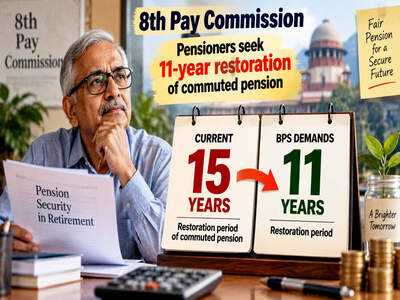
Avinash Rajput, secretary general, BPS, in a letter dated September 21, 2026, to the chairperson, 8th CPC, and the secretary, the Department of Pension & Pensioners’ Welfare, requested that an evidence-based actuarial review be conducted and that the commuted pension should be restored in 11 years instead of 15.
Central government pensioners have the option of a commuted pension, where they can take up to 40% of their basic pension as a lump sum at the time of retirement. The commuted portion is deducted from their monthly pension and is restored only after 15 years. The commuted pension option is available to pensioners drawing their pension under the Old Pension Scheme (OPS).
The BPS and many other central government employee and pensioner associations are of the view that the commuted pension is calculated at financial parameters that were set decades ago. They claim that under the current financial parameters, the government recovers the commuted pension amount in just 10 years.
BPS explains Himachal Pradesh HC’s view on commuted pension in its letter
The BPS writes that the Himachal Pradesh High Court examined the issue in the context of substantial changes in the actuarial and economic parameters underlying pension commutation, including-
Change in commutation factor: The factor at age 58 has reduced substantially—from the historical figure of 10.46 to 8.194 for central government employees. Changes in interest/discount rates and economic conditions, which materially affect the actuarial basis of the commutation calculation. Increase in life expectancy and changes in mortality patterns, reducing the risk of premature death and non-recovery of the commuted amount. The present central government commutation table came into effect on January 1, 2006, and the restoration period has continued at 15 years despite significant changes in economic, demographic and actuarial conditions since then. What BPS wants from government regarding commuted pension
In its letter, the BPS has raised five-point demands from the central government and the 8th Pay Commission. The BPS’ demands are-
The 8th Central Pay Commission may undertake a fresh actuarial review of the commutation table, factors, interest, discount rates, mortality/longevity data and the actual recovery period. The existing 15-year restoration period may be reconsidered based on current actuarial and economic parameters. As an immediate measure, the restoration of the commuted portion after 11 years may be examined. If an updated actuarial study supports a shorter period, the same may also be considered. An expert/actuarial committee, including qualified actuaries, representatives of the concerned ministries/8th CPC and pensioners’ organisations, may be constituted to examine the matter objectively and make time-bound recommendations. Suitable amendments to the CCS (Commutation of Pension) Rules may thereafter be recommended, with consideration also given to extending any revised provision to existing pensioners wherever legally and administratively feasible. The BPS says that the Himachal Pradesh HC provides an appropriate opportunity to reassess whether the existing 15-year restoration period remains actuarially justified under present-day conditions.
BPS has requested the government and the 8th Pay Commission to undertake an evidence-based actuarial review and consider the reduction of the pension restoration period to 11 years.
The BPS’ demand came in the wake of the Himachal Pradesh High Court’s decision dated September 16, 2026, where the Court did not reduce the 15-year pension commutation period, but emphasised the need to examine the issue rationally under the changed circumstances and relevant actuarial parameters.
Avinash Rajput, secretary general, BPS, in a letter dated September 21, 2026, to the chairperson, 8th CPC, and the secretary, the Department of Pension & Pensioners’ Welfare, requested that an evidence-based actuarial review be conducted and that the commuted pension should be restored in 11 years instead of 15.
Central government pensioners have the option of a commuted pension, where they can take up to 40% of their basic pension as a lump sum at the time of retirement. The commuted portion is deducted from their monthly pension and is restored only after 15 years. The commuted pension option is available to pensioners drawing their pension under the Old Pension Scheme (OPS).
The BPS and many other central government employee and pensioner associations are of the view that the commuted pension is calculated at financial parameters that were set decades ago. They claim that under the current financial parameters, the government recovers the commuted pension amount in just 10 years.
BPS explains Himachal Pradesh HC’s view on commuted pension in its letter
The BPS writes that the Himachal Pradesh High Court examined the issue in the context of substantial changes in the actuarial and economic parameters underlying pension commutation, including-
In its letter, the BPS has raised five-point demands from the central government and the 8th Pay Commission. The BPS’ demands are-
BPS has requested the government and the 8th Pay Commission to undertake an evidence-based actuarial review and consider the reduction of the pension restoration period to 11 years.
Next Story