
8th CPC: How much HRA Level 10 officers may get


The 8th Pay Commission began its meeting with employee and pensioner associations and other stakeholders in Chandigarh today (Wednesday, September 16, 2026). The three-day discussions started after the commission held similar meetings in Puducherry, Chennai and Jaipur this month.
In the meetings in Chandigarh, the pay commission is most likely to discuss central government employees’ issues related to pay, pension, allowances and work-related changes. In all previous discussions of the 8th Pay Commission with stakeholders, the issue of house rent allowance (HRA) has been discussed prominently. Since HRA forms a major part of employees’ salary, central government employee and pensioner bodies want the HRA to be raised prominently in the wake of fast-rising rents in Tier I and II cities. Most bodies also want HRA benefits to be extended to pensioners.
Stakeholders’ HRA recommendations to 8th Pay Commission
Source: Official memorandums
The National Council – Joint Consultative Machinery, the umbrella central government employee body, has recommended increasing the HRA rates from the 7th Pay Commission’s ranges of 24% of the basic pay (X-category cities), 16% (Y) and 8% (Z) cities to 40%, 35% and 30%, respectively.
The All India Defence Employees’ Federation, which represents civilian Defence employees, also has a similar demand for HRA rates. Like the NC-JCM, the AIDEF also wants HRA benefits for pensioners. The Indian Railways Technical Supervisors Association, on the other hand, has proposed a 4-Tier HRA, where it wants 40%, 30%, 20% and 10% HRA rates for different classes of cities.
At present, central government employees get 30% (X-category cities), 20% (Y) and 10% (Z) HRA rates after they were revised in January 2024, when the dearness allowance (DA) for these employees reached 50%.
How increased HRA rates may impact salaries of employees
HRA is a percentage of the basic salary. When the government notifies the 8th Pay Commission report, a new fitment factor will emerge. With that, the HRA amount will automatically be increased. If HRA rates are also increased, the salary jump can even be higher.
For example, a Level 1 employee gets Rs 18,000 as the basic pay and 30% of basic pay as HRA (for X-category city) under the 7th Pay Commission. If the 8th Pay Commission’s fitment factor is 2.1 and the government retains the 30% HRA rate, they may get an additional HRA of 5,940 per month.
But if, at the same fitment factor of 2.1, the HRA rate is increased to 35%, the additional HRA amount per month can be Rs 7,830.
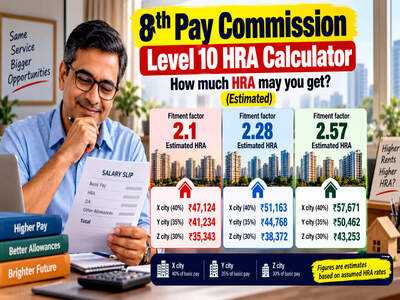
Estimated 8th Pay Commission HRA for Level 10 officers at 2.1, 2.28 and 2.57 fitment factors?
Since the HRA rates for the 8th Pay Commission will be known only after the report is notified, for HRA calculation purposes for a Level 10 employee, we are taking the NC-JCM-recommended HRA rates of 40%, 35% and 30%.
As per the 7th Pay Commission, a Level 10 officer has a basic salary of Rs 56,100, and at 30%, 20%, and 10% HRA rates, they get Rs 16,830, Rs 11,220, and Rs 5,610, respectively, for different categories of cities. Now let’s see what can be their HRA rates at 2.1, 2.28 and 2.57 fitment factors and 40%, 35% and 30%.
You can see that at a 2.57 fitment factor and 40% HRA rates, a Level 10 officer may get more than Rs 57,671 as HRA.
However, the real jump in their HRA will be known only after the 8th Pay Commission’s report is notified.
In the meetings in Chandigarh, the pay commission is most likely to discuss central government employees’ issues related to pay, pension, allowances and work-related changes. In all previous discussions of the 8th Pay Commission with stakeholders, the issue of house rent allowance (HRA) has been discussed prominently. Since HRA forms a major part of employees’ salary, central government employee and pensioner bodies want the HRA to be raised prominently in the wake of fast-rising rents in Tier I and II cities. Most bodies also want HRA benefits to be extended to pensioners.
Stakeholders’ HRA recommendations to 8th Pay Commission
Source: Official memorandums
The National Council – Joint Consultative Machinery, the umbrella central government employee body, has recommended increasing the HRA rates from the 7th Pay Commission’s ranges of 24% of the basic pay (X-category cities), 16% (Y) and 8% (Z) cities to 40%, 35% and 30%, respectively.
The All India Defence Employees’ Federation, which represents civilian Defence employees, also has a similar demand for HRA rates. Like the NC-JCM, the AIDEF also wants HRA benefits for pensioners. The Indian Railways Technical Supervisors Association, on the other hand, has proposed a 4-Tier HRA, where it wants 40%, 30%, 20% and 10% HRA rates for different classes of cities.
At present, central government employees get 30% (X-category cities), 20% (Y) and 10% (Z) HRA rates after they were revised in January 2024, when the dearness allowance (DA) for these employees reached 50%.
How increased HRA rates may impact salaries of employees
HRA is a percentage of the basic salary. When the government notifies the 8th Pay Commission report, a new fitment factor will emerge. With that, the HRA amount will automatically be increased. If HRA rates are also increased, the salary jump can even be higher.
For example, a Level 1 employee gets Rs 18,000 as the basic pay and 30% of basic pay as HRA (for X-category city) under the 7th Pay Commission. If the 8th Pay Commission’s fitment factor is 2.1 and the government retains the 30% HRA rate, they may get an additional HRA of 5,940 per month.
But if, at the same fitment factor of 2.1, the HRA rate is increased to 35%, the additional HRA amount per month can be Rs 7,830.
Estimated 8th Pay Commission HRA for Level 10 officers at 2.1, 2.28 and 2.57 fitment factors?
Since the HRA rates for the 8th Pay Commission will be known only after the report is notified, for HRA calculation purposes for a Level 10 employee, we are taking the NC-JCM-recommended HRA rates of 40%, 35% and 30%.
As per the 7th Pay Commission, a Level 10 officer has a basic salary of Rs 56,100, and at 30%, 20%, and 10% HRA rates, they get Rs 16,830, Rs 11,220, and Rs 5,610, respectively, for different categories of cities. Now let’s see what can be their HRA rates at 2.1, 2.28 and 2.57 fitment factors and 40%, 35% and 30%.
You can see that at a 2.57 fitment factor and 40% HRA rates, a Level 10 officer may get more than Rs 57,671 as HRA.
However, the real jump in their HRA will be known only after the 8th Pay Commission’s report is notified.
Next Story