
Govt proposes battery storage for larger rooftop solar systems


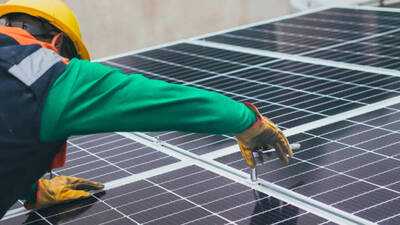
NEW DELHI: Govt has proposed making battery storage mandatory for larger rooftop solar installations , with consumers potentially required to install storage capacity equivalent to at least 20% of their daily generation, as it seeks to address grid management challenges arising from growing adoption of distributed renewable energy .
Under the revised draft Electricity (Rights of Consumers) Amendment Rules, 2026, circulated by the power ministry for stakeholder comments, state electricity regulatory commissions (SERCs) will be empowered to specify the capacity threshold beyond which rooftop solar consumers will have to install energy storage systems . In the absence of a threshold, the requirement will apply to renewable energy installations exceeding 10 kW.
The proposed provision will come into effect from April 1, 2028. Officials said the move is aimed at encouraging consumers to store surplus solar power generated during the day for use during evening peak hours, reducing the pressure on distribution companies (discoms) to manage fluctuations in renewable energy generation and procure expensive power to meet peak demand.
The ministry has also proposed changes to the net-metering framework, allowing SERCs to levy charges on rooftop solar consumers beyond a specified capacity threshold, taking into account the imputed cost of energy storage and network losses. No such charges will be levied up to the capacity threshold determined by the respective commission.
Officials said rooftop solar consumers use the distribution network to inject surplus power during solar hours and draw electricity during non-solar hours without fully contributing to the recovery of fixed costs. “It results in increased cross-subsidisation by other retail consumers. We have tried to address this issue,” said an official.
The draft also proposes allowing consumers to install renewable energy generation systems on other parts of their premises apart from rooftops, with installed capacity permitted to exceed their sanctioned electricity load, subject to limits prescribed by SERCs.
Govt has also proposed deferring the implementation of time-of-day tariffs to April 1, 2028, for consumers with maximum demand exceeding 10 kW and April 1, 2029, for other non-agricultural consumers.
The draft also seeks to strengthen consumer protection by requiring discoms to automatically review unusually high or low electricity bills, where consumption exceeds five times or falls below one-fifth of the average consumption during the previous six billing cycles. Consumers will not face disconnection if they continue paying based on their average consumption until the discrepancy is resolved, which must be done within 30 days.
Under the revised draft Electricity (Rights of Consumers) Amendment Rules, 2026, circulated by the power ministry for stakeholder comments, state electricity regulatory commissions (SERCs) will be empowered to specify the capacity threshold beyond which rooftop solar consumers will have to install energy storage systems . In the absence of a threshold, the requirement will apply to renewable energy installations exceeding 10 kW.
The proposed provision will come into effect from April 1, 2028. Officials said the move is aimed at encouraging consumers to store surplus solar power generated during the day for use during evening peak hours, reducing the pressure on distribution companies (discoms) to manage fluctuations in renewable energy generation and procure expensive power to meet peak demand.
The ministry has also proposed changes to the net-metering framework, allowing SERCs to levy charges on rooftop solar consumers beyond a specified capacity threshold, taking into account the imputed cost of energy storage and network losses. No such charges will be levied up to the capacity threshold determined by the respective commission.
Officials said rooftop solar consumers use the distribution network to inject surplus power during solar hours and draw electricity during non-solar hours without fully contributing to the recovery of fixed costs. “It results in increased cross-subsidisation by other retail consumers. We have tried to address this issue,” said an official.
The draft also proposes allowing consumers to install renewable energy generation systems on other parts of their premises apart from rooftops, with installed capacity permitted to exceed their sanctioned electricity load, subject to limits prescribed by SERCs.
Govt has also proposed deferring the implementation of time-of-day tariffs to April 1, 2028, for consumers with maximum demand exceeding 10 kW and April 1, 2029, for other non-agricultural consumers.
The draft also seeks to strengthen consumer protection by requiring discoms to automatically review unusually high or low electricity bills, where consumption exceeds five times or falls below one-fifth of the average consumption during the previous six billing cycles. Consumers will not face disconnection if they continue paying based on their average consumption until the discrepancy is resolved, which must be done within 30 days.
Next Story