
How new wage ceiling may impact EPF, EPS, EDLI


The Employees’ Provident Fund Organisation (EPFO) announced that the new Employees’ Provident Fund (EPF) wage ceiling of Rs 25,000 will come into effect today (Thursday, September 17, 2026) on the occasion of Vishwakarma Jayanti. The higher ceiling could change the amount that employers and employees contribute towards the employee’s Employees’ Provident Fund (EPF). The higher ceiling will also impact the monthly pension amount of the Employees’ Pension Scheme (EPS) subscribers, and is likely to increase the insurance cover under the Employees’ Deposit Linked Insurance (EDLI) scheme.
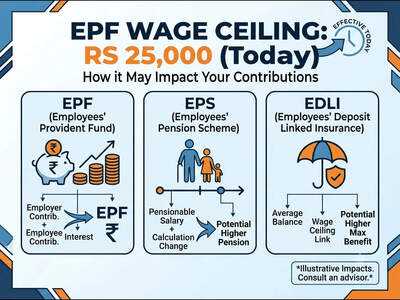
Now employees earning up to Rs 25,000 as basic pay mandatorily need to join the EPF and the EPS. Employees who joined their service on or after September 1, 2014, are not EPS members. Since the EDLI insurance cover is also calculated at the wage ceiling, a higher ceiling may lead to the maximum insurance amount rising from Rs 7 lakh to Rs 10.50 lakh.
Puneet Gupta, partner, People Advisory Services-Tax, EY India, explains, “This is expected to enhance retirement savings and social security coverage for employees. However, it will also have a direct cost implication for employers through a higher PF, pension and EDLI contributions, particularly for employees currently drawing wages between Rs 15,000 and Rs 25,000 where contributions are restricted to the statutory ceiling. Employees in the affected salary bracket are also likely to witness a reduction in take-home pay due to the higher employee PF contribution.”
How high wage ceiling may impact your EPF contributions
Under EPF contributions, both employers and employees contribute the same percentage to the employee’s EPF, a minimum of 12% of the wage cap limit. The previous minimum EPF contribution was Rs 1,800, which was calculated at 12% of the previous ceiling of Rs 15,000.
Now, the current wage ceiling is Rs 25,000. So the new contribution by both employer and employee will be Rs 3,000 (12% of Rs 25,000) each.
Thus Rs 1,200 (3,000-1,800) is the extra EPF contribution from both employer and employee (Rs 1,200*2= Rs 2,400) each.
Suchita Dutta, Executive Director of Indian Staffing Federation (ISF) explains, "The Cabinet’s decision to elevate the EPFO wage threshold to ₹25,000 marks a decisive turning point for India’s workforce landscape, striking at the very core of the flexi-staffing ecosystem. By pulling over 51 lakh workers into mandatory social security, the policy targets the precise salary band where informal hiring previously thrived. For fully compliant staffing firms, this eliminates the unfair cost advantage long enjoyed by unorganized operators, effectively resetting the competitive baseline. Beyond fiscal mechanics supported by an expanded ₹11,339 crore state outlay, the move transforms flexible employment from a stopgap measure into a sustainable career path. Portable benefits directly tackle industry-wide attrition, giving organized staffing agencies an undeniable edge in onboarding, retaining, and protecting talent transparently. Ultimately, it solidifies organized staffing as the nation's primary vehicle for turning informal labor into formal economic capital."
How high wage ceiling can impact EPS pension
Following the government's new wage ceiling decision, employees with a basic salary of Rs 25,000 or less would be eligible to join the EPS scheme in addition to the EPF. Under the EPS, subscribers are eligible to get a monthly pension at retirement only if they have completed 10 years of service.
Since the EPS pension is calculated at the 60-month average pay preceding the date of exit from EPS membership, a higher wage ceiling means, pension will be calculated at Rs 25,000, instead of 15,000 for employees whose 60-month average salary is Rs 25,000 or higher. However, in that case, their EPS contribution years under the new wage ceiling should be at least five years (60 months).
How high wage ceiling may impact your EDLI insurance cover
According to the current EDLI rules, if an EPF member dies while on duty, their nominee is entitled to a minimum of Rs 2.5 lakh and a maximum of Rs 7 lakh in insurance benefits. The maximum cover is calculated at Rs 15,000 wage ceiling. However, with the EPF wage ceiling rising to Rs 25,000 now, the maximum value insured might rise to Rs 10.50 lakh or more.
According to the EDLI 2026 scheme, the formula to calculate the EDLI insurance amount is:
EDLI benefit = (Average monthly salary of last 12 months x 35) capped at Rs 15,000 + 50% of the last 12-month average EPF balance preceding the month of employee’s death.
EDLI benefit= (Rs 15,000 x 35) + Rs 1,75,000= Rs 7,00,000
A new wage ceiling of Rs 25,000 can bring a higher coverage amount for the deceased employee whose 12-month average salary preceding the month he died was Rs 25,000 or above.
EDLI benefit under Rs 25,000 wage ceiling (estimated)= (Rs 25,000 x 35) + 1,75,000= Rs 10,50,000.
According to the notification of the ELDI 2026 scheme, the EPF ceiling for the EDLI benefit calculation is Rs 1,75,000, but if the government revises it after the EPF wage ceiling hike, the EDLI benefit can be more than Rs 10.50 lakh.
Now employees earning up to Rs 25,000 as basic pay mandatorily need to join the EPF and the EPS. Employees who joined their service on or after September 1, 2014, are not EPS members. Since the EDLI insurance cover is also calculated at the wage ceiling, a higher ceiling may lead to the maximum insurance amount rising from Rs 7 lakh to Rs 10.50 lakh.
Puneet Gupta, partner, People Advisory Services-Tax, EY India, explains, “This is expected to enhance retirement savings and social security coverage for employees. However, it will also have a direct cost implication for employers through a higher PF, pension and EDLI contributions, particularly for employees currently drawing wages between Rs 15,000 and Rs 25,000 where contributions are restricted to the statutory ceiling. Employees in the affected salary bracket are also likely to witness a reduction in take-home pay due to the higher employee PF contribution.”
How high wage ceiling may impact your EPF contributions
Under EPF contributions, both employers and employees contribute the same percentage to the employee’s EPF, a minimum of 12% of the wage cap limit. The previous minimum EPF contribution was Rs 1,800, which was calculated at 12% of the previous ceiling of Rs 15,000.
Now, the current wage ceiling is Rs 25,000. So the new contribution by both employer and employee will be Rs 3,000 (12% of Rs 25,000) each.
Thus Rs 1,200 (3,000-1,800) is the extra EPF contribution from both employer and employee (Rs 1,200*2= Rs 2,400) each.
Suchita Dutta, Executive Director of Indian Staffing Federation (ISF) explains, "The Cabinet’s decision to elevate the EPFO wage threshold to ₹25,000 marks a decisive turning point for India’s workforce landscape, striking at the very core of the flexi-staffing ecosystem. By pulling over 51 lakh workers into mandatory social security, the policy targets the precise salary band where informal hiring previously thrived. For fully compliant staffing firms, this eliminates the unfair cost advantage long enjoyed by unorganized operators, effectively resetting the competitive baseline. Beyond fiscal mechanics supported by an expanded ₹11,339 crore state outlay, the move transforms flexible employment from a stopgap measure into a sustainable career path. Portable benefits directly tackle industry-wide attrition, giving organized staffing agencies an undeniable edge in onboarding, retaining, and protecting talent transparently. Ultimately, it solidifies organized staffing as the nation's primary vehicle for turning informal labor into formal economic capital."
How high wage ceiling can impact EPS pension
Following the government's new wage ceiling decision, employees with a basic salary of Rs 25,000 or less would be eligible to join the EPS scheme in addition to the EPF. Under the EPS, subscribers are eligible to get a monthly pension at retirement only if they have completed 10 years of service.
Since the EPS pension is calculated at the 60-month average pay preceding the date of exit from EPS membership, a higher wage ceiling means, pension will be calculated at Rs 25,000, instead of 15,000 for employees whose 60-month average salary is Rs 25,000 or higher. However, in that case, their EPS contribution years under the new wage ceiling should be at least five years (60 months).
How high wage ceiling may impact your EDLI insurance cover
According to the current EDLI rules, if an EPF member dies while on duty, their nominee is entitled to a minimum of Rs 2.5 lakh and a maximum of Rs 7 lakh in insurance benefits. The maximum cover is calculated at Rs 15,000 wage ceiling. However, with the EPF wage ceiling rising to Rs 25,000 now, the maximum value insured might rise to Rs 10.50 lakh or more.
According to the EDLI 2026 scheme, the formula to calculate the EDLI insurance amount is:
EDLI benefit = (Average monthly salary of last 12 months x 35) capped at Rs 15,000 + 50% of the last 12-month average EPF balance preceding the month of employee’s death.
EDLI benefit= (Rs 15,000 x 35) + Rs 1,75,000= Rs 7,00,000
A new wage ceiling of Rs 25,000 can bring a higher coverage amount for the deceased employee whose 12-month average salary preceding the month he died was Rs 25,000 or above.
EDLI benefit under Rs 25,000 wage ceiling (estimated)= (Rs 25,000 x 35) + 1,75,000= Rs 10,50,000.
According to the notification of the ELDI 2026 scheme, the EPF ceiling for the EDLI benefit calculation is Rs 1,75,000, but if the government revises it after the EPF wage ceiling hike, the EDLI benefit can be more than Rs 10.50 lakh.
Next Story