
New labour code: Key reforms for migrant employee


If you are one of India’s millions of workers who move from one state to another for employment, the new labour code rules notified by the Central Government on May 8, 2026, were written with you in mind.
The Occupational Safety, Health and Working Conditions (Central) Rules, 2026, or OSH&WC Rules for short, mark a significant milestone in India’s long-awaited labour reform journey.
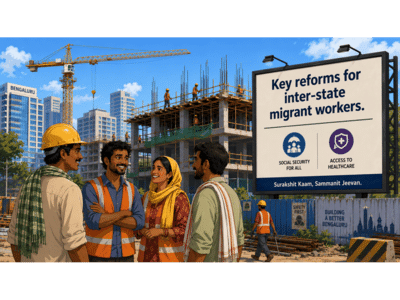
These rules significantly operationalise the Occupational Safety, Health and Working Conditions Code, 2020, or OSH&WC Codes for short, which Parliament had passed six years ago but many of its provisions had remained unimplemented, waiting for these rules. With their notification in the Gazette of India on May 8, 2026 the rules came into force, immediately.
For specifically the inter-state migrant workers, the new rules along with the parent Code they implement mark a decisive shift from the old Inter-State Migrant Workmen (Regulation of Employment and Conditions of Service) Act, 1979.
This Act was widely acknowledged to be poorly implemented and ill-suited to the realities of modern migration. The COVID-19 reverse migration crisis of 2020 had seen millions of workers walking hundreds of kilometres to return home because the government had no idea where they were or how many of them were there.
This was perhaps the most brutal indictment of the old regime. The new framework attempts to address some of these gaps by widening who gets recognised, simplifying registration, and expanding the net of welfare and protection measures for migrant workers.
Here are some of the key changes and what they could mean in practice.
The first shift: If you moved on your own, the law now recognises you
The old reality: The 1979 Act was built on a contractor-centric world. It assumed that migrant workers moved between states because a contractor recruited them and arranged for their travel. The law primarily applied to workers who were brought to a new state through such formal recruitment chains. If you packed your bags and moved to another city on your own, which is how the vast majority of today's migrant workers actually move, - you were legally invisible.
What has changed: The OSH&WC Code, 2020, which the new Rules now operationalize, fundamentally rewrites the definition of an "inter-state migrant worker." Under the new framework, you are recognised as an inter-state migrant worker if you have come from one state and found employment in another state on your own, without the involvement of any contractor.
As long as you are earning up to Rs 18,000 per month (or a higher amount as notified by the Central Government from time to time), you fall squarely within the law's protection.
Why it matters: This single change in definition may be the most consequential reform in decades. Research has consistently shown that most contemporary migration in India is self-driven. Workers no longer wait for a middleman to move, they have networks, phones, and initiative. The 1979 Act had become almost irrelevant to this majority. The new rules correct this fundamental mismatch, bringing the vast informal self-migration economy within the ambit of labour law protection for the first time.
The second shift: You must get an appointment letter, in writing
The old reality: A handshake, a verbal understanding, and a daily wage paid in cash was the employment "contract" for many inter-state migrant workers. Without written documentation, workers had no proof of what they were promised, no recourse if wages were withheld, and no evidence of employment for claiming social security benefits.
What has changed: The OSH&WC Rules, 2026, make it mandatory for every employer to issue an appointment letter to every employee before work begins. This is not a vague directive; the rules prescribe a detailed, standardized format.
Your appointment letter must contain your name, date of birth, Aadhaar number (with your consent), the establishment's Labour Identification Number, your Universal Account Number (UAN) or Insurance Number, your designation, whether you are a regular, fixed-term, or contractual employee, your skill category, your date of joining, your basic wages and dearness allowance, all other applicable allowances including accommodation, your eligibility for EPF and ESIC, and a description of your duties.
Why it matters: An appointment letter transforms you from an anonymous daily labourer into a documented worker with a paper trail. It is your primary instrument for enforcing every other right like wage recovery, grievance filing, social security claims, and legal recourse in case of disputes.
For migrant workers who have historically been the most exploited segment of the workforce, this requirement is a foundational protection. The rules also entitle contract workers to demand an experience certificate from their contractor, another document that has practical value when moving to the next job.
The third shift: A real digital database - because the government now has to know you exist
The old reality: When the COVID-19 lockdown was announced on the night of March 24, 2020, the central government and state governments were caught completely flat-footed by the scale of migration. There was no comprehensive, live database of where inter-state migrant workers were, how many there were, or which industries employed them. The result was humanitarian chaos and hundreds of deaths during the long walk home.
What has changed: The OSH&WC Rules, 2026 (Rule 13 specifically) require every employer to electronically furnish detailed statistics of inter-state migrant workers and their occupational safety and health data on a web portal designated by the Central Government.
This is not optional self-reporting, it is a statutory obligation that the employer must fulfill on an ongoing basis. Separately, under the Code, workers themselves can self-register on the Shram Suvidha portal using their Aadhaar and mobile phone authentication, placing themselves on a centralised government database.
Why it matters: A functioning national database of migrant workers is the backbone of every other protection. Without knowing who and where migrant workers are, no government can deliver benefits, respond to crises, or enforce workplace safety.
The digital data trail also creates accountability. An employer who has registered you on the portal cannot later claim you were not employed with them. For workers, self-registration on the Aadhaar-linked portal is the gateway to accessing portable benefits across states.
The fourth shift: Your ration card works anywhere, and you have a toll-free number
The old reality: One of the most grinding indignities of migrant life in India was losing access to subsidised food when you left your home state. Your ration card was tied to the fair price shop in your village in Bihar or Chhattisgarh. Once you were working in Surat or Bengaluru, you were entitled to nothing, you paid market prices in an expensive city on a low wage.
What has changed: The new labour framework makes statutory what has been rolling out administratively - the portability of Public Distribution System ( PDS) benefits for inter-state migrant workers. Under the One Nation One Ration Card scheme, your Aadhaar-linked ration card entitles you to draw subsidised food grains from any fair price shop in India, regardless of which state you are working in. The OSH&WC Code explicitly provides for this portability as a benefit that migrant workers are entitled to.
Complementing this, the Code also mandates a toll-free helpline specifically for inter-state migrant workers. If you face difficulties like wage theft, denial of safety equipment, refusal of allowances, or any other issue you can reach the government directly through this number.
Why it matters: Food security and access to grievance redressal are the most immediate, daily needs of a migrant worker. The combination of portable rations and a direct helpline addresses both. The helpline is particularly significant because it bypasses the need for physical presence in a labour office, which is often intimidating and logistically difficult for workers employed on construction sites or in remote industrial areas.
The fifth shift: Journey allowance and displacement allowance now tracked, not just promised
The old reality: The 1979 Act already contained provisions for journey allowance (your employer paid your train or bus fare from home to the worksite and back) and displacement allowance (a one-time payment to compensate you for the inconvenience of relocating). In practice, these were among the most consistently violated provisions of labour law. With no digital tracking and limited inspection, employers routinely ignored them with impunity.
What has changed: The new rules reinforce both entitlements within a digital compliance framework. Your employer is required to pay your to-and-fro travel costs to your home state at least once every 12 months, this is a statutory entitlement, not a discretionary benefit. At the time of recruitment, you must receive a displacement allowance equal to 50% of your monthly wages or Rs 75, whichever is higher.
Crucially, the digital registration and appointment letter requirements create a paper and data trail that makes it far harder for employers to deny these payments. The shift to an Inspector-cum-Facilitator system where labour inspectors are mandated to guide employers and workers on compliance, means enforcement is less likely to be about post-violation penalty and more about proactive compliance.
Why it matters: For workers who are already spending their savings on travel when they first migrate, the displacement allowance and annual journey allowance represent real money. More importantly, the digital backbone of the new rules means that if an employer does not pay, there is now a systematic record that they should have. A formal appointment letter specifying your entitlements and a government portal recording your employment are powerful tools when you need to file a complaint.
The bigger picture
The OSH&WC Rules, 2026 bring together and replace several fragmented regulatory frameworks under earlier labour laws into a more unified regime. Notified on May 8, they operationalise significant parts of the OSH & WC Code for matters administered by the central government.
For inter-state migrant workers, the framework marks an attempt to move away from a system in which many workers remained undocumented, difficult to trace, and outside the effective reach of labour protections.
The caveats, however, are real. The new Code raises the threshold for applicability from five migrant workers to ten, potentially placing smaller establishments outside its regulatory net. Self-registration also assumes access to Aadhaar-linked systems and a degree of digital literacy that may not always exist in practice.
Further, the history of Indian labour law contains many examples of ambitious reforms that struggled at the implementation stage. What these changes ultimately achieve will depend substantially on enforcement, both by state governments, which continue to exercise important rule-making powers, and by labour authorities on the ground.
Yet for a worker who leaves home and crosses state borders in search of employment, whether at a construction site, factory floor, warehouse, or another workplace far away from family and familiar surroundings, the new framework seeks to provide something the old regime often failed to adequately deliver: legal recognition, greater documentation, improved visibility within the system, and clearer channels for accessing benefits and protections.
That, ultimately, is where meaningful reform begins.
The Occupational Safety, Health and Working Conditions (Central) Rules, 2026 were notified in the Gazette of India on May 8, 2026, under G.S.R. 345(E), exercising powers under Sections 133 and 134 of the Occupational Safety, Health and Working Conditions Code, 2020.
(Disclaimer: The opinions expressed in this column are that of the writer. The facts and opinions expressed here do not reflect the views of www.economictimes.com)
The Occupational Safety, Health and Working Conditions (Central) Rules, 2026, or OSH&WC Rules for short, mark a significant milestone in India’s long-awaited labour reform journey.
These rules significantly operationalise the Occupational Safety, Health and Working Conditions Code, 2020, or OSH&WC Codes for short, which Parliament had passed six years ago but many of its provisions had remained unimplemented, waiting for these rules. With their notification in the Gazette of India on May 8, 2026 the rules came into force, immediately.
For specifically the inter-state migrant workers, the new rules along with the parent Code they implement mark a decisive shift from the old Inter-State Migrant Workmen (Regulation of Employment and Conditions of Service) Act, 1979.
This Act was widely acknowledged to be poorly implemented and ill-suited to the realities of modern migration. The COVID-19 reverse migration crisis of 2020 had seen millions of workers walking hundreds of kilometres to return home because the government had no idea where they were or how many of them were there.
This was perhaps the most brutal indictment of the old regime. The new framework attempts to address some of these gaps by widening who gets recognised, simplifying registration, and expanding the net of welfare and protection measures for migrant workers.
Here are some of the key changes and what they could mean in practice.
The first shift: If you moved on your own, the law now recognises you
The old reality: The 1979 Act was built on a contractor-centric world. It assumed that migrant workers moved between states because a contractor recruited them and arranged for their travel. The law primarily applied to workers who were brought to a new state through such formal recruitment chains. If you packed your bags and moved to another city on your own, which is how the vast majority of today's migrant workers actually move, - you were legally invisible.
What has changed: The OSH&WC Code, 2020, which the new Rules now operationalize, fundamentally rewrites the definition of an "inter-state migrant worker." Under the new framework, you are recognised as an inter-state migrant worker if you have come from one state and found employment in another state on your own, without the involvement of any contractor.
As long as you are earning up to Rs 18,000 per month (or a higher amount as notified by the Central Government from time to time), you fall squarely within the law's protection.
Why it matters: This single change in definition may be the most consequential reform in decades. Research has consistently shown that most contemporary migration in India is self-driven. Workers no longer wait for a middleman to move, they have networks, phones, and initiative. The 1979 Act had become almost irrelevant to this majority. The new rules correct this fundamental mismatch, bringing the vast informal self-migration economy within the ambit of labour law protection for the first time.
The second shift: You must get an appointment letter, in writing
The old reality: A handshake, a verbal understanding, and a daily wage paid in cash was the employment "contract" for many inter-state migrant workers. Without written documentation, workers had no proof of what they were promised, no recourse if wages were withheld, and no evidence of employment for claiming social security benefits.
What has changed: The OSH&WC Rules, 2026, make it mandatory for every employer to issue an appointment letter to every employee before work begins. This is not a vague directive; the rules prescribe a detailed, standardized format.
Your appointment letter must contain your name, date of birth, Aadhaar number (with your consent), the establishment's Labour Identification Number, your Universal Account Number (UAN) or Insurance Number, your designation, whether you are a regular, fixed-term, or contractual employee, your skill category, your date of joining, your basic wages and dearness allowance, all other applicable allowances including accommodation, your eligibility for EPF and ESIC, and a description of your duties.
Why it matters: An appointment letter transforms you from an anonymous daily labourer into a documented worker with a paper trail. It is your primary instrument for enforcing every other right like wage recovery, grievance filing, social security claims, and legal recourse in case of disputes.
For migrant workers who have historically been the most exploited segment of the workforce, this requirement is a foundational protection. The rules also entitle contract workers to demand an experience certificate from their contractor, another document that has practical value when moving to the next job.
The third shift: A real digital database - because the government now has to know you exist
The old reality: When the COVID-19 lockdown was announced on the night of March 24, 2020, the central government and state governments were caught completely flat-footed by the scale of migration. There was no comprehensive, live database of where inter-state migrant workers were, how many there were, or which industries employed them. The result was humanitarian chaos and hundreds of deaths during the long walk home.
What has changed: The OSH&WC Rules, 2026 (Rule 13 specifically) require every employer to electronically furnish detailed statistics of inter-state migrant workers and their occupational safety and health data on a web portal designated by the Central Government.
This is not optional self-reporting, it is a statutory obligation that the employer must fulfill on an ongoing basis. Separately, under the Code, workers themselves can self-register on the Shram Suvidha portal using their Aadhaar and mobile phone authentication, placing themselves on a centralised government database.
Why it matters: A functioning national database of migrant workers is the backbone of every other protection. Without knowing who and where migrant workers are, no government can deliver benefits, respond to crises, or enforce workplace safety.
The digital data trail also creates accountability. An employer who has registered you on the portal cannot later claim you were not employed with them. For workers, self-registration on the Aadhaar-linked portal is the gateway to accessing portable benefits across states.
The fourth shift: Your ration card works anywhere, and you have a toll-free number
The old reality: One of the most grinding indignities of migrant life in India was losing access to subsidised food when you left your home state. Your ration card was tied to the fair price shop in your village in Bihar or Chhattisgarh. Once you were working in Surat or Bengaluru, you were entitled to nothing, you paid market prices in an expensive city on a low wage.
What has changed: The new labour framework makes statutory what has been rolling out administratively - the portability of Public Distribution System ( PDS) benefits for inter-state migrant workers. Under the One Nation One Ration Card scheme, your Aadhaar-linked ration card entitles you to draw subsidised food grains from any fair price shop in India, regardless of which state you are working in. The OSH&WC Code explicitly provides for this portability as a benefit that migrant workers are entitled to.
Complementing this, the Code also mandates a toll-free helpline specifically for inter-state migrant workers. If you face difficulties like wage theft, denial of safety equipment, refusal of allowances, or any other issue you can reach the government directly through this number.
Why it matters: Food security and access to grievance redressal are the most immediate, daily needs of a migrant worker. The combination of portable rations and a direct helpline addresses both. The helpline is particularly significant because it bypasses the need for physical presence in a labour office, which is often intimidating and logistically difficult for workers employed on construction sites or in remote industrial areas.
The fifth shift: Journey allowance and displacement allowance now tracked, not just promised
The old reality: The 1979 Act already contained provisions for journey allowance (your employer paid your train or bus fare from home to the worksite and back) and displacement allowance (a one-time payment to compensate you for the inconvenience of relocating). In practice, these were among the most consistently violated provisions of labour law. With no digital tracking and limited inspection, employers routinely ignored them with impunity.
What has changed: The new rules reinforce both entitlements within a digital compliance framework. Your employer is required to pay your to-and-fro travel costs to your home state at least once every 12 months, this is a statutory entitlement, not a discretionary benefit. At the time of recruitment, you must receive a displacement allowance equal to 50% of your monthly wages or Rs 75, whichever is higher.
Crucially, the digital registration and appointment letter requirements create a paper and data trail that makes it far harder for employers to deny these payments. The shift to an Inspector-cum-Facilitator system where labour inspectors are mandated to guide employers and workers on compliance, means enforcement is less likely to be about post-violation penalty and more about proactive compliance.
Why it matters: For workers who are already spending their savings on travel when they first migrate, the displacement allowance and annual journey allowance represent real money. More importantly, the digital backbone of the new rules means that if an employer does not pay, there is now a systematic record that they should have. A formal appointment letter specifying your entitlements and a government portal recording your employment are powerful tools when you need to file a complaint.
The bigger picture
The OSH&WC Rules, 2026 bring together and replace several fragmented regulatory frameworks under earlier labour laws into a more unified regime. Notified on May 8, they operationalise significant parts of the OSH & WC Code for matters administered by the central government.
For inter-state migrant workers, the framework marks an attempt to move away from a system in which many workers remained undocumented, difficult to trace, and outside the effective reach of labour protections.
The caveats, however, are real. The new Code raises the threshold for applicability from five migrant workers to ten, potentially placing smaller establishments outside its regulatory net. Self-registration also assumes access to Aadhaar-linked systems and a degree of digital literacy that may not always exist in practice.
Further, the history of Indian labour law contains many examples of ambitious reforms that struggled at the implementation stage. What these changes ultimately achieve will depend substantially on enforcement, both by state governments, which continue to exercise important rule-making powers, and by labour authorities on the ground.
Yet for a worker who leaves home and crosses state borders in search of employment, whether at a construction site, factory floor, warehouse, or another workplace far away from family and familiar surroundings, the new framework seeks to provide something the old regime often failed to adequately deliver: legal recognition, greater documentation, improved visibility within the system, and clearer channels for accessing benefits and protections.
That, ultimately, is where meaningful reform begins.
The Occupational Safety, Health and Working Conditions (Central) Rules, 2026 were notified in the Gazette of India on May 8, 2026, under G.S.R. 345(E), exercising powers under Sections 133 and 134 of the Occupational Safety, Health and Working Conditions Code, 2020.
(Disclaimer: The opinions expressed in this column are that of the writer. The facts and opinions expressed here do not reflect the views of www.economictimes.com)
Next Story