
Rs 1.68 crore investments, Rs 89,000 monthly MF SIP. Can this 40-year-old investor retire at 50?


Building a sizeable investment corpus while managing household expenses and children’s future goals can be challenging, particularly when an investor is also targeting early retirement. For investors with multiple financial goals, simply having a high savings rate is not enough. The timing of each goal, accessibility of investments, asset allocation and insurance cover also need to be considered.
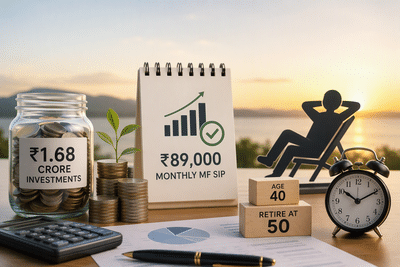
A 40-year-old investor from Pune who shared her investment journey reached out to ETMutualFunds and sought advice on planning for her two children’s education and her own retirement.
She works in a private company and takes home Rs 1.44 lakh a month. Her spouse is a homemaker and the couple has two children, aged 11 and 8. She follows the new tax regime and has a high risk appetite.
Also Read | MF Tracker: HDFC Pharma & Healthcare Fund tops equity MFs at 25% in 1 year. Should investors chase the rally?
The investor spends around Rs 35,000 every month on household expenses, including bills and other expenses. She invests Rs 89,000 through mutual fund SIPs every month and pays a home loan EMI of Rs 20,000.
Her investments across mutual funds, EPF, PPF and NPS have accumulated to around Rs 1.68 crore. She also owns a house in which the family currently lives. The house is valued at around Rs 65 lakh.
Her currency mutual fund portfolio includes names such as ICICI Prudential ELSS - Tax Saver Fund, ICICI Prudential Large Cap Fund, ICICI Prudential Value Fund, ICICI Prudential Nifty Next 50 Fund, HDFC BSE Sensex Index Fund, HDFC Mid Cap Fund, HDFC Mid Cap 150 Index Fund, SBI Small Cap Fund, Nippon India Small Cap Fund, Motilal Oswal Flexi Cap Fund, Motilal Oswal Nasdaq 100 FoF, Parag Parikh Flexicap Fund, Parag Parikh Liquid Fund.
Portfolio details
The investor plans to close her home loan by December 2026. The outstanding loan amount is Rs 1.10 lakh, while the current EMI is Rs 20,000. Her financial goals are to fund the education of her two children and build enough wealth to retire at 50. She has a Rs 1.5 crore HDFC Click to Protect life insurance policy. Her current health insurance is a Rs 7.5 lakh cover provided by her employer.
Is the investor on track for retirement at 50?
The expert, Shivam Pathak, CFP and Founder of Asset Elixir, analysed the portfolio and told ETMutualFunds that the investor has built a strong financial base at age 40.
"At 40, you have built a strong base. With Rs.1.44 lakh take-home income, Rs 35,000 monthly expenses and Rs 89,000 SIPs, you are investing nearly 62% of your income. The Rs 1.68 crore accumulated across mutual funds, EPF, PPF and NPS gives you a good starting point," the expert said.
The investor’s current savings rate is high, with a significant portion of her monthly income being directed towards investments. For retirement planning, however, the investor needs to account for the rise in expenses over the next decade as well as the fact that she wants to retire as early as 50.
Retirement corpus target
For calculating the retirement requirement, the expert has considered a monthly retirement expense of Rs 50,000 instead of the investor’s current monthly expense of Rs 35,000. This provides a reasonable cushion for higher expenses after retirement. At an inflation rate of 7%, Rs 50,000 today could become around Rs 98,000 by age 50.
However, expenses may not increase uniformly over time. Some expenses may decline while others can rise. Healthcare is one area where expenses could increase significantly with age.
For someone planning to retire at 50 and potentially fund expenses until the age of 90-95, the expert suggests targeting a retirement corpus of around Rs 4-4.5 crore by age 50. The home loan is expected to be closed by December 2026. Once the Rs 20,000 EMI is no longer required, the investor can redirect this amount towards investments.
The expert said that this would increase her monthly investment from Rs 89,000 to around Rs 1.09 lakh. At an illustrative return of 10%, the expert estimates that the mutual fund corpus could grow to around Rs 5.9 crore by age 50.
Note, the return assumption is only an illustration and actual market returns can be higher or lower.
Also Read | Sunil Singhania-led Abakkus Mutual Fund announces launch of its SIF platform Fokkus
A large corpus is not enough; accessibility also matters
The investor has accumulated money across mutual funds, EPF, PPF and NPS. While this provides diversification across different investment vehicles, the expert points out that having a large corpus does not automatically mean that the entire amount will be readily accessible when retirement begins. EPF, PPF and NPS have their own withdrawal rules and conditions.
Therefore, the investor should also focus on building a retirement bridge through her mutual fund portfolio as she approaches 50. This can provide greater flexibility for meeting expenses during the initial years after retirement.
Children’s education: Rs 20 lakh today will not remain Rs 20 lakh
The investor has two children, aged 11 and 8, and education is one of her two major financial goals. She has estimated Rs 20 lakh as the current education cost for each child. However, the amount required when the children actually enter higher education could be substantially higher because of education inflation.
The expert estimates that at 9-10% education inflation, the current Rs 20 lakh requirement could increase to around Rs 36-39 lakh for the 11-year-old child and Rs 47-52 lakh for the 8-year-old child.
The investor’s existing investments provide a starting point for these goals. However, as each education goal comes closer, the investment strategy should change.
The expert suggests gradually moving the amount required for a goal into safer assets once the goal is around three to five years away. This is because a sharp equity market correction close to the time when the money is required could affect the amount available for the education goal.
Should she consider an education loan?
The investor may also consider an education loan, where appropriate, rather than earmarking the entire retirement corpus for children’s education. An education loan can allow the investor to retain more of her retirement savings while also making the child responsible for part of the education financing.
The decision would depend on the course, cost, interest rate, repayment ability and the family’s financial situation at that time. The key consideration is not to compromise the investor’s retirement security while trying to fully fund every future education expense.
Also Read | Helios Flexi Cap Fund trims exposure in HDFC Bank, RIL, 2 more stocks; hikes stake in Swiggy, Paytm and 26 others
Should she add more mutual funds?
The investor already has a sizeable corpus and a high monthly SIP allocation. The expert does not recommend adding funds merely for the sake of increasing the number of schemes in the portfolio. Instead, consolidation and asset allocation should be the focus.
The investor has a high risk appetite, but risk appetite alone should not determine the portfolio allocation. The time remaining for each financial goal should also influence how much equity exposure is appropriate. Since retirement is only around 10 years away, the portfolio should gradually become more conservative as the retirement date approaches. The expert also suggests considering a 5-10% allocation to gold for diversification.
What should she do after the home loan closes?
The investor is planning to close her remaining Rs 1.10 lakh home loan by December 2026. Once the loan is closed, the Rs 20,000 EMI will no longer be a monthly obligation. The expert recommends continuing to invest this amount instead of allowing it to get absorbed into higher lifestyle expenses.
Is her insurance adequate?
The investor has a Rs 1.5 crore HDFC Click to Protect life insurance policy. The expert suggests reviewing whether this cover remains adequate considering her future responsibilities, particularly because she is the primary earning member and has a homemaker spouse and two dependent children.
Relying entirely on employer-sponsored health insurance can leave a gap if the investor changes jobs or the employer’s coverage changes. The expert recommends having an independent health insurance policy instead of relying only on the employer-provided cover.
One possible structure suggested by the expert is a Rs 10 lakh base health policy along with a Rs 40 lakh super top-up, subject to policy terms and the family’s requirements. "A 10 lakh base health policy + Rs. 40 lakh super top-up would be a practical structure to consider, subject to policy terms and family requirements," the expert said.
(Disclaimer: Recommendations, suggestions, views and opinions given by the experts are their own. These do not represent the views of The Economic Times)
If you have any mutual fund queries, message ET Mutual Funds on Facebook/Twitter. We will get them answered by our panel of experts. Do share your questions at ETMFqueries@timesinternet.in along with your age, risk profile, and Twitter handle.
A 40-year-old investor from Pune who shared her investment journey reached out to ETMutualFunds and sought advice on planning for her two children’s education and her own retirement.
She works in a private company and takes home Rs 1.44 lakh a month. Her spouse is a homemaker and the couple has two children, aged 11 and 8. She follows the new tax regime and has a high risk appetite.
Also Read | MF Tracker: HDFC Pharma & Healthcare Fund tops equity MFs at 25% in 1 year. Should investors chase the rally?
The investor spends around Rs 35,000 every month on household expenses, including bills and other expenses. She invests Rs 89,000 through mutual fund SIPs every month and pays a home loan EMI of Rs 20,000.
Her investments across mutual funds, EPF, PPF and NPS have accumulated to around Rs 1.68 crore. She also owns a house in which the family currently lives. The house is valued at around Rs 65 lakh.
Her currency mutual fund portfolio includes names such as ICICI Prudential ELSS - Tax Saver Fund, ICICI Prudential Large Cap Fund, ICICI Prudential Value Fund, ICICI Prudential Nifty Next 50 Fund, HDFC BSE Sensex Index Fund, HDFC Mid Cap Fund, HDFC Mid Cap 150 Index Fund, SBI Small Cap Fund, Nippon India Small Cap Fund, Motilal Oswal Flexi Cap Fund, Motilal Oswal Nasdaq 100 FoF, Parag Parikh Flexicap Fund, Parag Parikh Liquid Fund.
Portfolio details
The investor plans to close her home loan by December 2026. The outstanding loan amount is Rs 1.10 lakh, while the current EMI is Rs 20,000. Her financial goals are to fund the education of her two children and build enough wealth to retire at 50. She has a Rs 1.5 crore HDFC Click to Protect life insurance policy. Her current health insurance is a Rs 7.5 lakh cover provided by her employer.
Is the investor on track for retirement at 50?
The expert, Shivam Pathak, CFP and Founder of Asset Elixir, analysed the portfolio and told ETMutualFunds that the investor has built a strong financial base at age 40.
"At 40, you have built a strong base. With Rs.1.44 lakh take-home income, Rs 35,000 monthly expenses and Rs 89,000 SIPs, you are investing nearly 62% of your income. The Rs 1.68 crore accumulated across mutual funds, EPF, PPF and NPS gives you a good starting point," the expert said.
The investor’s current savings rate is high, with a significant portion of her monthly income being directed towards investments. For retirement planning, however, the investor needs to account for the rise in expenses over the next decade as well as the fact that she wants to retire as early as 50.
Retirement corpus target
For calculating the retirement requirement, the expert has considered a monthly retirement expense of Rs 50,000 instead of the investor’s current monthly expense of Rs 35,000. This provides a reasonable cushion for higher expenses after retirement. At an inflation rate of 7%, Rs 50,000 today could become around Rs 98,000 by age 50.
However, expenses may not increase uniformly over time. Some expenses may decline while others can rise. Healthcare is one area where expenses could increase significantly with age.
For someone planning to retire at 50 and potentially fund expenses until the age of 90-95, the expert suggests targeting a retirement corpus of around Rs 4-4.5 crore by age 50. The home loan is expected to be closed by December 2026. Once the Rs 20,000 EMI is no longer required, the investor can redirect this amount towards investments.
The expert said that this would increase her monthly investment from Rs 89,000 to around Rs 1.09 lakh. At an illustrative return of 10%, the expert estimates that the mutual fund corpus could grow to around Rs 5.9 crore by age 50.
Note, the return assumption is only an illustration and actual market returns can be higher or lower.
Also Read | Sunil Singhania-led Abakkus Mutual Fund announces launch of its SIF platform Fokkus
A large corpus is not enough; accessibility also matters
The investor has accumulated money across mutual funds, EPF, PPF and NPS. While this provides diversification across different investment vehicles, the expert points out that having a large corpus does not automatically mean that the entire amount will be readily accessible when retirement begins. EPF, PPF and NPS have their own withdrawal rules and conditions.
Therefore, the investor should also focus on building a retirement bridge through her mutual fund portfolio as she approaches 50. This can provide greater flexibility for meeting expenses during the initial years after retirement.
Children’s education: Rs 20 lakh today will not remain Rs 20 lakh
The investor has two children, aged 11 and 8, and education is one of her two major financial goals. She has estimated Rs 20 lakh as the current education cost for each child. However, the amount required when the children actually enter higher education could be substantially higher because of education inflation.
The expert estimates that at 9-10% education inflation, the current Rs 20 lakh requirement could increase to around Rs 36-39 lakh for the 11-year-old child and Rs 47-52 lakh for the 8-year-old child.
The investor’s existing investments provide a starting point for these goals. However, as each education goal comes closer, the investment strategy should change.
The expert suggests gradually moving the amount required for a goal into safer assets once the goal is around three to five years away. This is because a sharp equity market correction close to the time when the money is required could affect the amount available for the education goal.
Should she consider an education loan?
The investor may also consider an education loan, where appropriate, rather than earmarking the entire retirement corpus for children’s education. An education loan can allow the investor to retain more of her retirement savings while also making the child responsible for part of the education financing.
The decision would depend on the course, cost, interest rate, repayment ability and the family’s financial situation at that time. The key consideration is not to compromise the investor’s retirement security while trying to fully fund every future education expense.
Also Read | Helios Flexi Cap Fund trims exposure in HDFC Bank, RIL, 2 more stocks; hikes stake in Swiggy, Paytm and 26 others
Should she add more mutual funds?
The investor already has a sizeable corpus and a high monthly SIP allocation. The expert does not recommend adding funds merely for the sake of increasing the number of schemes in the portfolio. Instead, consolidation and asset allocation should be the focus.
The investor has a high risk appetite, but risk appetite alone should not determine the portfolio allocation. The time remaining for each financial goal should also influence how much equity exposure is appropriate. Since retirement is only around 10 years away, the portfolio should gradually become more conservative as the retirement date approaches. The expert also suggests considering a 5-10% allocation to gold for diversification.
What should she do after the home loan closes?
The investor is planning to close her remaining Rs 1.10 lakh home loan by December 2026. Once the loan is closed, the Rs 20,000 EMI will no longer be a monthly obligation. The expert recommends continuing to invest this amount instead of allowing it to get absorbed into higher lifestyle expenses.
Is her insurance adequate?
Relying entirely on employer-sponsored health insurance can leave a gap if the investor changes jobs or the employer’s coverage changes. The expert recommends having an independent health insurance policy instead of relying only on the employer-provided cover.
One possible structure suggested by the expert is a Rs 10 lakh base health policy along with a Rs 40 lakh super top-up, subject to policy terms and the family’s requirements. "A 10 lakh base health policy + Rs. 40 lakh super top-up would be a practical structure to consider, subject to policy terms and family requirements," the expert said.
(Disclaimer: Recommendations, suggestions, views and opinions given by the experts are their own. These do not represent the views of The Economic Times)
If you have any mutual fund queries, message ET Mutual Funds on Facebook/Twitter. We will get them answered by our panel of experts. Do share your questions at ETMFqueries@timesinternet.in along with your age, risk profile, and Twitter handle.
Next Story