
The onion index: How rising pyaaz prices can make your EMIs and investment portfolio cry


Onions are a staple food in Indian households, but their ability to make you cry can stretch beyond your kitchens! In fact, until some years ago any major rise in onion prices used to be an important election issue.
Onion prices have been rising steadily this year, and for the last two months have been the item with the highest inflation . According to government data, retail prices of 41 out of 42 essential commodities have risen over the year. But onions stand out with their over 100% inflation rate.

So why are onion prices so closely tracked? What does a rise in onion price mean for you beyond the obvious rise in your grocery and food budget?
Why have onion prices been rising and what do they mean for inflation?Onion prices have risen due to supply side issues. Depletion and some spoilage of stored rabi stocks and concerns over the timing and quality of kharif arrivals amid uneven rainfall have led to the sudden spike.
In September this year, TOI reported that at Lasalgaon APMC in Nashik, wholesale onion prices climbed 160% in less than three months, from Rs 1,740 per quintal on June 22 to Rs 4,550 on September 5, 2026!
Trade sources attributed the onion price surge to an estimated 5-7% decline in Maharashtra’s kharif onion production, linked to reduced acreage and delayed monsoon rains.
Not just that, the unseasonal rain during the summer harvest reduced the shelf life of stored onions and accelerated their spoilage.
A recent Reserve Bank of India (RBI) report acknowledges that the rise in onion prices this year has been higher than that seen in recent years. Onion prices have increased by about 84% since end-June (up to September 30).
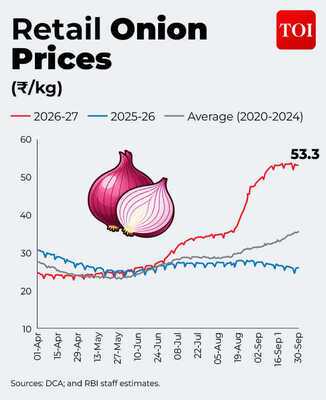 “Although onion prices exhibit a seasonal uptick during August-September before the arrival of the kharif crops, the magnitude of increase has been much higher this year than the historical average,” it notes.
The Onion Price Index - both wholesale and retail - has crossed 100% in September and October this year!
Onion prices form an important part of food inflation . The CPI Onion Index has a weightage of 24.36% in food inflation, and 0.70% in overall inflation. The CPI Food Index in turn has a weightage of 34.78% in overall inflation, making food prices an important part of the inflation data and its fluctuations.
How it impacts RBI’s decision makingRBI is mandated to maintain retail inflation in the 2-6% range, with 4% serving to be the ideal target. However, in October this year, CPI inflation crossed the 6% threshold for the first time in several months.
In anticipation of the approaching inflation hike, the central bank-led Monetary Policy Committee (MPC) has already hiked the repo rate by 25 basis points to 5.50%. With the inflation number now crossing 6%, economists see a December rate hike as a foregone conclusion.
While some economists see the possibility of a 50 basis points hike, others say the RBI may take a more cautious approach, awaiting to see the impact of falling global crude oil prices and the seasonal food price spike settling.
However, Ranen Banerjee, Partner and Leader, Economic Advisory, PwC India notes that a rise in onion prices alone is not enough to sway RBI’s decisions, especially as many factors governing onion prices are beyond its control.
“The MPC does not look at a particular commodity’s price in making its rate setting decision. The price of onions are highly sensitive to supply side factors that a monetary policy cannot effectively address. The current high prices are owing to lesser supplies in the mandis from the farms and these generally get addressed with new arrivals or government interventions on the supply side,” Banerjee tells TOI.
When inflation rises sharply, the RBI must assess whether it is a temporary supply shock or whether higher prices could spread across the economy.
So, even though a single commodity or food price may not influence RBI decisions, it definitely feeds into the overall inflation number, which the RBI tries to keep in check through repo rate decisions.
How it impacts your EMIs If you are wondering what onion prices have to do with your monthly EMI payouts - the link runs through monetary policy.
Repo rate is the interest rate at which banks are able to borrow money from the central bank. A hike in that makes borrowing costlier for banks, and they in turn make their loans costlier by hiking their lending rates.
Every time the RBI hikes the repo rate, you may feel a pinch in terms of higher EMIs, unless you are on a fixed interest loan. This means that you either have to pay higher EMIs if you want to pay your loan within the stipulated time, or you have to increase your loan tenure in a bid to keep your EMI constant. In both scenarios your total outgo on the loan goes up as the interest component of your loan rises.
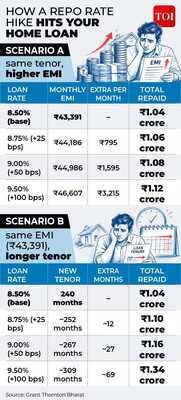 So a rise in food or onion prices not just impacts your household kitchen budget, it also has the ability to shrink your spending capability by raising your debt repayment outgo.
How it impacts Sensex and companiesA rise in interest rates also tends to feed negatively into the stock market, as other interest yielding asset classes become more attractive.
But, experts say that the stock market has already priced in the possibility of another repo rate hike. In fact, Sensex has been on a record winning spree since late October as sentiment has turned favourable.
“After the 25 basis points increase in the repo rate to 5.50% in October and the shift in policy stance to calibrated tightening, we expect a further 25 bps hike in December, taking the repo rate to 5.75%, followed by another 50bp over subsequent meetings,” Sneha Poddar, VP-Research, Wealth Management, Motilal Oswal Financial Services tells TOI.
“A gradual pace of tightening is largely priced in, though a sharper-than-expected increase could weigh on market sentiment in the near term; a significant correction, however, appears unlikely,” she says.
According to Sneha Poddar, banks, including public sector banks, are positioned to benefit.
“In a rising rate environment, lending rates reset almost immediately while deposit costs adjust with a lag, supporting profitability. Non-banking financial companies (NBFCs), which rely on borrowed funds, may face pressure on margins,” she explains.
“Real estate, automobiles and discretionary consumption are the most exposed, facing valuation and demand headwinds. Capital-intensive infrastructure, utilities and leveraged firms face higher financing costs, and a prolonged tightening cycle could delay private investment. We see crude oil, food inflation and the rupee as the key variables to monitor,” she adds.
(Disclaimer: Recommendations and views on the stock market, or any other asset classes or personal finance management tips given by experts and analysts are their own. These opinions do not represent the views of The Times of India.)
Onion prices have been rising steadily this year, and for the last two months have been the item with the highest inflation . According to government data, retail prices of 41 out of 42 essential commodities have risen over the year. But onions stand out with their over 100% inflation rate.
So why are onion prices so closely tracked? What does a rise in onion price mean for you beyond the obvious rise in your grocery and food budget?
Why have onion prices been rising and what do they mean for inflation?Onion prices have risen due to supply side issues. Depletion and some spoilage of stored rabi stocks and concerns over the timing and quality of kharif arrivals amid uneven rainfall have led to the sudden spike.
In September this year, TOI reported that at Lasalgaon APMC in Nashik, wholesale onion prices climbed 160% in less than three months, from Rs 1,740 per quintal on June 22 to Rs 4,550 on September 5, 2026!
]]>
Delayed monsoon rainfall has disrupted kharif onion planting across Maharashtra, Rajasthan, Karnataka and Andhra Pradesh.Trade sources attributed the onion price surge to an estimated 5-7% decline in Maharashtra’s kharif onion production, linked to reduced acreage and delayed monsoon rains.
Not just that, the unseasonal rain during the summer harvest reduced the shelf life of stored onions and accelerated their spoilage.
A recent Reserve Bank of India (RBI) report acknowledges that the rise in onion prices this year has been higher than that seen in recent years. Onion prices have increased by about 84% since end-June (up to September 30).
The Onion Price Index - both wholesale and retail - has crossed 100% in September and October this year!
Onion prices form an important part of food inflation . The CPI Onion Index has a weightage of 24.36% in food inflation, and 0.70% in overall inflation. The CPI Food Index in turn has a weightage of 34.78% in overall inflation, making food prices an important part of the inflation data and its fluctuations.
How it impacts RBI’s decision makingRBI is mandated to maintain retail inflation in the 2-6% range, with 4% serving to be the ideal target. However, in October this year, CPI inflation crossed the 6% threshold for the first time in several months.
In anticipation of the approaching inflation hike, the central bank-led Monetary Policy Committee (MPC) has already hiked the repo rate by 25 basis points to 5.50%. With the inflation number now crossing 6%, economists see a December rate hike as a foregone conclusion.
While some economists see the possibility of a 50 basis points hike, others say the RBI may take a more cautious approach, awaiting to see the impact of falling global crude oil prices and the seasonal food price spike settling.
]]>
A disproportionate rise in onion prices, hence feeds into inflation and in turn can impact the RBI’s repo rate math.However, Ranen Banerjee, Partner and Leader, Economic Advisory, PwC India notes that a rise in onion prices alone is not enough to sway RBI’s decisions, especially as many factors governing onion prices are beyond its control.
“The MPC does not look at a particular commodity’s price in making its rate setting decision. The price of onions are highly sensitive to supply side factors that a monetary policy cannot effectively address. The current high prices are owing to lesser supplies in the mandis from the farms and these generally get addressed with new arrivals or government interventions on the supply side,” Banerjee tells TOI.
When inflation rises sharply, the RBI must assess whether it is a temporary supply shock or whether higher prices could spread across the economy.
]]>
RBI’s October rate hike cited wider inflation concerns, including food and fuel pressures. It’s important to note that while the decision was not attributable to onions alone, food prices continue to play an important role.So, even though a single commodity or food price may not influence RBI decisions, it definitely feeds into the overall inflation number, which the RBI tries to keep in check through repo rate decisions.
How it impacts your EMIs If you are wondering what onion prices have to do with your monthly EMI payouts - the link runs through monetary policy.
Repo rate is the interest rate at which banks are able to borrow money from the central bank. A hike in that makes borrowing costlier for banks, and they in turn make their loans costlier by hiking their lending rates.
Every time the RBI hikes the repo rate, you may feel a pinch in terms of higher EMIs, unless you are on a fixed interest loan. This means that you either have to pay higher EMIs if you want to pay your loan within the stipulated time, or you have to increase your loan tenure in a bid to keep your EMI constant. In both scenarios your total outgo on the loan goes up as the interest component of your loan rises.
How it impacts Sensex and companiesA rise in interest rates also tends to feed negatively into the stock market, as other interest yielding asset classes become more attractive.
But, experts say that the stock market has already priced in the possibility of another repo rate hike. In fact, Sensex has been on a record winning spree since late October as sentiment has turned favourable.
“After the 25 basis points increase in the repo rate to 5.50% in October and the shift in policy stance to calibrated tightening, we expect a further 25 bps hike in December, taking the repo rate to 5.75%, followed by another 50bp over subsequent meetings,” Sneha Poddar, VP-Research, Wealth Management, Motilal Oswal Financial Services tells TOI.
“A gradual pace of tightening is largely priced in, though a sharper-than-expected increase could weigh on market sentiment in the near term; a significant correction, however, appears unlikely,” she says.
]]>
For companies selling packaged foods, household products and other everyday goods, higher food inflation can squeeze consumers' disposable incomes. Households may cut back on discretionary purchases to accommodate higher grocery bills. Companies exposed to food ingredients may also face higher costs, which can hurt profit margins if they cannot pass them on to customers.According to Sneha Poddar, banks, including public sector banks, are positioned to benefit.
“In a rising rate environment, lending rates reset almost immediately while deposit costs adjust with a lag, supporting profitability. Non-banking financial companies (NBFCs), which rely on borrowed funds, may face pressure on margins,” she explains.
“Real estate, automobiles and discretionary consumption are the most exposed, facing valuation and demand headwinds. Capital-intensive infrastructure, utilities and leveraged firms face higher financing costs, and a prolonged tightening cycle could delay private investment. We see crude oil, food inflation and the rupee as the key variables to monitor,” she adds.
(Disclaimer: Recommendations and views on the stock market, or any other asset classes or personal finance management tips given by experts and analysts are their own. These opinions do not represent the views of The Times of India.)
Next Story