
2,000-year-old Chola city lost to tsunamis throws up evidence of glorious past


CHENNAI: Poompuhar , the 2,000-year-old port city built by the early Cholas and lost to tsunamis , continues to throw up evidence of its glorious past.
After two weeks of underwater exploration, a Tamil Nadu archaeology department team has come up with more than 200 potsherds and images of structures more than 2km from today’s coastline off the Bay of Bengal that reiterate the region’s trade links with West Asia.
Underwater Poompuhar has been explored since 1981, but this phase was the first to find torpedo jars — long, narrow transport vessels associated with the Persian Gulf trade network, suggesting the movement of wine and other goods. Among the new finds are glazed pottery, suggesting links with ancient Iran. Paddle-impressed pottery suggests trade links with the Gangetic plains.
The three-week-long exploration was headed by Prof K Rajan, adviser to Tamil Nadu’s state department of archaeology. “Fragments of similar torpedo jars were found in other ancient ports such as Muzris. It shows ancient Kaveripoompattinam or Kaveripattinam (other names of Poompuhar) was well connected with West Asian countries.”
“...We also found limestone which could have been associated with Buddhist artefacts, possibly from Amaravati in Andhra Pradesh,” said V P Yathees Kumar, joint director, state archaeology department. The researchers suspect the presence of rouletted ware among the fragments and are planning to conduct a detailed study of the pottery.
40m x 16m oval structure under water
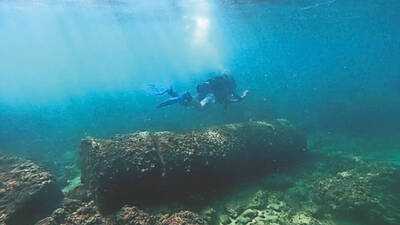
In 1991, researchers identified a U-shaped structure some 5.5km from the coast, at a depth of 23m. Later, they found the structure was oval-shaped, 40m long and 16m wide. The structural remains were covered by sand sediment and fishing nets, resembling a natural formation.
The structure, which is raised 2.5m from the seabed, is made of stone blocks.
What happened to old city?
Archaeologists say parts of the city, dated to the 3rd century BCE, could have been submerged due to sea erosion. They cite the example of Ellaiamman temple at Vanagiri, near Poompuhar, which was in use till 1991 and is now 100m into the sea. Geologists who conducted a palaeo-tsunami study at Poompuhar say it witnessed several tsunamis in the past 2,000 years. It finds mention in Tamil epics ‘Silapathikaram’ and ‘Manimegalai’, besides Greco-Roman records such as ‘Periplus of the Erythraean Sea’ and Ptolemy’s ‘Geography’ as Kaveripattinam and Kaboris Emporium.
After two weeks of underwater exploration, a Tamil Nadu archaeology department team has come up with more than 200 potsherds and images of structures more than 2km from today’s coastline off the Bay of Bengal that reiterate the region’s trade links with West Asia.
Underwater Poompuhar has been explored since 1981, but this phase was the first to find torpedo jars — long, narrow transport vessels associated with the Persian Gulf trade network, suggesting the movement of wine and other goods. Among the new finds are glazed pottery, suggesting links with ancient Iran. Paddle-impressed pottery suggests trade links with the Gangetic plains.
The three-week-long exploration was headed by Prof K Rajan, adviser to Tamil Nadu’s state department of archaeology. “Fragments of similar torpedo jars were found in other ancient ports such as Muzris. It shows ancient Kaveripoompattinam or Kaveripattinam (other names of Poompuhar) was well connected with West Asian countries.”
“...We also found limestone which could have been associated with Buddhist artefacts, possibly from Amaravati in Andhra Pradesh,” said V P Yathees Kumar, joint director, state archaeology department. The researchers suspect the presence of rouletted ware among the fragments and are planning to conduct a detailed study of the pottery.
40m x 16m oval structure under water
In 1991, researchers identified a U-shaped structure some 5.5km from the coast, at a depth of 23m. Later, they found the structure was oval-shaped, 40m long and 16m wide. The structural remains were covered by sand sediment and fishing nets, resembling a natural formation.
The structure, which is raised 2.5m from the seabed, is made of stone blocks.
What happened to old city?
Archaeologists say parts of the city, dated to the 3rd century BCE, could have been submerged due to sea erosion. They cite the example of Ellaiamman temple at Vanagiri, near Poompuhar, which was in use till 1991 and is now 100m into the sea. Geologists who conducted a palaeo-tsunami study at Poompuhar say it witnessed several tsunamis in the past 2,000 years. It finds mention in Tamil epics ‘Silapathikaram’ and ‘Manimegalai’, besides Greco-Roman records such as ‘Periplus of the Erythraean Sea’ and Ptolemy’s ‘Geography’ as Kaveripattinam and Kaboris Emporium.
Next Story