
70 security camps in Bastar to become tribals welfare hubs in 18 months, says Union Home Minister Amit Shah


RAIPUR: Standing inside a security camp in Bastar where six policemen were once killed in Maoist violence , Union Home Minister Amit Shah on Monday announced that 70 of the region’s nearly 200 such camps will be transformed into tribal welfare and governance centres over the next 18 months, taking government services from the state capital to villages that remained cut off from roads, ration, schools, healthcare and banking for decades due to Maoist violence.
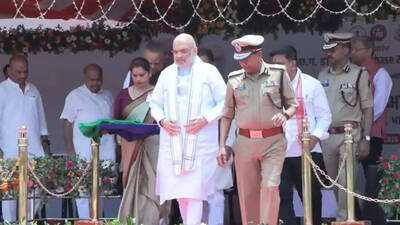
Launching the ‘ Jan Suvidha Kendra ’ model from the remote village of Netanar in Bastar, Shah said the transformation of a conflict-scarred security post into a public service hub reflected the larger change taking place in Bastar — from gunfire and fear to ration, banking, healthcare, education and access to government services.
“This is the same place where six policemen were killed, where schools and hospitals were destroyed, where ration, employment, education and banking were not allowed to reach. That very place has today become a welfare centre for poor tribals,” Shah said.
The new centres will provide Aadhaar services, ration cards, caste, income and domicile certificates, banking facilities, common service centre services and access to nearly 371 central and state government schemes from a single building, he said.
“This may look like a govt programme today, but I assure you that this centre will soon be full of tribal people and children, alive with activity and hope," Shah added.
The Union home minister also linked the new welfare camp model with livelihood opportunities. He said the Centre and the state government would work through the National Dairy Development Board (NDDB) to introduce a dairy model in Bastar, with tribal women being supported through livestock schemes.
“Dairy brought a magical transformation in Gujarat. Here, there is water, greenery and potential. If animal husbandry comes here, Bastar’s tribal women will lead a major transformation,” Shah said.
He added that forest produce would be packaged, branded and marketed through national-level cooperatives to open new employment opportunities in the region.
“Dairy and forest produce together will begin a new age of livelihood in Bastar,” he said.
Calling Netanar the birthplace and karmabhoomi of tribal icon Shaheed Gundadhur, who led the 1910 Bhumkal rebellion, Shah described the place as “like a pilgrimage site” for the country.
In a striking remark, he said, “India got Independence in 1947, but Bastar got freedom on March 31 this year,” linking the region’s transformation to the Centre’s deadline to eliminate Left-wing extremism.
Shah said the anti-Naxal campaign was never only about eliminating armed cadres, but also about ensuring tribal families and children finally received facilities denied to them for decades.
He accused Maoists of blocking development and then using underdevelopment as a justification for violence.
“They spread the misconception that development did not happen, that's why they took up weapons. The truth is development did not happen because they were sitting here with weapons,” Shah said.
The home minister recalled that during his 2020 visit to Bastar, he witnessed the “actual horror” of Naxalism, including tribals losing limbs in IED blasts, children being recruited from schools and innocent villagers being punished under so-called janatana sarkars.
He said nearly 3,000 surrendered Naxal cadres had been rehabilitated, including around 2,000 who had never received formal education.
Shah also said Prime Minister Narendra Modi had warned that the government must not “sleep peacefully” after security gains, adding that Naxalism would be considered truly over only when the damage caused to villages is repaired over the next five years.
Launching the ‘ Jan Suvidha Kendra ’ model from the remote village of Netanar in Bastar, Shah said the transformation of a conflict-scarred security post into a public service hub reflected the larger change taking place in Bastar — from gunfire and fear to ration, banking, healthcare, education and access to government services.
“This is the same place where six policemen were killed, where schools and hospitals were destroyed, where ration, employment, education and banking were not allowed to reach. That very place has today become a welfare centre for poor tribals,” Shah said.
The new centres will provide Aadhaar services, ration cards, caste, income and domicile certificates, banking facilities, common service centre services and access to nearly 371 central and state government schemes from a single building, he said.
“This may look like a govt programme today, but I assure you that this centre will soon be full of tribal people and children, alive with activity and hope," Shah added.
The Union home minister also linked the new welfare camp model with livelihood opportunities. He said the Centre and the state government would work through the National Dairy Development Board (NDDB) to introduce a dairy model in Bastar, with tribal women being supported through livestock schemes.
“Dairy brought a magical transformation in Gujarat. Here, there is water, greenery and potential. If animal husbandry comes here, Bastar’s tribal women will lead a major transformation,” Shah said.
He added that forest produce would be packaged, branded and marketed through national-level cooperatives to open new employment opportunities in the region.
“Dairy and forest produce together will begin a new age of livelihood in Bastar,” he said.
Calling Netanar the birthplace and karmabhoomi of tribal icon Shaheed Gundadhur, who led the 1910 Bhumkal rebellion, Shah described the place as “like a pilgrimage site” for the country.
In a striking remark, he said, “India got Independence in 1947, but Bastar got freedom on March 31 this year,” linking the region’s transformation to the Centre’s deadline to eliminate Left-wing extremism.
Shah said the anti-Naxal campaign was never only about eliminating armed cadres, but also about ensuring tribal families and children finally received facilities denied to them for decades.
He accused Maoists of blocking development and then using underdevelopment as a justification for violence.
“They spread the misconception that development did not happen, that's why they took up weapons. The truth is development did not happen because they were sitting here with weapons,” Shah said.
The home minister recalled that during his 2020 visit to Bastar, he witnessed the “actual horror” of Naxalism, including tribals losing limbs in IED blasts, children being recruited from schools and innocent villagers being punished under so-called janatana sarkars.
He said nearly 3,000 surrendered Naxal cadres had been rehabilitated, including around 2,000 who had never received formal education.
Shah also said Prime Minister Narendra Modi had warned that the government must not “sleep peacefully” after security gains, adding that Naxalism would be considered truly over only when the damage caused to villages is repaired over the next five years.
Next Story