
Anxiety treatable, but 83% of affected did not receive aid


MUMBAI: Whenever Thane businessman Shekhar travels to south Mumbai for a meeting, he sets off more than three hours early. This is because he plans his route carefully to ensure he is never more than five minutes from a hospital in case he “suffers a heart attack while driving”.
Karthik (32), an IIM graduate with a high-powered marketing job, dreads routine meetings. “There is this heaviness in my stomach and my legs seem leaden. It’s a paralysing fear that stays until the meeting is over,” he says.

Shekhar and Karthik (names changed) have anxiety disorders , a group of conditions that can turn ordinary journeys, workplace interactions and social situations into emotional ordeals.
The invisible burden
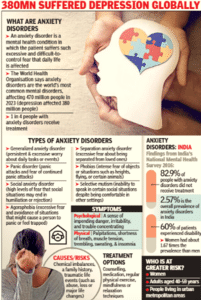
The National Mental Health Survey, conducted by the National Institute of Mental Health and Neuro Sciences (Nimhans) across 12 states between 2014 and 2016, found that 2.57% of adults had an anxiety disorder at the time of assessment.
Around 83% of those affected were not receiving treatment, while nearly 60% experienced disability of varying severity, according to the study published in the Indian Journal of Psychiatry in 2022.
“Anxiety disorders are frequently under-recognised and inadequately treated. Stigma surrounding mental illness and a lack of awareness contribute to the problem,” said psychiatrist Dr Kedar Tilwe of Fortis Hospital, Mulund. Child psychiatrist Dr Kersi Chavda said anxiety can take many forms, from social anxiety and academic stress to persistent, intrusive thoughts.
In children, it may manifest as school refusal. A child may repeatedly refuse to attend school despite parents bargaining, threatening or seeking help from counsellors. Among adolescents facing examinations, anxiety can also present as headaches, body aches or backaches, even when medical examinations reveal no underlying physical cause.
Social anxiety is another increasingly visible concern, said Dr Chavda. The pressure to appear perfect, amplified by carefully curated virtual lives on social media, can intensify the fear of being judged or found wanting.
“People are getting more and more cognisant of this disorder,” said Dr Chavda, adding that considerable gaps remain in recognising and diagnosing these conditions.
When the body’s alarm won’t switch off
Everyday anxiety is a normal response to uncertainty or danger. An anxiety disorder, however, involves persistent or disproportionate fear that interferes with daily life.
A senior psychologist from a civic hospital linked anxiety to the body’s built-in alarm system. The alarm is meant to respond to a threat, but sometimes it reacts to a gust of wind as though an intruder were approaching. When anxiety overwhelms a person’s ability to cope, it can manifest in different ways, including panic attacks .
Psychiatrist Dr Harish Shetty said the pressures of daily life can compound this response. “Crowded trains and buses, inadequate sleep, workplace demands, educational pressures, financial worries and concerns about personal safety can keep people in a state of heightened stress,” he said.
Weakening support systems and reduced emotional connectedness may also be contributing to the problem, said Dr Shetty. The daily commute, for instance, can become another source of anxiety for someone already worried about work, studies or safety.
Life in the slow lane
In adults, panic disorder can be accompanied by agoraphobia — fear of situations where escape might be difficult or help unavailable if a panic attack occurs. Shekhar’s elaborate route-planning illustrates how such fears can take control of everyday life.
“Patients may avoid bridges, crowded trains, flights or traffic jams. Some will not travel without their spouses or may turn down promotions or jobs that require them to venture beyond familiar surroundings,” said Dr Tilwe. As a result, he added, for many people with an anxiety disorder, it’s a life lived in second gear: not ready to take up new challenges as one prefers to stick to known schedules.
It’s treatable
Anxiety disorders are treatable, but a trained physician is needed to recognise the problem. Treatment depends on the type and severity of the disorder and may involve psychotherapy, medication or both.
Karthik (32), an IIM graduate with a high-powered marketing job, dreads routine meetings. “There is this heaviness in my stomach and my legs seem leaden. It’s a paralysing fear that stays until the meeting is over,” he says.
Shekhar and Karthik (names changed) have anxiety disorders , a group of conditions that can turn ordinary journeys, workplace interactions and social situations into emotional ordeals.
The invisible burden
The National Mental Health Survey, conducted by the National Institute of Mental Health and Neuro Sciences (Nimhans) across 12 states between 2014 and 2016, found that 2.57% of adults had an anxiety disorder at the time of assessment.
Around 83% of those affected were not receiving treatment, while nearly 60% experienced disability of varying severity, according to the study published in the Indian Journal of Psychiatry in 2022.
“Anxiety disorders are frequently under-recognised and inadequately treated. Stigma surrounding mental illness and a lack of awareness contribute to the problem,” said psychiatrist Dr Kedar Tilwe of Fortis Hospital, Mulund. Child psychiatrist Dr Kersi Chavda said anxiety can take many forms, from social anxiety and academic stress to persistent, intrusive thoughts.
In children, it may manifest as school refusal. A child may repeatedly refuse to attend school despite parents bargaining, threatening or seeking help from counsellors. Among adolescents facing examinations, anxiety can also present as headaches, body aches or backaches, even when medical examinations reveal no underlying physical cause.
Social anxiety is another increasingly visible concern, said Dr Chavda. The pressure to appear perfect, amplified by carefully curated virtual lives on social media, can intensify the fear of being judged or found wanting.
“People are getting more and more cognisant of this disorder,” said Dr Chavda, adding that considerable gaps remain in recognising and diagnosing these conditions.
When the body’s alarm won’t switch off
Everyday anxiety is a normal response to uncertainty or danger. An anxiety disorder, however, involves persistent or disproportionate fear that interferes with daily life.
A senior psychologist from a civic hospital linked anxiety to the body’s built-in alarm system. The alarm is meant to respond to a threat, but sometimes it reacts to a gust of wind as though an intruder were approaching. When anxiety overwhelms a person’s ability to cope, it can manifest in different ways, including panic attacks .
Psychiatrist Dr Harish Shetty said the pressures of daily life can compound this response. “Crowded trains and buses, inadequate sleep, workplace demands, educational pressures, financial worries and concerns about personal safety can keep people in a state of heightened stress,” he said.
Weakening support systems and reduced emotional connectedness may also be contributing to the problem, said Dr Shetty. The daily commute, for instance, can become another source of anxiety for someone already worried about work, studies or safety.
Life in the slow lane
In adults, panic disorder can be accompanied by agoraphobia — fear of situations where escape might be difficult or help unavailable if a panic attack occurs. Shekhar’s elaborate route-planning illustrates how such fears can take control of everyday life.
“Patients may avoid bridges, crowded trains, flights or traffic jams. Some will not travel without their spouses or may turn down promotions or jobs that require them to venture beyond familiar surroundings,” said Dr Tilwe. As a result, he added, for many people with an anxiety disorder, it’s a life lived in second gear: not ready to take up new challenges as one prefers to stick to known schedules.
It’s treatable
Anxiety disorders are treatable, but a trained physician is needed to recognise the problem. Treatment depends on the type and severity of the disorder and may involve psychotherapy, medication or both.
Next Story