
Astha Kunj files: The hidden crime corridor Delhi can't seem to fix


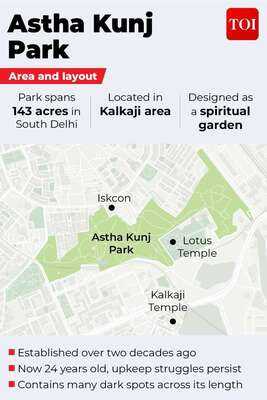
NEW DELHI: At dawn, Astha Kunj Udyan in southeast Delhi is a picture of calm. Retirees stroll along the paths, a yoga group stretches on the grass, and a couple sits in quiet meditation. By afternoon, children play on the lawns and families spread picnic cloths in the shade. Spread over 143 acres in one of the city’s most densely populated areas, the park is everything a public space should be.
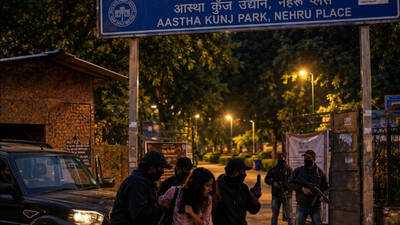
But after dark, the picture changes.
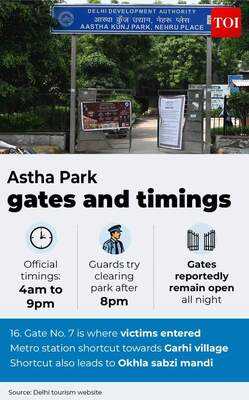
On September 21, a teenage girl and her male friend, who had come to Kalkaji Mandir for darshan, entered the park through Gate No. 7 at dusk. Three men posing as policemen allegedly separated the girl from her friend and took her to a secluded corner, where they threatened her with a firearm and a knife. By the time a PCR call reached Amar Colony police at around 8.45pm, the park had become the scene of a gang-rape, now registered under the BNS and the POCSO Act.
Not an isolated incidentThe September assault is not the first time the park has made an appearance in police records. Stories from PTI and ANI on the cases of 2025 are revealing.
The two October cases were police operations near the park, not crimes inside it, but they reflect the frequency with which the area figures in the city's crime map.
Why here?The answer lies in a cluster of small failures.
Years of neglect. The park was envisioned more than two decades ago as a spiritual garden linking three temples. Even 24 years after its establishment, it struggles with security, cleanliness and upkeep.
Is Astha Kunj alone?A Times of India's report on police audits suggests it is not, but it also provides a useful contrast. Swarn Jayanti Park in Prashant Vihar has 27 guards and four gates, yet police found its lighting and CCTV insufficient and identified several dark spots. Rohini's District Park has no CCTV and a damaged boundary wall and has seen cases under the Arms Act, Gambling Act and NDPS Act. By contrast, Roshanara Bagh, with 21 CCTV cameras, 12 guards and good lighting and boundaries, reported no crime. DDU Park and Amruth Park, where lighting and boundaries were found satisfactory, also reported none.
The audit does not prove cause and effect, but the pattern is hard to ignore. Parks with lights, cameras and intact walls appear safer than those without.
Delhi Police has now directed its units to audit all parks of one acre or more, almost 300 big parks and more than 800 smaller ones, assessing guards, lighting (including high-mast lights, CCTV, boundary walls, overgrown bushes and gate-closure timings). Reports are due within a week, and patrolling has been stepped up, with personnel on horseback in hard-to-reach areas. Delhi Police has also directed all DCPs to ensure enhanced patrolling and effective security measures.
The social dimensionBehind the infrastructure lies a social story. The accused in the latest case allegedly impersonated policemen, exploiting the trust people place in a uniform. The victim and her friend had come to a temple, not to a hidden corner of the city. When ordinary visitors are targeted this way, the cost is paid in fear. Locals now dread visiting the area after dark, and each such case quietly shrinks the public space available to women, teenagers and couples.
The park's victims are not only visitors. A homeless man who lived near the ISKCON temple was beaten to death over a stare. Two of the accused in that case were minors, and the 18-year-old was previously involved in an attempted murder case as a minor. Two robbers described themselves as school dropouts since Class 5, pushed into crime by addiction and money trouble. These are signs of a larger failure, of drug access, schooling and opportunity, that no guard post can fix.
Encounters, which dominate the police's crackdown narrative, punish offenders after the fact. They do not make a dark path lighter.
What should be done?The audit parameters themselves point to the answers.
Astha Kunj was conceived as a place of calm connecting three temples. Whether it stays a place of fear or becomes a model for the city's other parks will depend on what follows this audit.
But after dark, the picture changes.
On September 21, a teenage girl and her male friend, who had come to Kalkaji Mandir for darshan, entered the park through Gate No. 7 at dusk. Three men posing as policemen allegedly separated the girl from her friend and took her to a secluded corner, where they threatened her with a firearm and a knife. By the time a PCR call reached Amar Colony police at around 8.45pm, the park had become the scene of a gang-rape, now registered under the BNS and the POCSO Act.
Not an isolated incidentThe September assault is not the first time the park has made an appearance in police records. Stories from PTI and ANI on the cases of 2025 are revealing.
- June 2025: A walk that ended in blood
- August 2025: Killed for a stare
- August 2025: A tree and a late-night call
- October 7, 2025: A gunfight beside the green
- October 27, 2025: Diwali firing, park shootout
The two October cases were police operations near the park, not crimes inside it, but they reflect the frequency with which the area figures in the city's crime map.
Why here?The answer lies in a cluster of small failures.
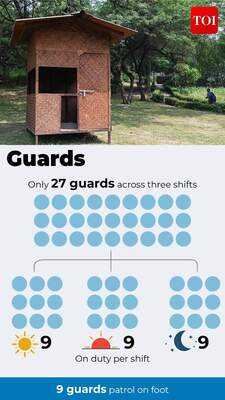
- Thin security
- Gates that never close
- Blind spots in surveillance
- Criminals who read the terrain
Years of neglect. The park was envisioned more than two decades ago as a spiritual garden linking three temples. Even 24 years after its establishment, it struggles with security, cleanliness and upkeep.
Is Astha Kunj alone?A Times of India's report on police audits suggests it is not, but it also provides a useful contrast. Swarn Jayanti Park in Prashant Vihar has 27 guards and four gates, yet police found its lighting and CCTV insufficient and identified several dark spots. Rohini's District Park has no CCTV and a damaged boundary wall and has seen cases under the Arms Act, Gambling Act and NDPS Act. By contrast, Roshanara Bagh, with 21 CCTV cameras, 12 guards and good lighting and boundaries, reported no crime. DDU Park and Amruth Park, where lighting and boundaries were found satisfactory, also reported none.
The audit does not prove cause and effect, but the pattern is hard to ignore. Parks with lights, cameras and intact walls appear safer than those without.
Delhi Police has now directed its units to audit all parks of one acre or more, almost 300 big parks and more than 800 smaller ones, assessing guards, lighting (including high-mast lights, CCTV, boundary walls, overgrown bushes and gate-closure timings). Reports are due within a week, and patrolling has been stepped up, with personnel on horseback in hard-to-reach areas. Delhi Police has also directed all DCPs to ensure enhanced patrolling and effective security measures.
The social dimensionBehind the infrastructure lies a social story. The accused in the latest case allegedly impersonated policemen, exploiting the trust people place in a uniform. The victim and her friend had come to a temple, not to a hidden corner of the city. When ordinary visitors are targeted this way, the cost is paid in fear. Locals now dread visiting the area after dark, and each such case quietly shrinks the public space available to women, teenagers and couples.
The park's victims are not only visitors. A homeless man who lived near the ISKCON temple was beaten to death over a stare. Two of the accused in that case were minors, and the 18-year-old was previously involved in an attempted murder case as a minor. Two robbers described themselves as school dropouts since Class 5, pushed into crime by addiction and money trouble. These are signs of a larger failure, of drug access, schooling and opportunity, that no guard post can fix.
Encounters, which dominate the police's crackdown narrative, punish offenders after the fact. They do not make a dark path lighter.
What should be done?The audit parameters themselves point to the answers.
- Light and watch: High-mast lighting and working CCTV, covering dark spots, gates and internal paths, not just the roads outside.
- Control the gates: Enforce closing hours, and give shortcut users a lit, monitored corridor so they do not need to cut through the dark.
- Guard smarter: More personnel per shift, mobile patrols, and regular police-DDA coordination, with clear accountability for lapses.
- Clear the cover: Trim overgrown bushes and trees that hide secluded corners.
- Make the public part of the solution: Morning walkers and yoga groups already own the park at dawn. Resident groups and temple visitors can help keep it occupied and reported after dusk.
Next Story