
Dakar Youth Olympics: Teen Indian rider finds perfect tango with stallion, win equestrian gold


Bhopal: In the sunlit arena at the Dakar 2026 Summer Youth Olympic Games in Diamniadio , Senegal , where a borrowed horse risked undoing his years of preparation in a single stride, fifteen-year-old Sresht Raju saddled up and rode like a seasoned pro, as if he had all the time in the world.
Two clear rounds. No penalties. Then, a gold medal for Team Asia .
While the glitter and sheen of gold spoke to the years of preparation and hard work that went into winning it, for India, the medal scripted another story, of breaking ground in a brave new world. It marked a rare and quietly historic moment in the country’s equestrian sport.
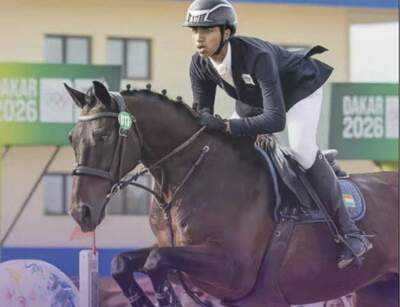
For Sresth, it was the culmination of a partnership that began not in an Olympic arena but in the disciplined world under the guidance of Gwalior’s Sanjay Singh .
Singh, a Gwalior-born former Border Security Force (BSF) rider, had trained Sresth for the past five years, instilling in him the discipline, grit and dogged resolve to accomplish a mission at all costs and not yield.
His coaching was never about spectacle, but repetition, balance, patience and the unglamorous work of teaching a young rider to read a course before asking a horse to jump over it.
That foundation mattered in Dakar. Like every rider at the Youth Olympics, Sresth competed on a borrowed horse—Crazy Horse Boop—whom he met only days before competition. There was no long-established trust, no familiar rhythm, no margin for a misjudged stride. Yet he adapted with a composure that suggested the training had become an instinct.
“I think now he’s starting to understand me, and I understand him,” Sresth said of the horse that partnered with him in his gold quest.
It was a simple sentence, but captured the essence of Singh’s method: equestrian success is not imposed on a horse; it is negotiated with one.
Sresth began riding only in 2022, according to an FEI profile . Four years later, he stood on an Olympic podium. The speed of that rise is striking, but those close to the pair point not to talent alone but to the culture Singh created around him.
A former BSF rider, Singh brings to coaching a particular kind of seriousness—precision over flourish, preparation over panic. His emphasis, those who know the pair say, has not been on jumping higher or faster, but on building consistency. A young rider, in Singh’s view, must learn to prepare thoroughly, remain composed under pressure and respond to an unfamiliar horse with patience rather than frustration.
That philosophy dictated the method and method to medal in Senegal.
Shresth was one of only three riders among 24 to complete both qualifying rounds without penalties, a feat that placed him among the most reliable performers in the field.
Team Asia finished on 17 penalties, ahead of Inter America on 21 and Africa on 29. The result was decided by the best three scores from each four-rider squad across two qualifying rounds, which meant every clear round carried disproportionate weight. Sresth’s contribution was not flashy. It was dependable.
And in a sport where a single rail can change the colour of a medal, dependability is its own kind of brilliance. He was joined in the winning quartet by China’s Ruirui Sun, the UAE’s Alya Adnan Awadh Almheiri and Indonesia’s Nusrtdinov Zayan Fatih. Together, they gave Asia a gold medal built on collective steadiness rather than individual heroics.
For Singh, the medal is a quiet vindication—that years spent shaping a rider’s foundations can matter more than chasing short-term results. For Mantena, it is something larger: evidence that trust, discipline and a strong coach-athlete bond can turn an unfamiliar horse, a foreign arena and Olympic pressure into history for India.
At fifteen, Shresth has already learned the lesson many riders take years to understand: that the best rounds are not always the boldest ones. Sometimes, they are the calmest.
Two clear rounds. No penalties. Then, a gold medal for Team Asia .
While the glitter and sheen of gold spoke to the years of preparation and hard work that went into winning it, for India, the medal scripted another story, of breaking ground in a brave new world. It marked a rare and quietly historic moment in the country’s equestrian sport.
For Sresth, it was the culmination of a partnership that began not in an Olympic arena but in the disciplined world under the guidance of Gwalior’s Sanjay Singh .
Singh, a Gwalior-born former Border Security Force (BSF) rider, had trained Sresth for the past five years, instilling in him the discipline, grit and dogged resolve to accomplish a mission at all costs and not yield.
His coaching was never about spectacle, but repetition, balance, patience and the unglamorous work of teaching a young rider to read a course before asking a horse to jump over it.
That foundation mattered in Dakar. Like every rider at the Youth Olympics, Sresth competed on a borrowed horse—Crazy Horse Boop—whom he met only days before competition. There was no long-established trust, no familiar rhythm, no margin for a misjudged stride. Yet he adapted with a composure that suggested the training had become an instinct.
“I think now he’s starting to understand me, and I understand him,” Sresth said of the horse that partnered with him in his gold quest.
It was a simple sentence, but captured the essence of Singh’s method: equestrian success is not imposed on a horse; it is negotiated with one.
Sresth began riding only in 2022, according to an FEI profile . Four years later, he stood on an Olympic podium. The speed of that rise is striking, but those close to the pair point not to talent alone but to the culture Singh created around him.
A former BSF rider, Singh brings to coaching a particular kind of seriousness—precision over flourish, preparation over panic. His emphasis, those who know the pair say, has not been on jumping higher or faster, but on building consistency. A young rider, in Singh’s view, must learn to prepare thoroughly, remain composed under pressure and respond to an unfamiliar horse with patience rather than frustration.
That philosophy dictated the method and method to medal in Senegal.
Shresth was one of only three riders among 24 to complete both qualifying rounds without penalties, a feat that placed him among the most reliable performers in the field.
Team Asia finished on 17 penalties, ahead of Inter America on 21 and Africa on 29. The result was decided by the best three scores from each four-rider squad across two qualifying rounds, which meant every clear round carried disproportionate weight. Sresth’s contribution was not flashy. It was dependable.
And in a sport where a single rail can change the colour of a medal, dependability is its own kind of brilliance. He was joined in the winning quartet by China’s Ruirui Sun, the UAE’s Alya Adnan Awadh Almheiri and Indonesia’s Nusrtdinov Zayan Fatih. Together, they gave Asia a gold medal built on collective steadiness rather than individual heroics.
For Singh, the medal is a quiet vindication—that years spent shaping a rider’s foundations can matter more than chasing short-term results. For Mantena, it is something larger: evidence that trust, discipline and a strong coach-athlete bond can turn an unfamiliar horse, a foreign arena and Olympic pressure into history for India.
At fifteen, Shresth has already learned the lesson many riders take years to understand: that the best rounds are not always the boldest ones. Sometimes, they are the calmest.
Next Story