
In 2018, Kerala's fishermen rescued people from rooftops as floods ravaged the state. How can tourism turn that spontaneous community response into a planned system to protect destinations from future disasters?


By: Gopinath Parayil
In August 2018, the young fishermen I usually see at the teashop near my home in Mattancherry were gone. They had taken their boats to Chengannur and other flooded areas and were pulling people off rooftops. Churches, police, local bodies and tourism professionals moved too. Nobody was in overall command, yet it all fitted together, as if the system already existed and was waiting to be switched on.
Keralam was rightly admired for that response. But admiration is not preparation. Floods and landslides returned in 2019, in Wayanad in 2024, and again this year. Where we lost more than 500 people across the state in 2018, more than 300 died in just one village in 2024. Each time, the response is generous and improvised, and much of what was learned stays with the people who happened to be there.
Last week, seawater rose up to 25 centimetres in Lanka village in Ezhikkara panchayat. Water that enters fishermen's homes can as easily enter a backwater resort a few kilometres away. That is why investing in community resilience is investing in the destination itself. For an industry that markets a place, it is plain business sense, not charity.
The tourism department handles accreditation, administration and marketing, and its responsible tourism mission has built community experiences worth about Rs 132 crore. But nobody is responsible for the destination as a living system: Its drainage, wetlands, energy, transport, livelihoods and readiness for extreme weather.
That system is what a climate responsible and climate resilient destination, or CRCRD, is about. Climate responsibility asks whether a place is reducing the risk it creates, through renewable energy, low-carbon transport and sensible land use. Climate resilience asks whether it can withstand a shock and recover, through preparedness, livelihoods and emergency capacity. A place that does only one is half-protected.
Disaster management has four phases: Mitigation, preparedness, response and recovery. Most attention and money go to response, but tourism has a role in all four. In mitigation, it can work with local govts on mangrove restoration and flood defences, which can double as paid experiences, like Malipuram's mangrove trails.
In preparedness, it can train hotel and homestay staff as certified first responders and help set up climate-linked insurance. In response, its rooms, kitchens and generators can serve as shelters, and boat owners can join rescues. In recovery, its reach and stories matter. After 2018, weavers in Chendamangalam turned flood-damaged handlooms into Chekutty dolls and raised enough to revive the handloom sector. State funding for these arrangements would also steady an industry that supports more than 14% of the state's GDP.
The humanitarian sector often lacks exactly what tourism holds: Beds, kitchens, logistics, storytelling and the ability to raise funds from people who love a place. Much of that capacity sits idle when a crisis begins.
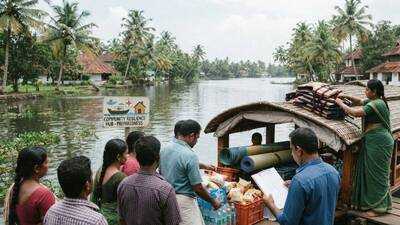
Keralam has shown it can be activated. In 2018, CGH Earth prepared food to be dropped into cut-off areas. Life jackets and canoes bought for recreation in Ezhikkara and Chendamangalam saved lives.
None of it was planned in advance. It worked because people already knew each other. Keralam discovered that its hotels, homestays, boats and guides formed a logistics network, but had no list of them. Why is there still no pre-monsoon map of the kitchens, boats, vehicles and skills a district can call on?
We publish the occupancy of every resort. Can we not also know which ones stand on higher ground and have a generator?
The cost of a disaster does not stop at the damage. Perception travels further than water. Nepal's recent floods left thousands dead or missing, but they struck a single valley. Travellers read it as a country in crisis, and communities far away lost bookings. The same happened after Wayanad in 2024 and the Pathanamthitta floods in August. Accurate, location-specific information is therefore part of resilience. This year, Keralam's tourism professionals began sharing verified ground reports, so travellers and partners abroad know which roads are open. But the industry rebuilds that network from scratch in every emergency.
The answer is not a new agency but a kind of operating system for a destination, a shared layer of collaborative intelligence. It maps assets, skills, risks and vulnerable households. It connects the hotels, transport operators, researchers and relief agencies who can act. And it turns what each disaster teaches into a written protocol the next district inherits.
It works only if built from the ground up, led by local self-govts. Keralam's panchayats and municipalities know where water collects, which roads close first and which neighbour owns a boat. Needs should travel from there to the top, not the other way round. Communities hit by disasters would then stop being cast as victims and become stewards of their own future. Such a system would also recognise the tea stall owner, the homestay host, the fisherwoman and the village artisan as the real custodians of a destination. A resilient Keralam board coordinating mitigation, preparedness, response and recovery across sectors would be a pioneering effort. Keralam need not begin everywhere. Three destinations would make a sound trial: Wayanad in the mountains, Kochi on the coast and Kumarakom in the backwaters.
Kochi is the obvious first candidate. From its solar-powered airport to the electric Water Metro, parts of the city already practise climate responsibility. What remains is resilience, which needs partnerships between local govt, tourism, fisheries and the community. Ezhikkara, where the seawater came in last week, could be among the first working labs. Three things could start before next June. Every district could publish an inventory of kitchens, boats, vehicles and skills. Industry associations could agree in advance who contributes what, and how small operators are compensated for feeding hundreds of people. Research and humanitarian institutions could help turn each season's lessons into protocols any panchayat can use. For years, Keralam has invited the world to experience God's Own Country. What if the next chapter is about showing the world how such a place is stewarded for the future?
(The writer is founder, The Blue Yonder)
In August 2018, the young fishermen I usually see at the teashop near my home in Mattancherry were gone. They had taken their boats to Chengannur and other flooded areas and were pulling people off rooftops. Churches, police, local bodies and tourism professionals moved too. Nobody was in overall command, yet it all fitted together, as if the system already existed and was waiting to be switched on.
Keralam was rightly admired for that response. But admiration is not preparation. Floods and landslides returned in 2019, in Wayanad in 2024, and again this year. Where we lost more than 500 people across the state in 2018, more than 300 died in just one village in 2024. Each time, the response is generous and improvised, and much of what was learned stays with the people who happened to be there.
Last week, seawater rose up to 25 centimetres in Lanka village in Ezhikkara panchayat. Water that enters fishermen's homes can as easily enter a backwater resort a few kilometres away. That is why investing in community resilience is investing in the destination itself. For an industry that markets a place, it is plain business sense, not charity.
The tourism department handles accreditation, administration and marketing, and its responsible tourism mission has built community experiences worth about Rs 132 crore. But nobody is responsible for the destination as a living system: Its drainage, wetlands, energy, transport, livelihoods and readiness for extreme weather.
That system is what a climate responsible and climate resilient destination, or CRCRD, is about. Climate responsibility asks whether a place is reducing the risk it creates, through renewable energy, low-carbon transport and sensible land use. Climate resilience asks whether it can withstand a shock and recover, through preparedness, livelihoods and emergency capacity. A place that does only one is half-protected.
Disaster management has four phases: Mitigation, preparedness, response and recovery. Most attention and money go to response, but tourism has a role in all four. In mitigation, it can work with local govts on mangrove restoration and flood defences, which can double as paid experiences, like Malipuram's mangrove trails.
In preparedness, it can train hotel and homestay staff as certified first responders and help set up climate-linked insurance. In response, its rooms, kitchens and generators can serve as shelters, and boat owners can join rescues. In recovery, its reach and stories matter. After 2018, weavers in Chendamangalam turned flood-damaged handlooms into Chekutty dolls and raised enough to revive the handloom sector. State funding for these arrangements would also steady an industry that supports more than 14% of the state's GDP.
The humanitarian sector often lacks exactly what tourism holds: Beds, kitchens, logistics, storytelling and the ability to raise funds from people who love a place. Much of that capacity sits idle when a crisis begins.
Keralam has shown it can be activated. In 2018, CGH Earth prepared food to be dropped into cut-off areas. Life jackets and canoes bought for recreation in Ezhikkara and Chendamangalam saved lives.
None of it was planned in advance. It worked because people already knew each other. Keralam discovered that its hotels, homestays, boats and guides formed a logistics network, but had no list of them. Why is there still no pre-monsoon map of the kitchens, boats, vehicles and skills a district can call on?
We publish the occupancy of every resort. Can we not also know which ones stand on higher ground and have a generator?
The answer is not a new agency but a kind of operating system for a destination, a shared layer of collaborative intelligence. It maps assets, skills, risks and vulnerable households. It connects the hotels, transport operators, researchers and relief agencies who can act. And it turns what each disaster teaches into a written protocol the next district inherits.
It works only if built from the ground up, led by local self-govts. Keralam's panchayats and municipalities know where water collects, which roads close first and which neighbour owns a boat. Needs should travel from there to the top, not the other way round. Communities hit by disasters would then stop being cast as victims and become stewards of their own future. Such a system would also recognise the tea stall owner, the homestay host, the fisherwoman and the village artisan as the real custodians of a destination. A resilient Keralam board coordinating mitigation, preparedness, response and recovery across sectors would be a pioneering effort. Keralam need not begin everywhere. Three destinations would make a sound trial: Wayanad in the mountains, Kochi on the coast and Kumarakom in the backwaters.
Kochi is the obvious first candidate. From its solar-powered airport to the electric Water Metro, parts of the city already practise climate responsibility. What remains is resilience, which needs partnerships between local govt, tourism, fisheries and the community. Ezhikkara, where the seawater came in last week, could be among the first working labs. Three things could start before next June. Every district could publish an inventory of kitchens, boats, vehicles and skills. Industry associations could agree in advance who contributes what, and how small operators are compensated for feeding hundreds of people. Research and humanitarian institutions could help turn each season's lessons into protocols any panchayat can use. For years, Keralam has invited the world to experience God's Own Country. What if the next chapter is about showing the world how such a place is stewarded for the future?
(The writer is founder, The Blue Yonder)
Next Story