
Karnataka governor asks CM DK Shivakumar to reconsider truncating Vande Mataram


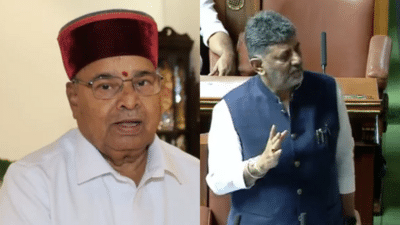
BENGALURU: Karnataka governor Thaawar Chand Gehlot on Monday wrote to chief minister D K Shivakumar asking him to reconsider the government’s decision to restrict the singing of Vande Mataram to only its first two stanzas.
In his four-page letter, the governor said, “...I advise the state government to reconsider the government order dated September 8, 2026, and follow the Central government’s prevailing instructions concerning the rendition of the national song at state government functions.”
Gehlot warned that an “unnecessary” conflict between the state government’s administrative instructions and the protocol prescribed by the Union government could be avoided by reconsidering the decision. He also said this would “prevent avoidable” constitutional litigation over the respective executive powers of the Union and the state.
The governor said the government should reconsider its decision after seeking an opinion on whether the “impugned restriction” to two stanzas could be sustained in view of the extended statutory protection accorded to Vande Mataram under the Prevention of Insults to National Honour (Amendment) Act, 2026; orders and instructions issued by the Ministry of Home Affairs concerning the official version and rendition of the national song; Articles 162, 256 and 257(1) of the Constitution of India; the constitutional distribution of legislative and executive powers between the Union and the states; and the requirement to maintain uniformity and dignity in observing nationally prescribed protocols concerning national symbols.
Citing Ministry of Home Affairs orders relating to the national song and national anthem of India, the governor specifically referred to instructions stating that, on occasions when the national song is sung in mass singing, the official version is to be recited.
“The central instructions therefore leave no scope for a state government to prescribe a different or truncated version for state government functions. The issue is not merely one of administrative convenience, but concerns conformity with the nationally prescribed protocol governing a national symbol,” the letter said.
In his four-page letter, the governor said, “...I advise the state government to reconsider the government order dated September 8, 2026, and follow the Central government’s prevailing instructions concerning the rendition of the national song at state government functions.”
Gehlot warned that an “unnecessary” conflict between the state government’s administrative instructions and the protocol prescribed by the Union government could be avoided by reconsidering the decision. He also said this would “prevent avoidable” constitutional litigation over the respective executive powers of the Union and the state.
The governor said the government should reconsider its decision after seeking an opinion on whether the “impugned restriction” to two stanzas could be sustained in view of the extended statutory protection accorded to Vande Mataram under the Prevention of Insults to National Honour (Amendment) Act, 2026; orders and instructions issued by the Ministry of Home Affairs concerning the official version and rendition of the national song; Articles 162, 256 and 257(1) of the Constitution of India; the constitutional distribution of legislative and executive powers between the Union and the states; and the requirement to maintain uniformity and dignity in observing nationally prescribed protocols concerning national symbols.
Citing Ministry of Home Affairs orders relating to the national song and national anthem of India, the governor specifically referred to instructions stating that, on occasions when the national song is sung in mass singing, the official version is to be recited.
“The central instructions therefore leave no scope for a state government to prescribe a different or truncated version for state government functions. The issue is not merely one of administrative convenience, but concerns conformity with the nationally prescribed protocol governing a national symbol,” the letter said.
Next Story