
Many western region water disputes resolved, says Amit Shah


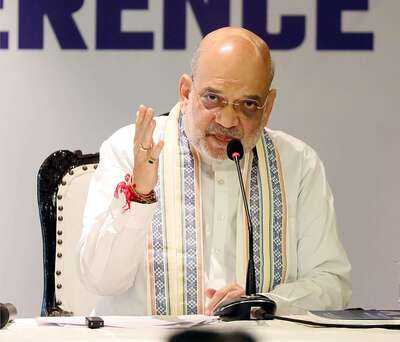
Panaji : Union home minister Amit Shah on Monday said there are no longer any disputes among western region states, including water disputes — calling it a major achievement. He added that all the issues taken up in the day’s meeting were related to monitoring, and that several interstate river disputes have also been resolved through the zonal council.
At the 28th meeting of the Western Zonal Council , members discussed several issues of major importance for the region and the country. These included the implementation of fast track special courts for speedy investigation and early disposal of rape cases involving women and children; the Emergency Response Support System ( ERSS-112 ); food safety standards; Ayushman Bharat–Pradhan Mantri Jan Arogya Yojana; ensuring brick-and-mortar banking facilities within the prescribed radius of every village; railway development projects; and environmental clearances, among others.
The council also discussed broader national priorities such as urban master planning, electricity supply, strengthening primary agricultural credit societies (PACSs), eliminating child malnutrition through Poshan Abhiyaan, reducing school dropout rates, increasing participation of public hospitals in Ayushman Bharat–Pradhan Mantri Jan Arogya Yojana , and issues related to cybercrime and digital infrastructure.
Shah described the western region as the ‘WEST Engine’ of India’s economic growth: W for wealth and finance generated in the region, E for exports and ports, S for startups and semiconductors, and T for tourism and the blue economy — where the western region holds the largest share in the country.
He chaired the meeting in Panaji. It was attended by Goa chief minister Pramod Sawant , Gujarat chief minister Bhupendra Patel , Maharashtra chief minister Devendra Fadnavis , and the administrator of Dadra and Nagar Haveli and Daman and Diu, Praful Patel.
The Union home minister told the gathering that Goa contributes more to economic growth than its geographical size would suggest, citing advanced tourism, high per capita income, and mines. He also pointed to India’s 7.8% growth in the first quarter of the financial year 2026–2027, calling it a matter of pride that the economy achieved such growth amid global turbulence.
Shah said the western region is crucial on multiple fronts and remains India’s largest economic, industrial, and financial centre. He said that since 2014, Prime Minister Narendra Modi has pursued continuous efforts and administrative reforms to transform India into a rapidly moving economy, and added that Daman and Diu, Dadra and Nagar Haveli, and the three member states have contributed significantly to the 7.8% growth.
Citing examples of the region’s economic strengths, Shah said more than one crore tourists visit Goa, including five lakh foreign tourists, with tourism contributing 16% of Goa’s GSDP. He said Maharashtra ranks first in India with 33,872 startups, Dholera has emerged as a semiconductor hub, Gujarat’s Mundra port handles the highest volume of cargo and Deendayal Port is the largest port in terms of cargo volume, and Mumbai — India’s financial capital — is also emerging as a major hub for global capital.
Shah said 1,893 issues have been discussed in these meetings, of which 1,445 have been resolved, calling the outcome an indicator of the functionality and effectiveness of the process. He attributed the progress to cooperation among state govts, Union Territories, and central ministries and departments, with the interstate council secretariat playing an active role.
He also said all four members of the Western Zonal Council are leading the country in green energy.
At the 28th meeting of the Western Zonal Council , members discussed several issues of major importance for the region and the country. These included the implementation of fast track special courts for speedy investigation and early disposal of rape cases involving women and children; the Emergency Response Support System ( ERSS-112 ); food safety standards; Ayushman Bharat–Pradhan Mantri Jan Arogya Yojana; ensuring brick-and-mortar banking facilities within the prescribed radius of every village; railway development projects; and environmental clearances, among others.
The council also discussed broader national priorities such as urban master planning, electricity supply, strengthening primary agricultural credit societies (PACSs), eliminating child malnutrition through Poshan Abhiyaan, reducing school dropout rates, increasing participation of public hospitals in Ayushman Bharat–Pradhan Mantri Jan Arogya Yojana , and issues related to cybercrime and digital infrastructure.
Shah described the western region as the ‘WEST Engine’ of India’s economic growth: W for wealth and finance generated in the region, E for exports and ports, S for startups and semiconductors, and T for tourism and the blue economy — where the western region holds the largest share in the country.
He chaired the meeting in Panaji. It was attended by Goa chief minister Pramod Sawant , Gujarat chief minister Bhupendra Patel , Maharashtra chief minister Devendra Fadnavis , and the administrator of Dadra and Nagar Haveli and Daman and Diu, Praful Patel.
The Union home minister told the gathering that Goa contributes more to economic growth than its geographical size would suggest, citing advanced tourism, high per capita income, and mines. He also pointed to India’s 7.8% growth in the first quarter of the financial year 2026–2027, calling it a matter of pride that the economy achieved such growth amid global turbulence.
Shah said the western region is crucial on multiple fronts and remains India’s largest economic, industrial, and financial centre. He said that since 2014, Prime Minister Narendra Modi has pursued continuous efforts and administrative reforms to transform India into a rapidly moving economy, and added that Daman and Diu, Dadra and Nagar Haveli, and the three member states have contributed significantly to the 7.8% growth.
Citing examples of the region’s economic strengths, Shah said more than one crore tourists visit Goa, including five lakh foreign tourists, with tourism contributing 16% of Goa’s GSDP. He said Maharashtra ranks first in India with 33,872 startups, Dholera has emerged as a semiconductor hub, Gujarat’s Mundra port handles the highest volume of cargo and Deendayal Port is the largest port in terms of cargo volume, and Mumbai — India’s financial capital — is also emerging as a major hub for global capital.
Shah said 1,893 issues have been discussed in these meetings, of which 1,445 have been resolved, calling the outcome an indicator of the functionality and effectiveness of the process. He attributed the progress to cooperation among state govts, Union Territories, and central ministries and departments, with the interstate council secretariat playing an active role.
He also said all four members of the Western Zonal Council are leading the country in green energy.
Next Story