
Rajasthan railway track blast plot: Pakistan-based 'chacha' link emerges; RDX found in 2 more bombs


JAISALMER: A major revelation has emerged in the suspected terror conspiracy to blow up a railway track in Rajasthan's Sri Ganganagar district, with preliminary forensic findings indicating the use of RDX in two bombs recovered near the railway line.
Investigators have also found indications that the explosive material may have been brought from Pakistan, raising suspicions of a cross-border terror network.
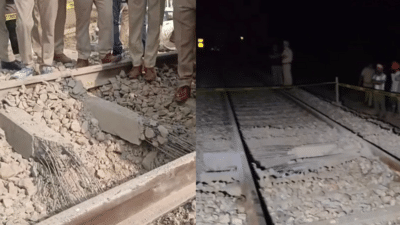
The investigation into the November 3 railway track blasts has now been handed over to the National Investigation Agency (NIA). Orders transferring the case to the central agency were issued on Saturday evening, said assistant superintendent of police (ASP) Nitin Chaudhary, an IPS officer who was overseeing the investigation by Sri Ganganagar police.
According to Chaudhary, two additional bombs were recovered from the railway track near Ramsinghpur railway station. One was live, while the other had already been defused. Chaudhary said that these two bombs were planced in late October but police came to know about them recently during the probe into the November 3 incident.
During the process of destroying the explosives, forensic examination provided evidence confirming the presence of RDX in both devices.The NIA will now take over the investigation into the case.
He said preliminary findings also indicated that the explosive material used in the two recovered bombs had originated from Pakistan.
This has strengthened the suspicion that RDX may also have been used in the two explosions reported on the railway track on November 3, and that the explosive material involved in those blasts could also have come from across the border.
The Rajasthan Anti-Terrorism Squad (ATS) has arrested three accused in connection with the conspiracy.
They have been identified as Mahakdeep Kaur, Devendra and Harpreet Singh. Their interrogation has reportedly yielded several important leads regarding the planning and execution of the suspected sabotage attempt.
Investigators are now trying to establish how the explosives were transported into India, who facilitated their movement and who else was involved in the conspiracy.
The possible role of handlers operating from Pakistan and their local network in India is also under scrutiny.
Chaudhary said preliminary investigation inputs suggested that Mahakdeep Kaur was allegedly trapped in a relationship by an ISI agent based in Pakistan.
The agent allegedly lured her with promises of money and subsequently persuaded her to participate in the conspiracy to carry out blasts on the railway track.
Security agencies suspect that Pakistan-based handlers may have been directing the operation through a network of local operatives.
The alleged recruitment, funding, supply of explosives and communication channels are expected to be key areas of the NIA investigation .
With the case now transferred to the NIA, the central agency will investigate the suspected cross-border links, the source and transportation of RDX, the role of Pakistan-based handlers and the wider network allegedly involved in targeting railway infrastructure in the border state.
The suspected use of highly-grade explosives and the possible involvement of foreign handlers have made the case a serious national security concern.
Source said The same Pakistani agent is emerging in both cases.
The common name of “Chacha” is surfacing in both cases.
The entire network was allegedly operating under the names of Chacha and Shah.
Chacha’s name had earlier emerged during the interrogation of accused arrested in connection with the seizure of 7.5kg of RDX in the intervening night of October 12 and 13 in the Rawla Mandi police station area.
Investigators have also found indications that the explosive material may have been brought from Pakistan, raising suspicions of a cross-border terror network.
The investigation into the November 3 railway track blasts has now been handed over to the National Investigation Agency (NIA). Orders transferring the case to the central agency were issued on Saturday evening, said assistant superintendent of police (ASP) Nitin Chaudhary, an IPS officer who was overseeing the investigation by Sri Ganganagar police.
According to Chaudhary, two additional bombs were recovered from the railway track near Ramsinghpur railway station. One was live, while the other had already been defused. Chaudhary said that these two bombs were planced in late October but police came to know about them recently during the probe into the November 3 incident.
During the process of destroying the explosives, forensic examination provided evidence confirming the presence of RDX in both devices.The NIA will now take over the investigation into the case.
He said preliminary findings also indicated that the explosive material used in the two recovered bombs had originated from Pakistan.
This has strengthened the suspicion that RDX may also have been used in the two explosions reported on the railway track on November 3, and that the explosive material involved in those blasts could also have come from across the border.
The Rajasthan Anti-Terrorism Squad (ATS) has arrested three accused in connection with the conspiracy.
They have been identified as Mahakdeep Kaur, Devendra and Harpreet Singh. Their interrogation has reportedly yielded several important leads regarding the planning and execution of the suspected sabotage attempt.
Investigators are now trying to establish how the explosives were transported into India, who facilitated their movement and who else was involved in the conspiracy.
The possible role of handlers operating from Pakistan and their local network in India is also under scrutiny.
Chaudhary said preliminary investigation inputs suggested that Mahakdeep Kaur was allegedly trapped in a relationship by an ISI agent based in Pakistan.
The agent allegedly lured her with promises of money and subsequently persuaded her to participate in the conspiracy to carry out blasts on the railway track.
Security agencies suspect that Pakistan-based handlers may have been directing the operation through a network of local operatives.
The alleged recruitment, funding, supply of explosives and communication channels are expected to be key areas of the NIA investigation .
With the case now transferred to the NIA, the central agency will investigate the suspected cross-border links, the source and transportation of RDX, the role of Pakistan-based handlers and the wider network allegedly involved in targeting railway infrastructure in the border state.
The suspected use of highly-grade explosives and the possible involvement of foreign handlers have made the case a serious national security concern.
Source said The same Pakistani agent is emerging in both cases.
The common name of “Chacha” is surfacing in both cases.
The entire network was allegedly operating under the names of Chacha and Shah.
Chacha’s name had earlier emerged during the interrogation of accused arrested in connection with the seizure of 7.5kg of RDX in the intervening night of October 12 and 13 in the Rawla Mandi police station area.
Next Story