
Tamil Nadu's mission to repair the hills of Tiruvannamalai


A nwardeen I grew up among the hills of Tiruvannamalai, and while their majesty never ceased to amaze him as child, their increasing vulnerability to landslides began to worry him. Which is why Anwardeen , now director of the Green Tamil Nadu Mission has set about to solve the problem.
The sacred hills of Tiruvannamalai are now set for an ecological restoration that promises to fix the damage caused by soil erosion, poor drainage, forest fires, disappearing vegetation, and silt-clogged water bodies around the temple town.
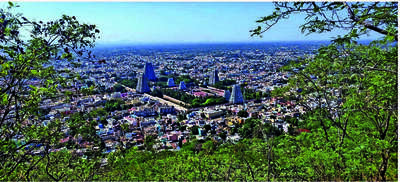
“Tiruvannamalai has seen devastation from landslides,” he says. “A massive landslide triggered by heavy rain from Cyclone Fengal on December 1, 2024, resulted in the deaths of seven members of a family. The cyclone loosened soil and caused a massive boulder and mud to crash into their house. We took samples from the Annamalaiyar Hills to assess the likelihood of further landslides in the area.”
The project will cover 962 hectares of hillside. “We’ve broken them up into 16 zones or micro-watersheds ,” says Anwardeen. “We plan to follow a ‘ridge-to-valley’ approach, meaning work starts at the top of the hills and moves down toward the valleys.” Satellite mapping, drone surveys and detailed studies of the land, water flow, and landslide risk are being used to decide where and how to intervene.
Work will happen in stages. In the first phase, the most vulnerable areas will be stabilised. Teams will then move on to treating the wider watershed and repairing water-harvesting structures. The final phase will involve large-scale restoration of the natural ecology.
Five ponds will be repaired by clearing silt, fixing overflow channels and embankments, and treating the streams that feed them. “This should add about 3,341 cubic metres of extra water storage, helping the area hold and absorb more rainwater, all of which will help prevent landslides.”
Anwardeen says that once completed, the project could turn Tiruvannamalai hills into a eco-model for how Tamil Nadu can protect and restore fragile hill areas, combining ecological repair, biodiversity protection, water security, and disaster preparedness in one integrated programme.
The project is expected to cost `10 crore and will begin soon. The biggest share, `2.5 crore, will go toward planting native trees and restoring the ecology. Another `2 crore is set aside for building structures like check dams and trenches to control water runoff, while `3 crore will fund fire-prevention work and the repair of ponds and water bodies. Smaller amounts have been allocated for restoring grasslands, stabilising slopes using natural methods, conducting surveys, involving local communities, and maintaining the work once it’s done.
“Green Tamil Nadu Mission has launched several initiatives in Tamil Nadu to expand the state’s green cover, ranging from urban afforestation to large-scale ecological restoration,” says Anwardeen. “We have partnered with the municipal administration and water supply department to implement greening projects in urban local bodies, to strengthen urban greening programmes. The initiative has also been extended to state and national highways, where green corridors are being developed along linear infrastructure.
“We are also working to improve urban biodiversity and carry out tree census across the state,” says Anwardeen.
What’s On The Cards?
A programme is under way to green the Eastern Ghats across nine districts, focusing on ecological restoration and tribal livelihoods
In Dharmapuri district, a bamboo restoration project has been taken up, combining ecological restoration with sustainable resource development and livelihood generation
State govt has proposed restoring and creating mangroves across 2,500 hectares through Green Tamil Nadu Mission, a move expected to enhance the resilience of coastal ecosystems
Restoration of the Buckingham Canal through mangrove-based ecological interventions, which is expected to demonstrate the use of nature-based solutions in degraded urban-coastal landscapes is also underway
Other initiatives include sandalwood restoration, large-scale agro-forestry programmes, development of community nature parks, improved clonal planting materials and palmyra restoration
The sacred hills of Tiruvannamalai are now set for an ecological restoration that promises to fix the damage caused by soil erosion, poor drainage, forest fires, disappearing vegetation, and silt-clogged water bodies around the temple town.
“Tiruvannamalai has seen devastation from landslides,” he says. “A massive landslide triggered by heavy rain from Cyclone Fengal on December 1, 2024, resulted in the deaths of seven members of a family. The cyclone loosened soil and caused a massive boulder and mud to crash into their house. We took samples from the Annamalaiyar Hills to assess the likelihood of further landslides in the area.”
The project will cover 962 hectares of hillside. “We’ve broken them up into 16 zones or micro-watersheds ,” says Anwardeen. “We plan to follow a ‘ridge-to-valley’ approach, meaning work starts at the top of the hills and moves down toward the valleys.” Satellite mapping, drone surveys and detailed studies of the land, water flow, and landslide risk are being used to decide where and how to intervene.
Work will happen in stages. In the first phase, the most vulnerable areas will be stabilised. Teams will then move on to treating the wider watershed and repairing water-harvesting structures. The final phase will involve large-scale restoration of the natural ecology.
Five ponds will be repaired by clearing silt, fixing overflow channels and embankments, and treating the streams that feed them. “This should add about 3,341 cubic metres of extra water storage, helping the area hold and absorb more rainwater, all of which will help prevent landslides.”
Anwardeen says that once completed, the project could turn Tiruvannamalai hills into a eco-model for how Tamil Nadu can protect and restore fragile hill areas, combining ecological repair, biodiversity protection, water security, and disaster preparedness in one integrated programme.
The project is expected to cost `10 crore and will begin soon. The biggest share, `2.5 crore, will go toward planting native trees and restoring the ecology. Another `2 crore is set aside for building structures like check dams and trenches to control water runoff, while `3 crore will fund fire-prevention work and the repair of ponds and water bodies. Smaller amounts have been allocated for restoring grasslands, stabilising slopes using natural methods, conducting surveys, involving local communities, and maintaining the work once it’s done.
“Green Tamil Nadu Mission has launched several initiatives in Tamil Nadu to expand the state’s green cover, ranging from urban afforestation to large-scale ecological restoration,” says Anwardeen. “We have partnered with the municipal administration and water supply department to implement greening projects in urban local bodies, to strengthen urban greening programmes. The initiative has also been extended to state and national highways, where green corridors are being developed along linear infrastructure.
“We are also working to improve urban biodiversity and carry out tree census across the state,” says Anwardeen.
What’s On The Cards?
A programme is under way to green the Eastern Ghats across nine districts, focusing on ecological restoration and tribal livelihoods
In Dharmapuri district, a bamboo restoration project has been taken up, combining ecological restoration with sustainable resource development and livelihood generation
State govt has proposed restoring and creating mangroves across 2,500 hectares through Green Tamil Nadu Mission, a move expected to enhance the resilience of coastal ecosystems
Restoration of the Buckingham Canal through mangrove-based ecological interventions, which is expected to demonstrate the use of nature-based solutions in degraded urban-coastal landscapes is also underway
Other initiatives include sandalwood restoration, large-scale agro-forestry programmes, development of community nature parks, improved clonal planting materials and palmyra restoration
Next Story