
Tricky tusk: Karnataka may seek SC nod for elephant contraception


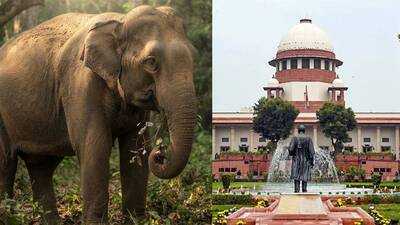
BENGALURU: With increasing human-elephant conflicts in parts of the state, Karnataka is considering moving Supreme Court for permission to use contraceptives to control its growing elephant population.
The state is likely to file an interlocutory application before the court, seeking relief from its Sept 2014 ruling that imposed a ban on administering contraceptives or adopting sterilisation methods to control elephant populations.
The govt has maintained the exercise would be restricted to elephants living outside forest areas. Earlier, several states, including Jharkhand and Keralam, had moved top court with similar requests. Subsequently, the ministry of environment, forest and climate change approached the court with a modification petition.
With a sharp rise in their population over the past three decades and the forest cover remaining constant, elephants are increasingly straying into human habitations. According to 2023 elephant census, Karnataka has India's highest elephant population at 6,395.
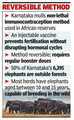
Forest, environment and ecology minister Ramalinga Reddy told TOI Karnataka had earlier tried to bring other states affected by human-elephant conflict on board to jointly pursue the matter. "Not all states were cooperative. As there was no action from the Centre, we (Karnataka) decided to pursue it scientifically," the minister said.
Kumar Pushkar, IFS, chief wildlife warden and principal chief conservator of forests (wildlife), said, "In Sept 2014, while hearing a PIL, Shakti Prasad Nayak vs Union of India, Supreme Court restrained West Bengal govt from administering contraceptives or adopting sterilisation methods to control the wild elephant population. But over the past 12 years, there have been many changes. The problem is becoming increasingly complex."
Karnataka's wildlife problem is further compounded by lethal attacks by leopards, tigers, sloth bears, wild boars, gaurs and bonnet macaques. "While leopards have adapted to both natural and human landscape, breeding fast, Nagarahole reserve has the country's highest density of tigers. The wild boars - damaging crops until now - have now started attacking humans," a forest officer said.
The state is likely to file an interlocutory application before the court, seeking relief from its Sept 2014 ruling that imposed a ban on administering contraceptives or adopting sterilisation methods to control elephant populations.
The govt has maintained the exercise would be restricted to elephants living outside forest areas. Earlier, several states, including Jharkhand and Keralam, had moved top court with similar requests. Subsequently, the ministry of environment, forest and climate change approached the court with a modification petition.
With a sharp rise in their population over the past three decades and the forest cover remaining constant, elephants are increasingly straying into human habitations. According to 2023 elephant census, Karnataka has India's highest elephant population at 6,395.
Forest, environment and ecology minister Ramalinga Reddy told TOI Karnataka had earlier tried to bring other states affected by human-elephant conflict on board to jointly pursue the matter. "Not all states were cooperative. As there was no action from the Centre, we (Karnataka) decided to pursue it scientifically," the minister said.
Kumar Pushkar, IFS, chief wildlife warden and principal chief conservator of forests (wildlife), said, "In Sept 2014, while hearing a PIL, Shakti Prasad Nayak vs Union of India, Supreme Court restrained West Bengal govt from administering contraceptives or adopting sterilisation methods to control the wild elephant population. But over the past 12 years, there have been many changes. The problem is becoming increasingly complex."
Karnataka's wildlife problem is further compounded by lethal attacks by leopards, tigers, sloth bears, wild boars, gaurs and bonnet macaques. "While leopards have adapted to both natural and human landscape, breeding fast, Nagarahole reserve has the country's highest density of tigers. The wild boars - damaging crops until now - have now started attacking humans," a forest officer said.
Next Story