
GEMS Millennium School, Gurugram's CBSE results are a case study in what balanced education can do


There is a question that follows most Indian parents through the years of their child's schooling. Something that is rarely spoken aloud but never far from the surface. Are the marks telling me the whole story? A child who scores 95% can still be anxious, disengaged, or entirely unprepared for the world that begins the morning after their last board exam. Somewhere in the space between a grade and a genuinely educated young person lies the real work of a school and the real measure of what it has managed to do.
Across India, that question is finding more formal expression. The National Education Policy 2020 1 gave institutional language to what educators had long understood: that an education built on rote learning and exam pressure produces students who can perform under examination conditions, but struggle to think independently beyond them. CBSE has begun responding by revising its assessment architecture to place greater weight on application and higher-order reasoning, steadily nudging schools away from a model that rewards memorisation over comprehension. In 2025, over 44 lakh students appeared for CBSE board examinations 2,3 across Grades 10 and 12, one of the largest annual academic assessments anywhere in the world. The national pass rate stood at 93.66% for Grade 10 and 88.39% for Grade 12, both showing marginal improvement over the previous year. Behind those aggregate figures, however, lies enormous variation in teaching quality, institutional culture, and the kind of learning that actually takes place.
That variation is precisely what makes individual school results worth examining on their own terms. A pass rate tells you a school got its students across the line. An average of 91% tells you something about the depth of preparation across an entire cohort. And a 100% pass rate for students with Special Educational Needs (SEN) tells you something about the values a school chooses to hold itself to, even when no one is requiring it to. The question worth asking of any institution's results is not simply how high the numbers climb, but how consistently and how inclusively they hold.
It is against that framework that the 2025–26 CBSE board results from GEMS Millennium School, Palam Vihar, Gurugram merit a closer look. The school, which is part of the global GEMS Education network, has operated across multiple countries for over 65 years and recorded a 100% pass rate in both Grade 10 and Grade 12 at a time when national averages sat 7 to 12 percentage points lower. The Grade 10 batch averaged 91.3%; Grade 12 averaged 85.1%. Across both batches, 37% of students scored above 90%, and 21% of subject scores were perfect hundreds. These are not figures carried by a handful of exceptional students. They reflect what the distribution looked like across the school.
The architecture of achievement
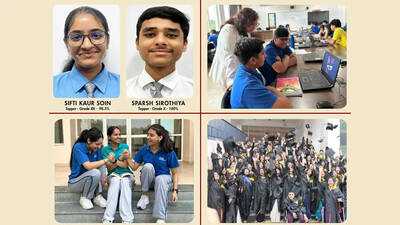
Academic results of this consistency rarely emerge without deliberate institutional design and a shared understanding among teachers, leadership, and students of what learning is actually meant to achieve. In Grade 10, Sparsh Sirothiya achieved a perfect score of 100%, with Ansh Sehgal at 99.8%, Kunjal and Ahaan Sirothiya each at 99.6%, and several others in the high nineties. In Grade 12, Sifti Kaur Soin led at 98.5%, followed by Ananya Singh at 98% and Hanshika Rana at 97.8%. What is notable about these results, taken together, is not the peak. It is the breadth. Strong top-line performances supported by a high cohort average suggest something structural, not incidental.
Research published in Cogent Social Sciences 4 examining holistic education models in Indian contexts found a statistically significant correlation between integrated, student-centred learning environments and improved academic literacy outcomes. The argument that wellbeing and academic rigour are not in competition but are, in fact, mutually reinforcing, is one that schools delivering consistent results appear to have internalised. Mary Mehendri, Principal of GEMS Millennium School , frames the year's outcomes in precisely those terms, “ These results are not merely a reflection of academic achievement; they are a celebration of perseverance, discipline, curiosity, and human potential. Every child has walked a unique journey, and we are immensely proud of the resilience and integrity they have shown. I congratulate our students, teachers, and parents for working together as one learning community”.

Every learner counts
If a school's top results reflect its ambitions, its SEN outcomes reveal its character. A 100% pass rate for all Special Educational Needs students at GEMS Millennium School is the kind of data point that tends to be mentioned in passing, when it deserves to be read with some care. These are students who require differentiated instruction, additional emotional scaffolding, and an institutional commitment that goes well beyond what a standard curriculum demands. Achieving a full pass rate across that cohort, in the same year the broader batches performed at this level, indicates that the school's support systems are not supplementary to its academic programme. They are woven into it.
The most vivid illustration of this comes from Raghav Maheshwari, a student within the SEN cohort who scored 94.8% in Grade 12. Behind that number is a story of sustained effort, patient mentorship, and a classroom environment that did not treat his learning needs as obstacles to manage. His own words are generous, and plainly felt, “ I am grateful to my parents, teachers, and the entire school for always believing in me and supporting me through every challenge. But I especially want to thank my friends at school, who stood by me throughout this journey. This result is as much theirs as it is mine.”
The same philosophy of encouragement and individual attention, school leaders argue, is what enables such outcomes to emerge consistently across the student community. Dr. Amrita, Head of Education and Culture at GEMS Education India, connects the individual to the institutional, “ At GEMS, we believe education must nurture not just high achievers, but confident, compassionate, and future-ready individuals. These outstanding results reaffirm the power of great teaching, personalised support, and a culture where every child is seen, heard, and encouraged to thrive”.

A long game, played from the beginning
Board results are, by their nature, a retrospective document, a record of what accumulated over years of daily learning. For parents currently navigating school admissions for younger children, they also function as forward-looking evidence. The child enrolling at Pre-Nursery today will sit those examinations in 2037 or 2038. What they bring into that room - their capacity for sustained effort, their relationship with difficulty, their ability to think and not merely recall, will have been shaped, incrementally, by every classroom they passed through in the years before.
This is why the results of a school's senior cohort speak, quietly but directly, to parents of its youngest students. They are the long-run answer to the question every family is really asking at the point of admission: can I trust this school with my child's education, not just their performance? Amandeep Singh, parent of Grade 12 topper Sifti Kaur Soin, puts it in terms that will resonate “ This achievement is a reflection of Sifti's hard work, discipline, and dedication over the years. We are equally grateful to the teachers at GEMS Millennium School for constantly guiding, encouraging, and supporting her, not just academically, but emotionally as well, through one of the most important phases of her life”.
That sense of trust and long-term support is also central to how the institution understands its role in shaping outcomes over time.
Francis Joseph, India CEO of GEMS Education, situates the school's outcomes within a broader commitment to education that holds across geographies “ As a part of the global GEMS Education family, GEMS Millennium School continues to embody our commitment to educational excellence and holistic development. These results reflect the dedication of our educators, the trust of our parent community, and the extraordinary spirit of our students. We are proud to see young learners from Gurugram achieving at global standards while remaining grounded in strong values”.

The schools in India that are getting this right share a recognisable quality: they have stopped treating academic results as the goal, and started treating them as evidence of something more patient and more deliberate happening in the years that precede them. That distinction, subtle as it sounds, tends to show up plainly in the numbers.
Reference -
Ministry of Education, Government of India. (2020). National Education Policy 2020. https://www.education.gov.in/sites/upload_files/mhrd/files/NEP_Final_English_0.pdf Central Board of Secondary Education. (2025). Press release: Class XII results 2025. https://www.cbse.gov.in/cbsenew/documents//PressRelease2025_ClassXII.pdf Central Board of Secondary Education. (2025). Press release: Class X result 2025. https://www.cbse.gov.in/cbsenew/documents//Press_Release-Class_X_Result_13052025.pdf Nedungadi, P., Menon, R., Gutjahr, G., & Raman, R. (2024). Evaluating holistic education and digital learning model for advancing SDG4: A longitudinal mixed-effects modeling approach. Cogent Social Sciences, 10(1), Article 2299134. https://doi.org/10.1080/23311886.2023.2299134
Disclaimer: This article has been produced on behalf of GEMS Education by Times Internet’s Spotlight team.
Across India, that question is finding more formal expression. The National Education Policy 2020 1 gave institutional language to what educators had long understood: that an education built on rote learning and exam pressure produces students who can perform under examination conditions, but struggle to think independently beyond them. CBSE has begun responding by revising its assessment architecture to place greater weight on application and higher-order reasoning, steadily nudging schools away from a model that rewards memorisation over comprehension. In 2025, over 44 lakh students appeared for CBSE board examinations 2,3 across Grades 10 and 12, one of the largest annual academic assessments anywhere in the world. The national pass rate stood at 93.66% for Grade 10 and 88.39% for Grade 12, both showing marginal improvement over the previous year. Behind those aggregate figures, however, lies enormous variation in teaching quality, institutional culture, and the kind of learning that actually takes place.
That variation is precisely what makes individual school results worth examining on their own terms. A pass rate tells you a school got its students across the line. An average of 91% tells you something about the depth of preparation across an entire cohort. And a 100% pass rate for students with Special Educational Needs (SEN) tells you something about the values a school chooses to hold itself to, even when no one is requiring it to. The question worth asking of any institution's results is not simply how high the numbers climb, but how consistently and how inclusively they hold.
It is against that framework that the 2025–26 CBSE board results from GEMS Millennium School, Palam Vihar, Gurugram merit a closer look. The school, which is part of the global GEMS Education network, has operated across multiple countries for over 65 years and recorded a 100% pass rate in both Grade 10 and Grade 12 at a time when national averages sat 7 to 12 percentage points lower. The Grade 10 batch averaged 91.3%; Grade 12 averaged 85.1%. Across both batches, 37% of students scored above 90%, and 21% of subject scores were perfect hundreds. These are not figures carried by a handful of exceptional students. They reflect what the distribution looked like across the school.
The architecture of achievement
Academic results of this consistency rarely emerge without deliberate institutional design and a shared understanding among teachers, leadership, and students of what learning is actually meant to achieve. In Grade 10, Sparsh Sirothiya achieved a perfect score of 100%, with Ansh Sehgal at 99.8%, Kunjal and Ahaan Sirothiya each at 99.6%, and several others in the high nineties. In Grade 12, Sifti Kaur Soin led at 98.5%, followed by Ananya Singh at 98% and Hanshika Rana at 97.8%. What is notable about these results, taken together, is not the peak. It is the breadth. Strong top-line performances supported by a high cohort average suggest something structural, not incidental.
Research published in Cogent Social Sciences 4 examining holistic education models in Indian contexts found a statistically significant correlation between integrated, student-centred learning environments and improved academic literacy outcomes. The argument that wellbeing and academic rigour are not in competition but are, in fact, mutually reinforcing, is one that schools delivering consistent results appear to have internalised. Mary Mehendri, Principal of GEMS Millennium School , frames the year's outcomes in precisely those terms, “ These results are not merely a reflection of academic achievement; they are a celebration of perseverance, discipline, curiosity, and human potential. Every child has walked a unique journey, and we are immensely proud of the resilience and integrity they have shown. I congratulate our students, teachers, and parents for working together as one learning community”.
Every learner counts
If a school's top results reflect its ambitions, its SEN outcomes reveal its character. A 100% pass rate for all Special Educational Needs students at GEMS Millennium School is the kind of data point that tends to be mentioned in passing, when it deserves to be read with some care. These are students who require differentiated instruction, additional emotional scaffolding, and an institutional commitment that goes well beyond what a standard curriculum demands. Achieving a full pass rate across that cohort, in the same year the broader batches performed at this level, indicates that the school's support systems are not supplementary to its academic programme. They are woven into it.
The most vivid illustration of this comes from Raghav Maheshwari, a student within the SEN cohort who scored 94.8% in Grade 12. Behind that number is a story of sustained effort, patient mentorship, and a classroom environment that did not treat his learning needs as obstacles to manage. His own words are generous, and plainly felt, “ I am grateful to my parents, teachers, and the entire school for always believing in me and supporting me through every challenge. But I especially want to thank my friends at school, who stood by me throughout this journey. This result is as much theirs as it is mine.”
The same philosophy of encouragement and individual attention, school leaders argue, is what enables such outcomes to emerge consistently across the student community. Dr. Amrita, Head of Education and Culture at GEMS Education India, connects the individual to the institutional, “ At GEMS, we believe education must nurture not just high achievers, but confident, compassionate, and future-ready individuals. These outstanding results reaffirm the power of great teaching, personalised support, and a culture where every child is seen, heard, and encouraged to thrive”.
A long game, played from the beginning
Board results are, by their nature, a retrospective document, a record of what accumulated over years of daily learning. For parents currently navigating school admissions for younger children, they also function as forward-looking evidence. The child enrolling at Pre-Nursery today will sit those examinations in 2037 or 2038. What they bring into that room - their capacity for sustained effort, their relationship with difficulty, their ability to think and not merely recall, will have been shaped, incrementally, by every classroom they passed through in the years before.
This is why the results of a school's senior cohort speak, quietly but directly, to parents of its youngest students. They are the long-run answer to the question every family is really asking at the point of admission: can I trust this school with my child's education, not just their performance? Amandeep Singh, parent of Grade 12 topper Sifti Kaur Soin, puts it in terms that will resonate “ This achievement is a reflection of Sifti's hard work, discipline, and dedication over the years. We are equally grateful to the teachers at GEMS Millennium School for constantly guiding, encouraging, and supporting her, not just academically, but emotionally as well, through one of the most important phases of her life”.
That sense of trust and long-term support is also central to how the institution understands its role in shaping outcomes over time.
Francis Joseph, India CEO of GEMS Education, situates the school's outcomes within a broader commitment to education that holds across geographies “ As a part of the global GEMS Education family, GEMS Millennium School continues to embody our commitment to educational excellence and holistic development. These results reflect the dedication of our educators, the trust of our parent community, and the extraordinary spirit of our students. We are proud to see young learners from Gurugram achieving at global standards while remaining grounded in strong values”.
The schools in India that are getting this right share a recognisable quality: they have stopped treating academic results as the goal, and started treating them as evidence of something more patient and more deliberate happening in the years that precede them. That distinction, subtle as it sounds, tends to show up plainly in the numbers.
Reference -
Next Story