
IIT Madras alumnus left corporate roles to build an AI startup; how Akash Ramdas raised $9 million to accelerate semiconductor materials discovery


AI chips are becoming more powerful, but the heat they generate is creating a growing challenge for the semiconductor industry. Finding materials that can manage heat and improve the performance of nanoscale electronic devices is a time-consuming process, requiring researchers to evaluate a vast number of possible compounds.
Akash Ramdas , an IIT Madras alumnus who went on to complete his master’s degree and PhD at Stanford University, is working on this problem through his startup, Discovered Materials. Along with IIT Madras batchmate Adwait Sridhar, he co-founded the company to use AI agents to accelerate materials discovery for the semiconductor industry. The startup has secured $9 million in seed funding, according to the information provided.
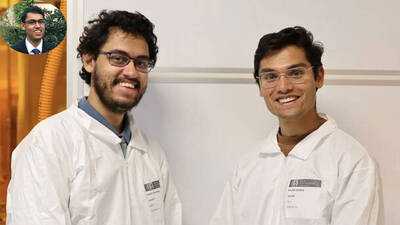
From IIT Madras to Stanford UniversityRamdas graduated from IIT Madras in 2019 with a BTech degree in Metallurgical and Materials Engineering. He then moved to Stanford University, where he pursued a master’s degree in Materials Science and Engineering and a PhD in Materials Engineering.
His research focused on using computational methods to identify materials that could improve the performance of nanoscale electronic devices. As conventional materials such as silicon and copper approach physical limits in certain applications, researchers are exploring alternatives that can work more efficiently at increasingly smaller scales.
Finding suitable replacements is difficult. Scientists must identify candidates from a vast range of possible compounds and assess several properties before a material can be considered for practical use. Experimentally synthesising and testing each candidate can take considerable time.
Ramdas’s doctoral work explored how computational techniques and machine learning could help narrow this search. In one study, his research screened more than 15,000 metals using computational methods and identified around 10 candidates predicted to outperform copper and alternatives under consideration, including ruthenium.
Why materials discovery matters for AI chipsThe demand for more powerful computing systems has increased the importance of materials research. AI workloads require substantial computing capacity, while the chips running these workloads face challenges involving heat, energy consumption and performance.
Heat dissipation is one part of this problem. Materials used in and around semiconductor devices influence how heat moves through a chip and how reliably the device operates. Identifying materials with suitable thermal and electrical properties could help researchers develop more efficient electronic components.
Traditional materials discovery can involve repeated calculations, experiments and validation. Computational screening can reduce the number of candidates that need to be tested in laboratories, helping researchers focus on the most promising options.
Discovered Materials aims to apply AI agents to this process, with the broader goal of shortening the time required to move from materials research to semiconductor manufacturing. The company describes its work as using AI to accelerate the journey from the laboratory to the fabrication stage.
Why he moved from research to a startupBefore co-founding Discovered Materials, Ramdas gained experience across research and industry. His professional background includes a product supply internship at Procter & Gamble and a short stint as a programme manager in healthcare at The ePlane Company.
He also continued his research at Stanford as a postdoctoral researcher, working on computational methods for discovering materials for nanoelectronic devices. His startup brings this research focus into an effort to address the needs of the semiconductor industry.
For Ramdas and Sridhar, the challenge is to make materials discovery faster and more useful for real-world applications. Their work sits at the intersection of artificial intelligence, computational materials science and semiconductor engineering, where finding the right material can influence the performance of future electronic devices.
The company's $9 million seed funding gives the founders resources to develop their approach as they work towards making AI-assisted materials discovery more practical for the industry.
Disclaimer: TOI Education does not independently verify all personal claims or company-related information. The research and technical claims should be assessed in the context of the cited studies and supporting evidence.
Akash Ramdas , an IIT Madras alumnus who went on to complete his master’s degree and PhD at Stanford University, is working on this problem through his startup, Discovered Materials. Along with IIT Madras batchmate Adwait Sridhar, he co-founded the company to use AI agents to accelerate materials discovery for the semiconductor industry. The startup has secured $9 million in seed funding, according to the information provided.
From IIT Madras to Stanford UniversityRamdas graduated from IIT Madras in 2019 with a BTech degree in Metallurgical and Materials Engineering. He then moved to Stanford University, where he pursued a master’s degree in Materials Science and Engineering and a PhD in Materials Engineering.
His research focused on using computational methods to identify materials that could improve the performance of nanoscale electronic devices. As conventional materials such as silicon and copper approach physical limits in certain applications, researchers are exploring alternatives that can work more efficiently at increasingly smaller scales.
Finding suitable replacements is difficult. Scientists must identify candidates from a vast range of possible compounds and assess several properties before a material can be considered for practical use. Experimentally synthesising and testing each candidate can take considerable time.
Ramdas’s doctoral work explored how computational techniques and machine learning could help narrow this search. In one study, his research screened more than 15,000 metals using computational methods and identified around 10 candidates predicted to outperform copper and alternatives under consideration, including ruthenium.
Why materials discovery matters for AI chipsThe demand for more powerful computing systems has increased the importance of materials research. AI workloads require substantial computing capacity, while the chips running these workloads face challenges involving heat, energy consumption and performance.
Heat dissipation is one part of this problem. Materials used in and around semiconductor devices influence how heat moves through a chip and how reliably the device operates. Identifying materials with suitable thermal and electrical properties could help researchers develop more efficient electronic components.
Traditional materials discovery can involve repeated calculations, experiments and validation. Computational screening can reduce the number of candidates that need to be tested in laboratories, helping researchers focus on the most promising options.
Discovered Materials aims to apply AI agents to this process, with the broader goal of shortening the time required to move from materials research to semiconductor manufacturing. The company describes its work as using AI to accelerate the journey from the laboratory to the fabrication stage.
Why he moved from research to a startupBefore co-founding Discovered Materials, Ramdas gained experience across research and industry. His professional background includes a product supply internship at Procter & Gamble and a short stint as a programme manager in healthcare at The ePlane Company.
He also continued his research at Stanford as a postdoctoral researcher, working on computational methods for discovering materials for nanoelectronic devices. His startup brings this research focus into an effort to address the needs of the semiconductor industry.
For Ramdas and Sridhar, the challenge is to make materials discovery faster and more useful for real-world applications. Their work sits at the intersection of artificial intelligence, computational materials science and semiconductor engineering, where finding the right material can influence the performance of future electronic devices.
The company's $9 million seed funding gives the founders resources to develop their approach as they work towards making AI-assisted materials discovery more practical for the industry.
Disclaimer: TOI Education does not independently verify all personal claims or company-related information. The research and technical claims should be assessed in the context of the cited studies and supporting evidence.
Next Story