
Merriam-Webster adds 1,400 new words: From 'slay' to 'vibe coding', is Gen Z changing not just how we speak, but how we see the world?


“Languages aren't just made of words. They're modes of looking at the world. They're keys to civilizations."R.F. Kuang put it beautifully in Babel. And perhaps there is no better time to revisit that thought than now, when language is changing almost as quickly as the world around us.
Language has always held an indescribable power. Sometimes, it draws boundaries around identities; at other times, it becomes the bridge that allows strangers to belong to the same community. It carries histories, preserves cultures, and gives names to experiences that might otherwise remain invisible.
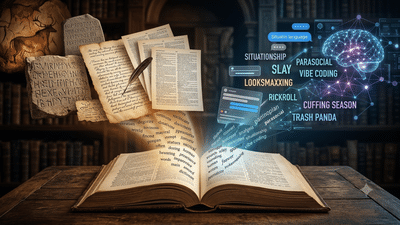
From cave carvings and ancient inscriptions to pidgins, creoles, and now the ever-expanding vocabulary of Gen Z, humanity has spent thousands of years doing essentially the same thing: finding new ways to describe a changing world.
I remember the summer vacations of 2016, when I would claim a corner of my bedroom, bury myself in novels, and maintain a little list of “new words” to strengthen my vocabulary. Every unfamiliar word felt like discovering a secret passage into another world.
Then I entered the workforce.
Suddenly, the lexicon seemed to have changed overnight. “I am in a work situationship,” says one colleague. Another looks at her friend's presentation and says, “You slay, girl.”
Someone is “chronically online." Someone else needs to “touch grass." A colleague is “quiet quitting”. Another is "looksmaxxing." Somewhere, someone is probably “vibe coding”.
And it suddenly hits you that you don’t fit into your own generation and the lexicon you followed seems obsolete. Yet again, you find yourself strolling into an unknown linguistic aisle.
How the young cohort is smashing all records and rediscovering its own languageMerriam-Webster has added 1,400 new words and definitions to its online dictionary, bringing internet culture , artificial intelligence, food trends, relationships and modern anxieties into the official vocabulary. Yes, you read it right, 1400 is the number.
The additions include “looksmaxxing”, “parasocial”, “Rickroll”, “meme coin”, “vibe coding”, “AGI”, “cuffing season”, “Sunday scaries”, “crashout”, “copium” and, perhaps delightfully, “trash panda” — a playful name for a raccoon.
For anyone who grew up believing dictionaries were solemn books filled with words like magnanimous, benevolent and perspicacious, this might sound like linguistic chaos. We know Gen Z is taking it at another level, when the language echoes even in the Parliament .
But it is actually something far more serious. It is a record of a civilisation changing in real time.
Every generation changes language. Gen Z is accelerating itLanguage has never been static. Civilisations have borrowed, invented, shortened, and discarded words as societies changed.
Industrialisation brought new vocabulary for machines, factories, and labour. The digital revolution introduced words such as "email," "internet," and "selfie." Social media has now taken that process and put it on fast-forward.
Gen Z has grown up in a world where culture can travel from Seoul to Mumbai to New York in seconds. A phrase coined in an online community can become globally recognisable within days.
"Looksmaxxing," for example, gives a name to an internet-driven preoccupation with improving one's appearance. “Parasocial” captures a relationship that has become increasingly relevant in an age of influencers and digital celebrities. “Cuffing season” packages a recurring social and romantic pattern into two words.
The vocabulary is new because some of the experiences are new, or at least newly visible.
Words do more than describe society; they teach society how to see itself
This is where the story becomes bigger than Gen Z slang . Language does not merely sit on top of civilisation like a label. It can influence how people organise experiences, recognise patterns and communicate them to others.
Once a phenomenon receives a name, it becomes easier to identify. Think about "parasocial." Before the word became widely understood, someone might have struggled to explain why they felt emotionally connected to a celebrity who did not know them. The word provides a shorthand for that experience.
The same principle applies to “Sunday scaries," "crashout," or "copium." They turn vague feelings and behaviours into recognisable cultural categories.
That is one of language's latent powers: it can transform an experience from something individual into something collectively understood.
And then comes AI: Is it the next linguistic earthquake?
The most intriguing question is what happens when the generation reshaping language begins living alongside machines that can generate language themselves.
Merriam-Webster's additions include “vibe coding”, "AGI," and a new noun usage of "compute." The dictionary has also added “uncanny valley," a phrase that describes the discomfort produced by something that looks almost human but not quite.
This could be the beginning of a much larger linguistic shift.
If Gen Z helped make internet culture conversational, AI could make machine-generated language part of everyday communication. Future generations may not demarcate as sharply between language created by humans, remixed by humans, and generated by machines.
That raises an unusual question: who gets to shape the vocabulary of the future when humans are no longer the only ones generating the words?
Civilisations leave their fingerprints in their vocabulary
Look at the words a society repeatedly needs, and you can begin to see what that society values, fears, and experiences.
The appearance of AI-related terminology reflects a technological transformation. Relationship vocabulary reflects changing social behaviour. Internet expressions reflect the emergence of digital communities. Food terms reflect cultural exchange.
A dictionary, therefore, can become an accidental historical document.
Centuries from now, historians may not care that “trash panda” was once an amusing internet phrase. But they may care that words surrounding algorithms, digital identity, online relationships, and virtual culture entered everyday language during this period.
Because language preserves change.
The future may not belong to the words that sound the most serious
There is a temptation to treat words such as “vibe coding” or “looksmaxxing” as linguistic clutter, temporary internet noise destined to disappear.
Some will. That has always happened. Languages are full of words that enjoyed brief popularity and then faded.
But others will survive precisely because they capture something their time could not previously express so neatly.
That is how language moves forward: not through a committee deciding what people should say, but through millions of people deciding what they need to say.
Gen Z is therefore doing something generations have always done, changing language to fit its reality.
The difference is the speed, the scale, and the technology behind it.
The next great transformation in language may not arrive in a library, a classroom, or a literary salon.
It may arrive as a meme.
And by the time the dictionary catches up, civilisation may already have moved on to its next word. And we are already watching it happen.
Language has always held an indescribable power. Sometimes, it draws boundaries around identities; at other times, it becomes the bridge that allows strangers to belong to the same community. It carries histories, preserves cultures, and gives names to experiences that might otherwise remain invisible.
From cave carvings and ancient inscriptions to pidgins, creoles, and now the ever-expanding vocabulary of Gen Z, humanity has spent thousands of years doing essentially the same thing: finding new ways to describe a changing world.
I remember the summer vacations of 2016, when I would claim a corner of my bedroom, bury myself in novels, and maintain a little list of “new words” to strengthen my vocabulary. Every unfamiliar word felt like discovering a secret passage into another world.
Then I entered the workforce.
Suddenly, the lexicon seemed to have changed overnight. “I am in a work situationship,” says one colleague. Another looks at her friend's presentation and says, “You slay, girl.”
Someone is “chronically online." Someone else needs to “touch grass." A colleague is “quiet quitting”. Another is "looksmaxxing." Somewhere, someone is probably “vibe coding”.
And it suddenly hits you that you don’t fit into your own generation and the lexicon you followed seems obsolete. Yet again, you find yourself strolling into an unknown linguistic aisle.
How the young cohort is smashing all records and rediscovering its own languageMerriam-Webster has added 1,400 new words and definitions to its online dictionary, bringing internet culture , artificial intelligence, food trends, relationships and modern anxieties into the official vocabulary. Yes, you read it right, 1400 is the number.
The additions include “looksmaxxing”, “parasocial”, “Rickroll”, “meme coin”, “vibe coding”, “AGI”, “cuffing season”, “Sunday scaries”, “crashout”, “copium” and, perhaps delightfully, “trash panda” — a playful name for a raccoon.
For anyone who grew up believing dictionaries were solemn books filled with words like magnanimous, benevolent and perspicacious, this might sound like linguistic chaos. We know Gen Z is taking it at another level, when the language echoes even in the Parliament .
But it is actually something far more serious. It is a record of a civilisation changing in real time.
Every generation changes language. Gen Z is accelerating itLanguage has never been static. Civilisations have borrowed, invented, shortened, and discarded words as societies changed.
Industrialisation brought new vocabulary for machines, factories, and labour. The digital revolution introduced words such as "email," "internet," and "selfie." Social media has now taken that process and put it on fast-forward.
Gen Z has grown up in a world where culture can travel from Seoul to Mumbai to New York in seconds. A phrase coined in an online community can become globally recognisable within days.
"Looksmaxxing," for example, gives a name to an internet-driven preoccupation with improving one's appearance. “Parasocial” captures a relationship that has become increasingly relevant in an age of influencers and digital celebrities. “Cuffing season” packages a recurring social and romantic pattern into two words.
The vocabulary is new because some of the experiences are new, or at least newly visible.
Words do more than describe society; they teach society how to see itself
This is where the story becomes bigger than Gen Z slang . Language does not merely sit on top of civilisation like a label. It can influence how people organise experiences, recognise patterns and communicate them to others.
Once a phenomenon receives a name, it becomes easier to identify. Think about "parasocial." Before the word became widely understood, someone might have struggled to explain why they felt emotionally connected to a celebrity who did not know them. The word provides a shorthand for that experience.
The same principle applies to “Sunday scaries," "crashout," or "copium." They turn vague feelings and behaviours into recognisable cultural categories.
That is one of language's latent powers: it can transform an experience from something individual into something collectively understood.
And then comes AI: Is it the next linguistic earthquake?
The most intriguing question is what happens when the generation reshaping language begins living alongside machines that can generate language themselves.
Merriam-Webster's additions include “vibe coding”, "AGI," and a new noun usage of "compute." The dictionary has also added “uncanny valley," a phrase that describes the discomfort produced by something that looks almost human but not quite.
This could be the beginning of a much larger linguistic shift.
If Gen Z helped make internet culture conversational, AI could make machine-generated language part of everyday communication. Future generations may not demarcate as sharply between language created by humans, remixed by humans, and generated by machines.
That raises an unusual question: who gets to shape the vocabulary of the future when humans are no longer the only ones generating the words?
Civilisations leave their fingerprints in their vocabulary
Look at the words a society repeatedly needs, and you can begin to see what that society values, fears, and experiences.
The appearance of AI-related terminology reflects a technological transformation. Relationship vocabulary reflects changing social behaviour. Internet expressions reflect the emergence of digital communities. Food terms reflect cultural exchange.
A dictionary, therefore, can become an accidental historical document.
Centuries from now, historians may not care that “trash panda” was once an amusing internet phrase. But they may care that words surrounding algorithms, digital identity, online relationships, and virtual culture entered everyday language during this period.
Because language preserves change.
The future may not belong to the words that sound the most serious
There is a temptation to treat words such as “vibe coding” or “looksmaxxing” as linguistic clutter, temporary internet noise destined to disappear.
Some will. That has always happened. Languages are full of words that enjoyed brief popularity and then faded.
But others will survive precisely because they capture something their time could not previously express so neatly.
That is how language moves forward: not through a committee deciding what people should say, but through millions of people deciding what they need to say.
Gen Z is therefore doing something generations have always done, changing language to fit its reality.
The difference is the speed, the scale, and the technology behind it.
The next great transformation in language may not arrive in a library, a classroom, or a literary salon.
It may arrive as a meme.
And by the time the dictionary catches up, civilisation may already have moved on to its next word. And we are already watching it happen.
Next Story