
Six Indian American students named 2026 Davidson Fellows, win $25K-$100K scholarships


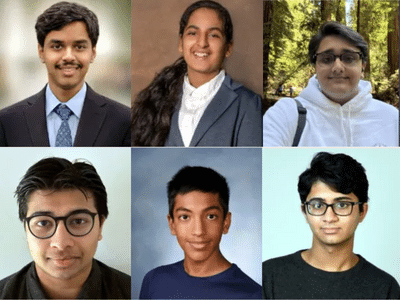
Six Indian American students have been named recipients of the 2026 Davidson Fellows Scholarship, which recognises outstanding work by gifted young people. The students received scholarships worth $25,000, $50,000 or $100,000 for projects spanning aviation safety, agriculture, nuclear energy, malaria prevention and drug discovery.
Aditya Sengupta, 18, from Bellevue, Washington, received the $100,000 Davidson Fellow Laureate scholarship. Tanishka Aglave, Hitaishi Chillara, Praadhyumn Indaana and Rajarshi Mandal each received $50,000, while Pavan Subramani was awarded $25,000.
Also Read: Maharashtra educationist's daughter Nila Vikhe Patil elected to Swedish Parliament
The scholarship recognises students aged 18 or younger who have completed significant projects with the potential to make a meaningful contribution to society.
What is the Davidson Fellows Scholarship?
The Davidson Fellows Scholarship is an annual programme run by the Davidson Institute, a nonprofit organisation that supports profoundly gifted young people.
The programme awards scholarships of $100,000, $50,000 and $25,000 to students whose work demonstrates significant achievement. Projects are assessed on their quality, importance and potential contribution.
Also Read: Munich's Oktoberfest roars to life as mayor taps first keg
The scholarship covers several fields, including science, technology, engineering, mathematics, literature, music, philosophy and the “Outside the Box” category.
Applicants must be US citizens or permanent residents living in the US, or meet the programme’s eligibility provisions for those stationed overseas on active US military duty.
Projects by the six Indian American students
The six students worked on projects addressing challenges in areas ranging from aviation and agriculture to healthcare and energy.
Aditya Sengupta developed ForeCAT, a machine-learning system that combines atmospheric physics and computing to improve predictions of clear-air turbulence. Such turbulence can occur without visible clouds or storms.
Tanishka Aglave worked on an approach to combat citrus greening disease. Her project combines a treatment derived from curry leaf extract, local heat therapy and a computer-vision application to help growers assess the disease.
Hitaishi Chillara developed a computational framework using cosmological simulations, telescope observations and machine learning to study the relationship between galaxies and the supermassive black holes at their centres.
Praadhyumn Indaana created a physics-guided neural network to improve predictions of critical heat flux, a threshold linked to heat-transfer problems in nuclear reactors.
Rajarshi Mandal developed a mathematical model to help distribute insecticide-treated mosquito nets for malaria prevention. The model considers factors such as insecticide resistance, climate and the condition of nets over time.
Pavan Subramani used generative AI and molecular dynamics simulations to identify potential drug candidates targeting the Receptor for Advanced Glycation End products (RAGE), a protein associated with inflammatory diseases.
Aditya Sengupta, 18, from Bellevue, Washington, received the $100,000 Davidson Fellow Laureate scholarship. Tanishka Aglave, Hitaishi Chillara, Praadhyumn Indaana and Rajarshi Mandal each received $50,000, while Pavan Subramani was awarded $25,000.
Also Read: Maharashtra educationist's daughter Nila Vikhe Patil elected to Swedish Parliament
The scholarship recognises students aged 18 or younger who have completed significant projects with the potential to make a meaningful contribution to society.
What is the Davidson Fellows Scholarship?
The Davidson Fellows Scholarship is an annual programme run by the Davidson Institute, a nonprofit organisation that supports profoundly gifted young people.
The programme awards scholarships of $100,000, $50,000 and $25,000 to students whose work demonstrates significant achievement. Projects are assessed on their quality, importance and potential contribution.
Also Read: Munich's Oktoberfest roars to life as mayor taps first keg
The scholarship covers several fields, including science, technology, engineering, mathematics, literature, music, philosophy and the “Outside the Box” category.
Applicants must be US citizens or permanent residents living in the US, or meet the programme’s eligibility provisions for those stationed overseas on active US military duty.
Projects by the six Indian American students
The six students worked on projects addressing challenges in areas ranging from aviation and agriculture to healthcare and energy.
Aditya Sengupta developed ForeCAT, a machine-learning system that combines atmospheric physics and computing to improve predictions of clear-air turbulence. Such turbulence can occur without visible clouds or storms.
Tanishka Aglave worked on an approach to combat citrus greening disease. Her project combines a treatment derived from curry leaf extract, local heat therapy and a computer-vision application to help growers assess the disease.
Hitaishi Chillara developed a computational framework using cosmological simulations, telescope observations and machine learning to study the relationship between galaxies and the supermassive black holes at their centres.
Praadhyumn Indaana created a physics-guided neural network to improve predictions of critical heat flux, a threshold linked to heat-transfer problems in nuclear reactors.
Rajarshi Mandal developed a mathematical model to help distribute insecticide-treated mosquito nets for malaria prevention. The model considers factors such as insecticide resistance, climate and the condition of nets over time.
Pavan Subramani used generative AI and molecular dynamics simulations to identify potential drug candidates targeting the Receptor for Advanced Glycation End products (RAGE), a protein associated with inflammatory diseases.
Next Story