
US proposes $70,000 OPT fee, may deter Indian students from studying there


New Delhi: The US proposal to introduce a $70,000 fee to allow international students to stay and work temporarily after college could further dent Indian students' interest in studying in the country, already under strain from tighter visa scrutiny and immigration uncertainty, experts said.
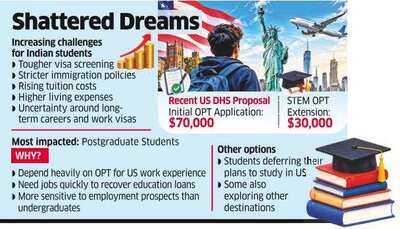
The US Department of Homeland Security (DHS) on October 7 proposed charging a $70,000 fee for initial Optional Practical Training (OPT) applications and $30,000 for subsequent or STEM OPT extensions.

This comes at a time when study-abroad platforms are reporting a slowdown in demand for US education amid increasing visa-related uncertainties and stricter immigration policies besides rising education and living costs.
 For instance, Career Mosaic is seeing a 40% decline in Indian student applications to the US compared to last year, while MSM Unify and upGrad are seeing about 20% and 19% decline in applications and queries, respectively.
"Students most impacted are postgraduate applicants," Manisha Zaveri, founder of Career Mosaic, told ET.
Several students who considered applying for postgraduate programmes are deferring those plans. "They are opting to work in India until things turn around," she said.
Some students are also considering other destinations, particularly Germany, Australia, Ireland and other European countries, experts said.
The impact is different across student segments, according to Adarsh Khandelwal, cofounder of Collegify. "Undergraduate families generally have a longer investment horizon while postgraduate students are often more sensitive to employment prospects due to a shorter period to recover their educational investment," he said.
Postgraduate students typically depend more on OPT to gain work experience and recover the high cost of their education.
"Visa screening is tougher, internship guidance has narrowed, and the proposed $100,000 OPT fee, if it goes through, would hit the very route most Indian graduates use to gain US work experience," Sanjay Laul, founder of MSM Unify, said.
According to Praneet Singh, vice president, university partnerships, at upGrad Study Abroad, students are becoming more conscious about return on investment (ROI). "They are looking closely at university rankings, employability, tuition costs, scholarship availability, STEM eligibility and the strength of a programme's industry linkages," he said.
Another question is, who will pay the proposed fee? On paper, it is supposed to be paid by the university while recommending a student for OPT for the first time.
"But the rule openly allows universities to pass the cost on to students or employers, so in practice, the bill is likely to land on one of them," Laul said.
A few firms may pay for the hard-to-find profiles they really need, experts said.
The proposal adds to concerns about long-term career prospects, particularly following suspensions of the permanent labour certification (PERM) process at eight major companies including Microsoft, Cognizant, TCS and Infosys, experts said.
The US Department of Homeland Security (DHS) on October 7 proposed charging a $70,000 fee for initial Optional Practical Training (OPT) applications and $30,000 for subsequent or STEM OPT extensions.
This comes at a time when study-abroad platforms are reporting a slowdown in demand for US education amid increasing visa-related uncertainties and stricter immigration policies besides rising education and living costs.
"Students most impacted are postgraduate applicants," Manisha Zaveri, founder of Career Mosaic, told ET.
Several students who considered applying for postgraduate programmes are deferring those plans. "They are opting to work in India until things turn around," she said.
Some students are also considering other destinations, particularly Germany, Australia, Ireland and other European countries, experts said.
The impact is different across student segments, according to Adarsh Khandelwal, cofounder of Collegify. "Undergraduate families generally have a longer investment horizon while postgraduate students are often more sensitive to employment prospects due to a shorter period to recover their educational investment," he said.
Postgraduate students typically depend more on OPT to gain work experience and recover the high cost of their education.
"Visa screening is tougher, internship guidance has narrowed, and the proposed $100,000 OPT fee, if it goes through, would hit the very route most Indian graduates use to gain US work experience," Sanjay Laul, founder of MSM Unify, said.
According to Praneet Singh, vice president, university partnerships, at upGrad Study Abroad, students are becoming more conscious about return on investment (ROI). "They are looking closely at university rankings, employability, tuition costs, scholarship availability, STEM eligibility and the strength of a programme's industry linkages," he said.
Another question is, who will pay the proposed fee? On paper, it is supposed to be paid by the university while recommending a student for OPT for the first time.
"But the rule openly allows universities to pass the cost on to students or employers, so in practice, the bill is likely to land on one of them," Laul said.
A few firms may pay for the hard-to-find profiles they really need, experts said.
The proposal adds to concerns about long-term career prospects, particularly following suspensions of the permanent labour certification (PERM) process at eight major companies including Microsoft, Cognizant, TCS and Infosys, experts said.
Next Story